Trail Cameras · Head to head
Bushnell CORE S-4K vs DS-4K: one trigger figure is misleading and the other decides it
Bushnell's two no-glow 4K cameras sit $30 apart on list price and are often within ten dollars of each other in the real world. The single-sensor S-4K actually takes the first photo quicker. The dual-sensor DS-4K gets back to ready almost three times faster, and that is the number that fills a card.
By Mike M.Updated Spec-checked · every figure sourced
#adReader-supported: we may earn a commission if you buy through our links, at no extra cost to you. It never decides a ranking. How we rank · Disclosure
The contenders
Side by side
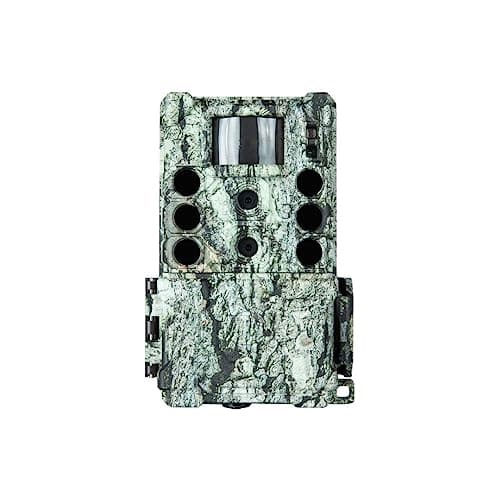
Buy this one
Bushnell CORE DS-4K No Glow
SD / Wi-Fi8.7 /10Dual sensors (one tuned for day, one for night), a 0.15 s trigger Bushnell calls best in class, 120 ft no-glow range and 4K video: the SD camera to beat for night detail.
$159.00Amazon#ad · Price as of October 16, 2026 · Disclosure for the link to Bushnell CORE DS-4K No Glow
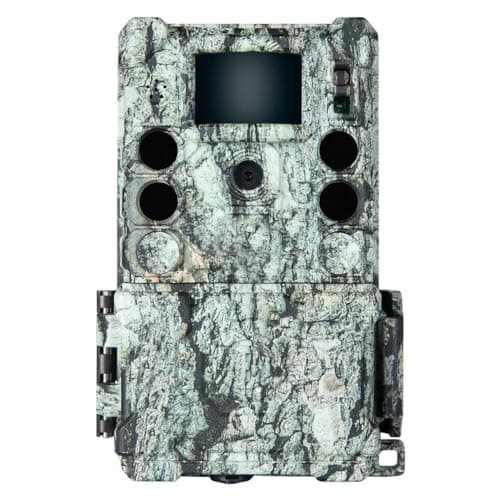
Buy this if the gap is real money
Bushnell CORE S-4K No Glow
SD / Wi-Fi7.9 /10The single-sensor CORE: 0.2 s trigger with a published 1 s recovery, 110 ft no-glow range and 4K video for $30 less than the DS.
$149.57Amazon#ad · Price as of October 16, 2026 · Disclosure for the link to Bushnell CORE S-4K No Glow
The short version
That matters because of what trail cameras miss. A camera does not usually miss the deer; it misses the second, third and fourth deer in the group, and the buck trailing the does by eight seconds. Trigger speed decides whether you catch the first animal. Recovery decides how many of the rest you catch. The background on both axes is in trigger speed explained.
Measured, side by side
Why the cheaper camera triggers faster
This is the result most buyers get backwards. Bushnell advertises the DS-4K's 0.15-second trigger as "best in class" and lists the S-4K at 0.2 seconds, so the spec sheet says the expensive camera is faster. Measured, it is the other way round: Trailcampro clocked the S-4K at 0.08 s to the first photo and the DS-4K at 0.15 s. The DS-4K hit its published number exactly; the S-4K beat its own by more than half.
A likely explanation is the dual-sensor design itself — two imagers mean a decision about which one to use before the shutter fires — but Bushnell does not document the pipeline, so treat that as an inference rather than a fact. What is not an inference is the practical size of the difference: 0.07 seconds is about four inches of travel for a walking deer and roughly three feet for one at a trot. On a trail set it is invisible. It only becomes real if you are shooting a road crossing or a fence jump where the animal is moving fast and in frame briefly.
Video is a wash: 0.70 s trigger on the S-4K, 0.68 s on the DS-4K.
Recovery: the number that decides it
Recovery is how long the camera needs after writing a photo before it can trigger again. Bushnell publishes 1 second for the S-4K and nothing at all for the DS-4K. Measured, the S-4K takes 1.9 s — nearly double its own claim — and the DS-4K takes 0.7 s.
Video recovery goes the same way, 0.5 s against 1.1 s. If you shoot mostly video, that gap compounds across a night.
80 ft at 42 degrees vs 70 ft at 34
Neither camera's detection range is published by Bushnell. Trailcampro measured the DS-4K at 80 ft across a 42.4-degree detection angle with a 41.5-degree field of view, and the S-4K at 70 ft across 33.6 degrees with a 40.9-degree field of view. It scored the DS-4K's detection circuit 93/100.
The ten extra feet is the smaller half of that. The important number is the detection angle against the field of view. On the DS-4K the sensor's 42.4-degree sweep is slightly wider than the 41.5-degree lens, so anything the camera can see, it can trigger on. On the S-4K the 33.6-degree sweep is 7 degrees narrower than its 40.9-degree lens, which leaves a wedge down each side of the frame where an animal appears in the photo but never set the camera off — the classic "deer walking out of the edge of the picture" result. Why that mismatch produces the shots it does is covered in trail camera detection range.
What the second sensor actually buys
The DS in DS-4K is the dual-sensor arrangement: one imager tuned for daylight, a second for infrared. On paper it is the right way to solve the problem that makes most night photos look bad, because a sensor optimized for color daylight is a compromise under an IR array. In the independent scoring, though, the payoff is narrow: picture quality came out 82/100 for the DS-4K and 80/100 for the S-4K, and both resolutions (32MP and 30MP) are interpolated rather than native.
So the honest version is: the second sensor is worth about two points of picture quality, not a tier. Buy the DS-4K for its recovery time and its detection circuit, and treat the night sensor as a bonus. If night image quality is the specific weakness you are fixing, the cameras built around that are in best trail camera for night pictures, and the flash-type decision behind it is in no-glow vs low-glow.
Flash range, claimed and criticized
Bushnell claims 120 ft of night range for the DS-4K and 110 ft for the S-4K, both from a no-glow array. Trailcampro's DS-4K review lists "limited flash range" as a con and notes the camera "will only record 14 second videos in the dark." In the 2026 shootout's combined flash-range ranking the two CORE bodies placed 23rd (S-4K) and 31st (DS-4K) — mid-pack to low, in a field where the overall flash winner was the GardePro T6LRW.
Read those together and the picture is consistent: these are strong detection-and-speed cameras with ordinary no-glow reach. No-glow always costs light, because the 940nm array the deer cannot see is dimmer than the 850nm array it can. Set either camera 20 to 30 feet off the trail rather than 60, and the flash range stops being the limiting factor. Our placement guide works through the distances.
Price and stock on 2026-10-16
Bushnell lists the S-4K at $149.95 and the DS-4K at $179.95. On the day we checked, the Amazon listings were about $150 for the S-4K, in stock, and about $159 for the DS-4K, with only a handful of units showing — a gap of under ten dollars rather than thirty. Prices on this page come from the live price feed and change daily, so use the buy buttons above rather than these words; the point is that the gap between these two moves a lot, and the whole recommendation turns on it.
Who should buy which
Buy the DS-4K if the camera is going on a trail, a travel corridor, a funnel or a property line — anywhere animals pass through rather than stand around. Recovery and detection width are exactly what those sets need, and this is one of the two or three best SD-card cameras on this site for that job.
Buy the S-4K if the gap is real money to you, if the set is a bait site, feeder or mineral station where the subject lingers, or if you want the smaller housing — it is 5 x 3.5 x 3 inches against the DS-4K's 5.5 x 3.5 x 3.5, which matters when you are fitting a steel box. It also takes cards up to 512GB.
Buy neither if you do not want to walk to the camera. Both are SD-card cameras: no cellular, no Wi-Fi, no app. If checking cards on foot is the thing you are trying to stop doing, the comparison you actually want is cellular vs Wi-Fi vs SD card, and the cameras are in best cellular trail cameras. If you want 4K from other makers too, the full field is in best 4K trail cameras.
In detail
The contenders, in full
Buy this one
Bushnell CORE DS-4K No Glow
Dual sensors (one tuned for day, one for night), a 0.15 s trigger Bushnell calls best in class, 120 ft no-glow range and 4K video: the SD camera to beat for night detail.
Spec sheetSpec-checked · sources linked
How the 8.7 score breaks down
- Trigger speed & recovery (25%)
- 10
- Night image quality (25%)
- 10
- Battery life (20%)
- 7
- Detection range & field of view (15%)
- 8
- Ease of use & value (15%)
- 7
What the spec sheet supports
- Two image sensors: a dedicated night sensor is the honest way to get sharper IR photos
- 0.15 s published trigger, confirmed at 0.15 s by Trailcampro's own test
- 0.7 s photo recovery as measured: nearly three times quicker back to ready than the single-sensor S-4K
- 80 ft at 42.4° measured detection, scored 93/100 — the widest, longest circuit of the two CORE bodies
- On-camera color screen for aiming and review
Where it falls short
- $179.95 list price, twice a budget SD camera
- Bushnell publishes no recovery time, AA count or detection range itself; every one of those figures here is Trailcampro's measurement
- Trailcampro flags limited flash range and 14-second maximum videos after dark, against Bushnell's 120 ft claim
- No cellular; you walk to it
Skip this if…
…you check cameras once a season and want photos on your phone; put the money toward a Flex-Dark and a plan.
#ad · Price as of October 16, 2026 · Disclosure for the link to Bushnell CORE DS-4K No Glow
Buy this if the gap is real money
Bushnell CORE S-4K No Glow
The single-sensor CORE: 0.2 s trigger with a published 1 s recovery, 110 ft no-glow range and 4K video for $30 less than the DS.
Spec sheetSpec-checked · sources linked
| Category | SD / Wi-Fi |
|---|---|
| Trigger speed | 0.2 s published; Trailcampro measured 0.08 s for photos and 0.70 s for video |
| Recovery time | 1 s published; Trailcampro measured 1.9 s for photos and 1.1 s for video |
| Detection range | 70 ft at a 33.6° detection angle (40.9° field of view), per Trailcampro |
| Flash | No glow |
| Flash range | 110 ft night range |
| Photo resolution | Up to 30MP (Trailcampro records it as interpolated) |
| Video | 4K |
| Batteries | AA; Trailcampro lists 6 AA and estimates 21.5 months in picture mode, 2.4 months shooting video |
| App features | 1.5-inch color viewscreen |
| Storage | SD cards up to 512GB, per Trailcampro |
| Dimensions | 5 in x 3.5 in x 3 in, per Trailcampro |
How the 7.9 score breaks down
- Trigger speed & recovery (25%)
- 9
- Night image quality (25%)
- 8
- Battery life (20%)
- 7
- Detection range & field of view (15%)
- 7
- Ease of use & value (15%)
- 8
What the spec sheet supports
- 0.08 s measured photo trigger — the quickest first frame of the two CORE bodies, and quicker than Bushnell's own 0.2 s claim
- 110 ft no-glow range
- 4K video at $149.95 list
- Takes SD cards to 512GB and fits a smaller box than the DS-4K
Where it falls short
- Single sensor; the DS-4K's night sensor is the reason to spend more
- 1.9 s measured photo recovery, nearly double Bushnell's stated 1 s and almost three times the DS-4K's
- 70 ft at 33.6° measured detection: 10 ft shorter and 9° narrower than the DS-4K
- SD only
Skip this if…
…night detail at distance is the whole reason you're upgrading; that's the DS-4K's job.
#ad · Price as of October 16, 2026 · Disclosure for the link to Bushnell CORE S-4K No Glow
How we scored this
The research behind these picks
Every pick here is built from documented evidence: the maker's published trigger speed, flash type, battery configuration and detection range; each brand's plan tiers verified on its own plan page and turned into the real monthly cost at one and four cameras; the independent shootouts (Trailcampro, Outdoor Life, Field & Stream, TechGearLab) cited by name for the measurements they published; and a public rubric applied the same way to every model. Every figure links to where it came from, so you can check our work in one click.
Scores are editorial judgments from that documented research. Commissions never set a score or decide a pick. The rubric and its weights are published.
Questions
Frequently asked
Is the Bushnell CORE DS-4K worth the extra money over the S-4K?
Yes for trail and corridor sets, because of recovery time: 0.7 s measured against the S-4K's 1.9 s, plus 80 ft of detection across 42.4 degrees against 70 ft across 33.6. No for feeders and bait sites, where the animal stays in frame and recovery does not change what you get.
What does the DS in Bushnell CORE DS-4K mean?
Dual sensor: one imager tuned for daylight and a second for infrared night shots. Independent picture-quality scoring puts the payoff at about two points (82/100 vs 80/100), so it is a real design but not the main reason to buy the camera.
Which Bushnell CORE camera has the faster trigger?
Measured, the cheaper S-4K: 0.08 s to the first photo against the DS-4K's 0.15 s. Bushnell's own sheets say the opposite (0.2 s and 0.15 s), and the DS-4K is the one that matched its claim.
Are the Bushnell CORE S-4K and DS-4K cellular?
No. Both are SD-card cameras with no cellular and no Wi-Fi, so there is no subscription and no app — you walk to the camera to pull the card. Bushnell's cellular line is the CelluCORE series.
How long do the batteries last in a Bushnell CORE 4K?
Both take 6 AA. Trailcampro estimates 25 months for the DS-4K and 21.5 months for the S-4K in picture mode on lithiums at 35 day and 35 night photos a day — and 2.4 months for the S-4K if you shoot video daily. Video is what drains these cameras, not time.
Keep reading
Related on Cam & Canopy
- Best 4K trail camerasWhere both CORE bodies rank against the field.
- Trigger speed explainedWhy recovery beats trigger.
- Detection rangeThe angle-vs-lens mismatch, in full.
- Best non-cellular camerasThe wider SD-card field.
- Best for night picturesIf night detail is the real goal.
- No-glow vs low-glowWhat no-glow costs in flash reach.
Receipts
Sources
- Trailcampro — Bushnell Core DS-4K No Glow review, measured trigger, recovery, detection and scores (checked 2026-10-16)
- Trailcampro — Bushnell Core S-4K No Glow review, measured trigger, recovery, detection and scores (checked 2026-10-16)
- Bushnell — CORE DS-4K No Glow product page (checked 2026-09-21)
- Bushnell — CORE S-4K No Glow product page (checked 2026-09-21)
- Trailcampro — 2026 Trail Camera Shootout results (checked 2026-09-21)
- Trailcampro — store search "bushnell core", prices, scores and stock (checked 2026-09-26)
Every number above is traceable: specs come from the maker's own product pages (linked on every product), plan prices from the maker's plan page with an “as of” date, and independent measurements are attributed to whoever made them. Amazon prices change often, so every buy button takes you to Amazon's current price for that listing. Read the full method.