Power · Guide
Trail camera battery life explained: what 'up to 12 months' means, and how to estimate yours
Every claim on a box is a best case in warm weather at a quiet set. Here's what the makers actually publish, what Trailcampro measured, the five things that drain a camera, and a way to estimate your own set without a lab.
By Mike M.Updated Spec-checked, not field-tested
#adReader-supported: we may earn a commission if you buy through our links, at no extra cost to you. It never decides a ranking. How we rank · Disclosure

What the makers publish
- Spypoint (Flex-M2): "up to 12 months with a LIT-22 rechargeable lithium battery or up to 6 months with AA batteries."
- Browning (Defender HD DV, Strike Force Pro X): "Up to 1 Year Battery Life" on 8 or 6 AA.
- Tactacam: "Excellent battery life" (X 3.0), "shorter battery life than X 3.0 depending on settings" (Pro 3.0); no months figure.
- Moultrie: no runtime claim for the POWER MAG III; "18 AA" equivalent capacity instead.
- Bushnell (CelluCORE 20 Solar): "maintains full charge for up to 70 images per day with adequate sun light."
- GardePro (X66 3.0 Ultra): "approximately 3 months under typical usage" defined as 15 day and 15 night photos daily with real-time upload.
Notice the shapes: months, photos per day, AA equivalence, or an adjective. GardePro's is the most useful because it states the assumption (30 photos a day, uploaded). "Up to" everywhere else means a warm, quiet set on fresh lithiums.
What Trailcampro measured
The five things that drain a camera
- Night flash. The IR array is the biggest single draw. A no-glow (940nm) array draws more than low-glow for the same reach; Tactacam says as much about the Pro 3.0. A set with 20 night triggers a night burns batteries; a daytime field edge barely does.
- Video. The sensor, processor and (at night) the array run for the whole clip. Trailcampro's 31-to-5.7 month ratio is the price.
- Cellular transmission and retries. Sending a photo costs more than taking it, and a camera at one bar retries. Instant-send at a busy feeder on weak signal is the worst case a cellular camera can be in.
- Cold. Alkalines lose most of their capacity near 0°F; lithium primaries are rated to -40°F; NiMH to about -4°F. The same set that ran three months in October runs weeks in January on alkalines. See batteries in cold weather.
- Sensitivity and false triggers. A high-sensitivity PIR on a windy edge fires on grass all afternoon, each trigger a photo and, on cellular, an upload. Stealth Cam's PIR zone selection and false-image detection exist to stop this.
Estimating your own set
You don't need a lab; you need last month's card. Count night photos and day photos, and note the video setting.
- Daytime photos only, no cellular, lithiums: plan on a season and then some. Trailcampro's 31 months is the ceiling.
- Heavy night activity (feeder, scrape in rut), photos only: divide that by two or three.
- Video mode, any set: divide by five (the T5NG ratio).
- Cellular, instant send, good signal: take the maker's "up to" claim and halve it for a busy set.
- Cellular, weak signal: halve it again, then add a panel.
- Below freezing on alkalines: don't. Lithium or a pack.
Those are rules of thumb built from the makers' assumptions and Trailcampro's ratio, not measurements of your camera. They're conservative on purpose; a camera that outlasts your estimate is a pleasant surprise, and the other kind isn't.
Settings that extend it
- Photo mode, single shot, unless you're specifically after video of one animal.
- A delay between triggers at feeders (5 to 10 minutes) instead of the 10-second default.
- Scheduled transmission once or twice a day instead of instant, on cellular.
- Downsized transmit resolution; request HD only when it matters.
- Medium sensitivity in summer; trim the grass in front of the lens.
- On Browning cameras, the "Power Save" IR mode when reach isn't needed.
Full settings walkthrough: trail camera settings.
The three things to buy
Our picks for this
Lithium AAs, a tray pack, a panel-with-battery
The AA that every battery estimate assumes; the pack that doubles Spypoint's claim; the panel that Tactacam rates at 5,000 photos a day in sun.
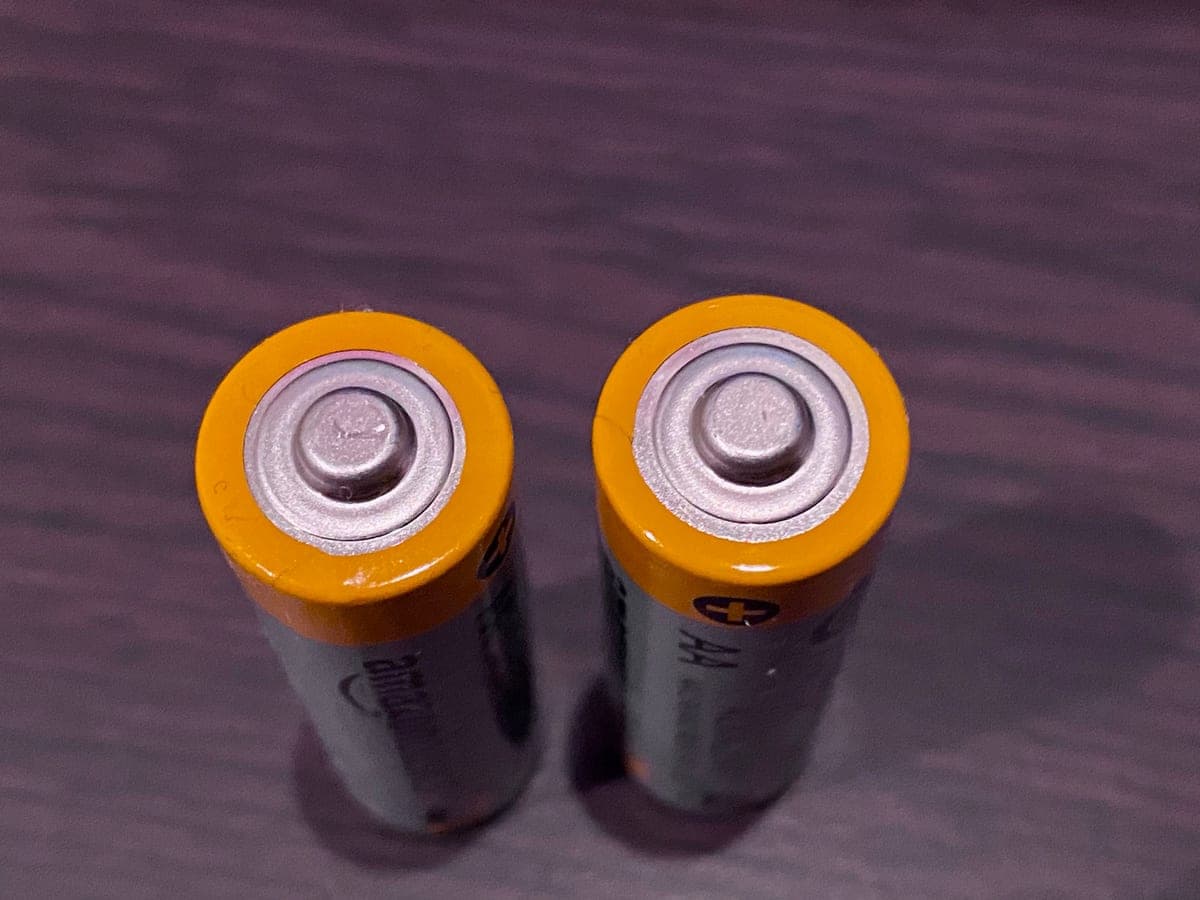 Stock photo
Best AA batteries for trail cameras
Energizer Ultimate Lithium AA
Batteries8.9/10The AA to put in a trail camera: rated from -40°F to 140°F, up to 25 years of shelf life, lighter than alkaline, and the battery Trailcampro uses for its life estimates.
Check price · Amazon#ad · Price set by Amazon · Disclosure for the link to Energizer Ultimate Lithium AA
 Stock photo
Best battery pack for Spypoint Flex
Spypoint LIT-22 Lithium Battery Pack
Battery pack8.2/10A 7.4V, 5.4Ah lithium pack that replaces the Flex AA tray; Spypoint claims up to 12 months on a Flex-M2 with it.
Check price · Amazon#ad · Price set by Amazon · Disclosure for the link to Spypoint LIT-22 Lithium Battery Pack
 Stock photo
Best solar panel for Tactacam Reveal
Tactacam Reveal Folding Solar Panel
Solar panel8.4/10Two panels, a 7.2V/4,900 mAh battery and a 12V/2A output that Tactacam says supports up to 5,000 photos a day in direct sun; it fits every Reveal and most 12V cameras.
Check price · Amazon#ad · Price set by Amazon · Disclosure for the link to Tactacam Reveal Folding Solar Panel
How we scored this
Cameras we claim to have field-tested: none we don't own
Plenty of sites say they hung every camera on this list in a tree for a season. We don't say that, and we say so on every page. What we do instead: read the maker's published trigger speed, flash type, battery configuration and detection range; verify each brand's plan tiers on its own plan page and compute the real monthly cost at one and four cameras; cite the independent shootouts (Trailcampro, Outdoor Life, Field & Stream, TechGearLab) as their measurements, never ours; and score every pick on a public rubric. Every figure links to where it came from.
Scores are editorial judgments from that documented research, not lab results. Commissions never set a score or decide a pick. The rubric and its weights are published.
Questions
Frequently asked
How long do trail camera batteries last?
Photo mode on lithium AAs, an SD camera can run a year or more (Trailcampro estimated 31 months on a T5NG); video mode under six. Cellular cameras: makers claim 6 to 12 months on AAs or a pack, less at busy or weak-signal sets, and much less in cold on alkalines.
How long do cellular trail camera batteries last?
Spypoint claims up to 6 months on AAs or 12 on a LIT-22 pack for the Flex-M2; Browning claims up to 1 year on 8 AAs; GardePro says about 3 months at 30 uploaded photos a day with its 17,500 mAh pack. Busy sets and weak signal cut those sharply.
Why does my trail camera drain batteries so fast?
Usually night video, a busy feeder with instant cellular sending, weak signal causing retries, alkalines in cold, or false triggers from grass on high sensitivity. Check last month's card for the night-to-day and video counts.
Does video drain trail camera batteries?
Heavily. Trailcampro's estimate for the same camera on the same lithiums: 31.1 months in photo mode, 5.7 months in video mode.
Keep reading
Related on Cam & Canopy
Receipts
Sources
- Trailcampro — GardePro T5NG review, measured figures (checked 2026-09-21)
- Spypoint — FLEX series overview (checked 2026-09-21)
- Browning Trail Cameras — Defender Pro Scout Max HD DV product page (checked 2026-09-21)
- Browning Trail Cameras — Strike Force Pro X 1080 product page (checked 2026-09-21)
- Tactacam — Reveal camera comparison: X 3.0 vs Pro 3.0 vs Ultra (checked 2026-09-21)
- Moultrie — POWER MAG III product page (checked 2026-09-21)
- Bushnell — CelluCORE 20 Solar product page (checked 2026-09-21)
- GardePro — X66 3.0 Ultra product page (checked 2026-09-21)
- Energizer — Ultimate Lithium AA product page (checked 2026-09-21)
- MicroBattery — Panasonic eneloop pro AA BK-3HCCA spec listing (checked 2026-09-21)
- Stealth Cam — Deceptor Max 3.0 product page (checked 2026-09-21)
- Spypoint — LIT-22 rechargeable lithium battery pack product page (checked 2026-09-21)
- Tactacam — REVEAL Folding Solar Panel product page (checked 2026-09-21)
We don't claim to have field-tested these cameras and we don't pretend to. Specs come from the maker's own product pages (linked on every product), plan prices from the maker's plan page with an “as of” date, and independent measurements are attributed to whoever made them. Amazon prices change often, so we don't print them. Where a figure isn't published, we say so. Read the full method.