Cellular Trail Cameras · Review
Browning Defender Pro Scout Max HD DV review: the fastest cell cam with the most hidden running cost
Browning publishes a 0.25-second trigger and a 0.35-second recovery, and nothing else in this price class states both. It also publishes no plan price at all. That trade is the whole review, and whether it is worth taking depends on how many of these you intend to hang.
By Mike M.Updated Spec-checked · every figure sourced
#adReader-supported: we may earn a commission if you buy through our links, at no extra cost to you. It never decides a ranking. How we rank · Disclosure
Reviewed
The camera under review
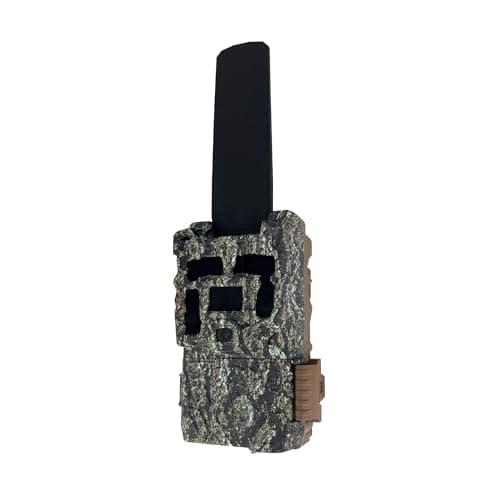
Best trigger speed cellular camera
Browning Defender Pro Scout Max HD DV
Browning (Strike Force Wireless)7.8 /10The fastest published trigger and recovery of any cell cam here (0.25 s / 0.35 s), invisible IR, direct 10-second video to your phone, and a 12V jack; plan prices sit behind a login.
$164.95Amazon#ad · Price as of October 12, 2026 · Disclosure for the link to Browning Defender Pro Scout Max HD DV
Who it's for
This is a camera for one specific frustration: the deer that walked through the frame and left you a photo of its back end. If your sets are trail crossings, field-edge funnels, logging roads or a gate your truck goes through, the trigger and recovery figures below are the reason to read on. If your cameras sit over feeders, mineral or scrapes where animals stop and stand, you are paying for speed you will not use, and a cheaper cell cam does the same job.
It is also a camera for someone who has already done the plan math and decided they can live with an unknown. That sounds like a strange thing to say about a $160 purchase, and it is, which is why it gets its own section.
0.25 s trigger, 0.35 s recovery
Browning's spec sheet for the Defender Pro Scout Max HD DV reads "0.25 Second Trigger Speed" and "0.35 Second Recovery Time Between Images." Both numbers matter, and most makers only publish the first one.
A whitetail at an easy walk covers roughly three feet per second. At 0.25 seconds the animal has moved about nine inches between the sensor seeing it and the shutter opening, which keeps a crossing animal inside the frame instead of at the edge of it. The geometry is worked through in trigger speed explained, and the short version is that trigger speed only matters in proportion to how fast your subject is moving across the lens rather than toward it.
One honest caveat: these are Browning's published figures, not measurements we took, and not independent measurements either. Browning does not submit this body to the shootout in the category where recovery is measured. Trailcampro ranked it ninth overall for flash range in its 2026 testing, which is the one independent number we can attach to it. Treat 0.25 s / 0.35 s as the maker's claim and weigh it accordingly.
Invisible IR to 100 feet
Browning lists "100 ft. Invisible Infrared Night Illumination" with "Illuma-Smart Technology," its automatic flash-power adjustment, and three selectable modes: Power Save, Fast Motion and Long Range. Invisible IR means a 940nm array with no visible red glow, which is the right choice on pressured ground and the only sensible choice on a gate or a driveway where a glowing camera is an invitation.
The three flash modes are more useful than they sound. Long Range pushes light out at the cost of battery; Power Save does the opposite; Fast Motion shortens the exposure so a moving animal at night blurs less, which pairs with the trigger speed rather than fighting it. The usual no-glow tax applies: invisible IR throws less usable light than a low-glow array of the same wattage, so expect grainier night images at the far end of that 100 feet than a low-glow camera would give you. That trade is covered in no-glow vs low-glow.
Direct video: the feature nobody copies
The "DV" in the model name is the point of the camera. Browning lists "Full HD 1080p Videos with Sound (5 sec. - 2 min. length)" on the card, and its 2026 cellular lineup announcement describes 10-second clips transmitted directly rather than on request.
Almost every other cellular camera sends you a still, and a video only if you tap a button in the app and wait. That round trip is fine when you are curious and useless when you are not holding your phone. Direct clips mean the thing that walked past your gate at 2 a.m. arrives as motion, with audio, while you are asleep. The only cameras in our registry that come close are the ones with a live feed, and those meter it: see cellular cameras with live view for what streaming actually costs per camera.
The cost here is data. A 10-second 1080p clip is a far bigger upload than a still, and on a metered plan that is the number that moves. Which brings us to the problem.
Two SIMs, one choice
Browning ships "Pre-Installed AT&T and Verizon SIM Cards" and describes "Dual Carrier Technology - Choose Between AT&T or Verizon," operating on a nationwide 4G LTE network. Read that wording carefully: you choose a carrier, the camera does not keep hopping between them looking for the better signal. The HD Solar page words it differently and says it "Auto-Detects the Best Cell Carrier Signal in Your Area," so the two bodies may not behave identically here.
For most properties that distinction is academic, because signal at a given tree does not change much from week to week. It matters on ground that sits at the edge of both networks, where a Tactacam's automatic multi-network selection is genuinely more forgiving. If that is your situation, start with the best cellular camera for low signal instead, and check whether your ground is better served by a Verizon-first camera or an AT&T-first one.
8 AA and a 12V jack
Browning lists "8 AA Batteries, Not Included," "Up to 1 Year Battery Life" and a "12-Volt External Power Jack." Eight AAs is half what a Tactacam Reveal takes, which cuts the cost of a refill but also the runway; the one-year claim is a maker claim at some unstated photo volume and should be read as the ceiling, not the plan. Direct video will not get you near it.
The 12V jack is the useful part. It takes any of the universal 12V panels in our solar panel roundup, or a sealed lead-acid box if the set is somewhere the sun never reaches, which is the approach in 12V battery boxes for trail cameras. In cold weather, lithium AAs are not optional on a camera that sends video; the temperature curves are in batteries in cold weather.
The plan price Browning doesn't publish
This is the single biggest mark against an otherwise excellent camera, and it gets worse with scale. One camera is a $160 purchase plus an unknown. Four cameras is a $640 purchase plus four unknowns, and plan cost is the line item that quietly outgrows the hardware: on Moultrie's Unlimited tier, four cameras is $51.96 a month, which passes the price of four cameras inside a year. The cross-brand math is laid out in cellular trail camera plans compared and plans for multiple cameras.
There is one mitigation worth knowing: Browning's 2026 lineup notes that these bodies work as plain SD-card cameras without an active plan. If you pull the plan in February and run the camera on the card until August, you are not holding a brick. That is more than Reconyx offers, where an active plan is required for the camera to operate at all.
Where you can actually buy one
On the day this review was written, Browning's own store listed the HD DV at $159.99 and the HD Solar at $179.99, and both read sold out. Trailcampro had the HD DV at $169.95 and the HD Solar at $189.95 in stock, plus bundled packages at $214.95 and $209.95. Amazon had both bodies in stock at third-party prices around the $165 mark, in single-digit quantities.
That is a camera in genuinely thin supply rather than a discontinued one, which is worth knowing before you set your heart on it. The buy button on this page goes to the live Amazon listing; if it has gone, the search fallback will show you what is currently offered under that model name, and Trailcampro is the retailer we found holding stock. Prices above are what each seller showed on 2026-10-09 and will move.
HD DV vs HD Solar
| Evidence | Browning Defender Pro Scout Max HD DV | Browning Defender Pro Scout Max HD Solar |
|---|---|---|
| Trigger speed | 0.25 s | 0.2 s |
| Recovery time | 0.35 s between images | 0.5 s between images |
| Detection range | 100 ft | 100 ft |
| Flash | Invisible infrared, adjustable (Power Save, Fast Motion, Long Range), Illuma-Smart auto adjust | Invisible infrared, adjustable, Illuma-Smart |
| Flash range | 100 ft; ninth overall in Trailcampro's 2026 flash-range shootout | 100 ft |
| Photo resolution | 46MP, 'all HD all the time' images | 46MP |
| Video | 1080p with sound, 5 s to 2 min; 10-second clips transmitted directly | 1080p with sound, 5 s to 2 min |
| Solar | — | Built-in solar panel |
| Batteries | 8 AA (not included), up to 1 year battery life (maker claim) | 8 AA backup (not included), up to 1 year battery life (maker claim) |
| External power | 12-volt external power jack | 12-volt external power jack |
| App features | GPS-tagged images, color view screen, Strike Force Wireless app; works as an SD camera without a plan | GPS-tagged images, 1.5-inch color view screen |
| Score | 7.8/10 | 8.0/10 |
The Solar trades a little recovery time for a panel: 0.2 s trigger against the DV's 0.25 s, but 0.5 s recovery against 0.35 s, plus a built-in panel, a 1.5-inch color screen, support for up to 512GB SDXC cards and a quarter-twenty tripod socket. It costs $20 more at list and about $20 more at retail.
Pick the DV if the set is a crossing and you are willing to carry batteries, because the faster recovery catches the second and third animal in a group. Pick the Solar if the set is a field edge, a gate or a pasture corner with real sun on it, because a panel ends the battery conversation and the recovery difference is 0.15 seconds. Neither choice is wrong; the sun exposure at the tree decides it.
What to buy instead
Our picks for this
The solar sibling, and two cameras that publish their plan prices
If the unpublished plan cost is the dealbreaker, these two are the closest no-glow cameras that tell you what they cost to run before you buy.
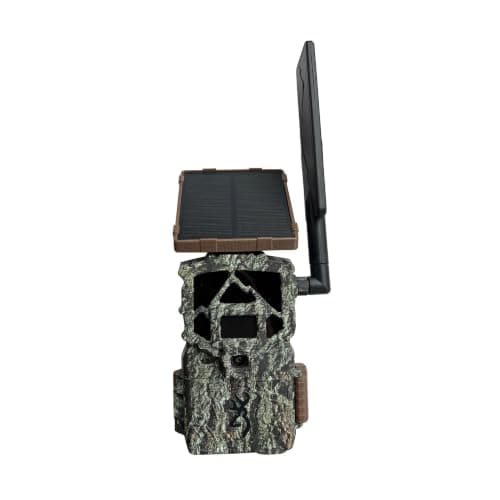
Best solar camera for trigger speed
Browning Defender Pro Scout Max HD Solar
Browning (Strike Force Wireless)8.0/10Same camera with a built-in panel and a screen; 0.2 s trigger, 0.5 s recovery.
$165.00Amazon#ad · Price as of October 12, 2026 · Disclosure for the link to Browning Defender Pro Scout Max HD Solar
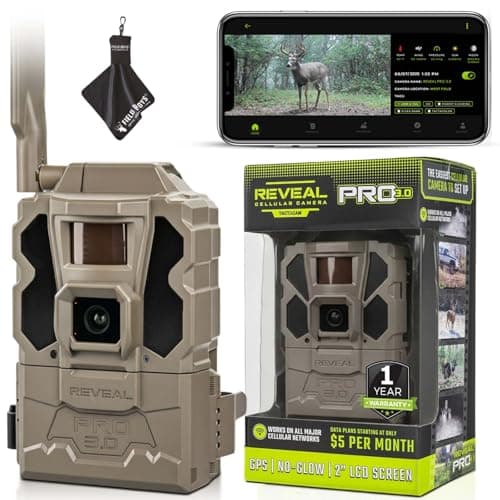
Best no-glow Tactacam
Tactacam Reveal Pro 3.0
Tactacam Reveal7.6/10No-glow, a 2-inch screen, published plans from $5/mo, and the Xtra add-on is charged per account rather than per camera.
$129.99Amazon#ad · Price as of October 12, 2026 · Disclosure for the link to Tactacam Reveal Pro 3.0
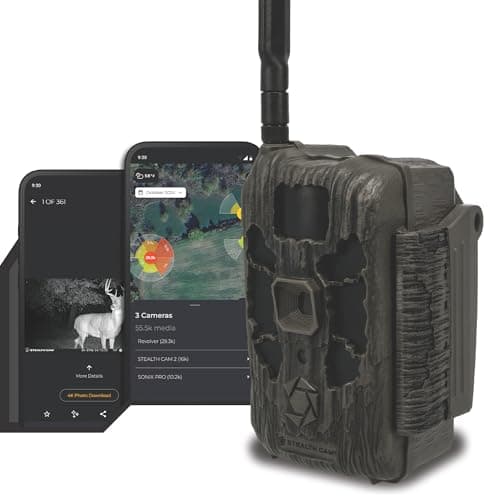
Best no-glow flash array
Stealth Cam Deceptor Max 3.0
Stealth Cam Command7.6/10940nm no-glow at 0.3 s with GPS, on published Command plans from $5/mo and an annual rate of $48.
$115.00Amazon#ad · Price as of October 12, 2026 · Disclosure for the link to Stealth Cam Deceptor Max 3.0
If trigger speed is genuinely the only thing you care about and brand does not matter, the whole field is ranked in fastest trigger speed trail cameras. If you want the invisible flash without the Browning plan mystery, best no-glow cellular cameras is the page to read next.
And if the reason you are looking at a 0.25-second camera with invisible IR is a gate, a shed or a driveway rather than a deer trail, read best trail cameras for security first. The Browning is on that list for exactly these reasons, and the page covers the parts a camera cannot solve on its own, such as the steel box and the cable that keep it on the tree.
For the rest of the range, including the three SD-card Elite bodies that carry no plan at all, best Browning trail cameras ranks five models on published trigger and recovery figures.
In detail
The full spec sheet and score
Best trigger speed cellular camera
Browning Defender Pro Scout Max HD DV
The fastest published trigger and recovery of any cell cam here (0.25 s / 0.35 s), invisible IR, direct 10-second video to your phone, and a 12V jack; plan prices sit behind a login.
Spec sheetSpec-checked · sources linked
| Plan ecosystem | Browning (Strike Force Wireless). The plan decides the running cost; see the plan explainer linked on this page. |
|---|---|
| Network | Pre-installed AT&T and Verizon SIMs, dual carrier technology |
| Plan | Month-to-month plans via Strike Force Wireless; prices require an account login and could not be verified |
| Trigger speed | 0.25 s |
| Recovery time | 0.35 s between images |
| Detection range | 100 ft |
| Flash | Invisible infrared, adjustable (Power Save, Fast Motion, Long Range), Illuma-Smart auto adjust |
| Flash range | 100 ft; ninth overall in Trailcampro's 2026 flash-range shootout |
| Photo resolution | 46MP, 'all HD all the time' images |
| Video | 1080p with sound, 5 s to 2 min; 10-second clips transmitted directly |
| Batteries | 8 AA (not included), up to 1 year battery life (maker claim) |
| External power | 12-volt external power jack |
| App features | GPS-tagged images, color view screen, Strike Force Wireless app; works as an SD camera without a plan |
How the 7.8 score breaks down
- Trigger speed & recovery (20%)
- 10
- Night image quality (20%)
- 8
- Battery & solar life (20%)
- 8
- Real monthly plan cost (20%)
- 5
- Detection range & field of view (10%)
- 8
- App, setup & reliability (10%)
- 8
What the spec sheet supports
- 0.25 s trigger with a published 0.35 s recovery, the only cell cam here that states both
- Invisible IR with adjustable flash modes
- Direct video: clips arrive without a separate request
- 8 AA plus a 12V jack; runs as a plain SD camera if you pause the plan
Where it falls short
- Browning's plan prices are behind the Strike Force Wireless login; we could not verify them
- Dual carrier means choosing AT&T or Verizon, not automatic hopping across all four networks
- $159.99 at Browning and sold out there on 2026-10-09; retail stock sits around $165-$170
Skip this if…
…you want to know the running cost before you buy; every other brand here publishes it and Browning doesn't.
#ad · Price as of October 12, 2026 · Disclosure for the link to Browning Defender Pro Scout Max HD DV
How we scored this
The research behind these picks
Every pick here is built from documented evidence: the maker's published trigger speed, flash type, battery configuration and detection range; each brand's plan tiers verified on its own plan page and turned into the real monthly cost at one and four cameras; the independent shootouts (Trailcampro, Outdoor Life, Field & Stream, TechGearLab) cited by name for the measurements they published; and a public rubric applied the same way to every model. Every figure links to where it came from, so you can check our work in one click.
Scores are editorial judgments from that documented research. Commissions never set a score or decide a pick. The rubric and its weights are published.
Questions
Frequently asked
How fast is the Browning Defender Pro Scout Max HD DV?
Browning publishes a 0.25-second trigger speed and a 0.35-second recovery time between images. It is the fastest published pair of figures on any cellular camera in our registry, though it is a maker claim rather than an independent measurement.
What does the Browning Defender Pro Scout Max HD DV plan cost per month?
Browning does not publish it. Its cell cam plans page requires a Strike Force Wireless account login, and the product page says only "month-to-month data plans, no contracts." We could not verify a price, so we do not quote one.
Does the Browning Defender Pro Scout Max work without a data plan?
Yes. Browning's 2026 cellular lineup announcement states these bodies operate as standard SD-card cameras when no plan is active, so pausing a subscription does not disable the camera.
Is the flash on the Defender Pro Scout Max HD DV visible at night?
No. Browning lists "100 ft. Invisible Infrared Night Illumination," which is a no-glow 940nm array with no visible red light, plus Illuma-Smart automatic flash adjustment and Power Save, Fast Motion and Long Range modes.
Does it use AT&T or Verizon?
Both SIMs ship pre-installed and you choose one. The HD DV page describes choosing between AT&T and Verizon; the HD Solar page describes auto-detecting the stronger signal, so the two bodies are worded differently on this point.
HD DV or HD Solar?
The DV for trail crossings: 0.35-second recovery catches the animals behind the first one. The Solar for sunny field edges and gates, where the built-in panel ends the battery problem and the 0.5-second recovery is close enough.
Keep reading
Related on Cam & Canopy
- Fastest trigger speed trail camerasWhere 0.25 s ranks against the field.
- Best no-glow cellular camerasInvisible flash, published plan prices.
- Best trail cameras for securityThe Browning on a gate, plus box and cable.
- Cellular plans comparedWhat every other brand publishes.
- Trigger speed explainedWhen a quarter second changes the photo.
- Moultrie Edge 3 Pro reviewThe no-glow camera that publishes its plan price.
- Best cellular trail camerasThe main ranking.
Receipts
Sources
- Browning Trail Cameras — Defender Pro Scout Max HD DV product page, specs, $159.99 list price and sold-out status (checked 2026-10-09)
- Browning Trail Cameras — Defender Pro Scout Max HD Solar product page, specs, $179.99 list price and sold-out status (checked 2026-10-09)
- Browning Trail Cameras — cell cam plans page (defers to Strike Force Wireless login; checked 2026-09-21)
- Browning Trail Cameras — 2026 cellular lineup announcement (checked 2026-09-21)
- Trailcampro — cellular trail camera collection: retail prices and stock for Browning, Spypoint, Stealth Cam and Tactacam (checked 2026-10-09)
- Trailcampro — Bushnell CelluCORE 20 review, measured trigger, recovery and detection figures (checked 2026-10-09)
- Trailcampro — 2026 Trail Camera Shootout results (checked 2026-09-21)
- Tactacam — REVEAL Pro 3.0 product page (checked 2026-09-21)
- Tactacam — REVEAL app plans page (checked 2026-09-21)
- Stealth Cam — Command data plans page (checked 2026-10-01)
- Moultrie Mobile — plans page (checked 2026-09-21)
- Spypoint — photo transmission plans (checked 2026-09-21)
Every number above is traceable: specs come from the maker's own product pages (linked on every product), plan prices from the maker's plan page with an “as of” date, and independent measurements are attributed to whoever made them. Amazon prices change often, so every buy button takes you to Amazon's current price for that listing. Read the full method.