Cellular Trail Cameras · The rankings
Best cellular trail cameras for AT&T: what a SIM can and cannot do for you
Two of the cameras here name AT&T on the spec sheet. The rest say 'automatic' and mean it. The difference matters most when the camera picks a network and gets it wrong, which is a fixable problem if you bought the right hardware.
By Mike M.Updated Spec-checked · every figure sourced
#adReader-supported: we may earn a commission if you buy through our links, at no extra cost to you. It never decides a ranking. How we rank · Disclosure
Quick picks
The rankings at a glance
| # | Product | Best for | Score | Price |
|---|---|---|---|---|
| 1 | 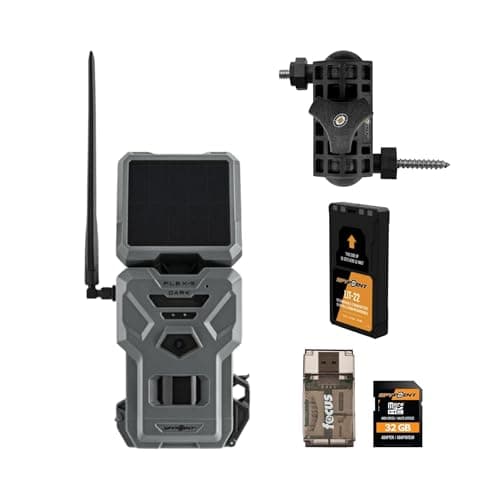 Spypoint Flex-S-Dark The only camera here with dual-SIM hardware: two carrier identities in the body, so AT&T is one of two options rather than a coin toss. Integrated solar for the retry-heavy sets, no-glow to 100 ft, and a free 100-photo tier while you find out whether the set works at all. | Best cellular camera for AT&T areasSpypoint | 8.8 /10 | $219.99Amazon |
| 2 | 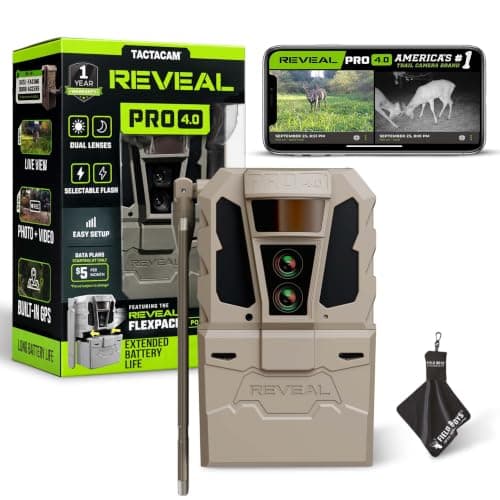 Tactacam Reveal Pro 4.0 One integrated SIM with Auto-Carrier Selection, and the longest measured battery life of any camera on this page: Trailcampro recorded 12.4 months in photo mode. Battery is what a marginal set spends, so this is the single-SIM camera that survives one. | Best single-SIM cameraTactacam Reveal | 7.8 /10 | $159.99Amazon |
| 3 | 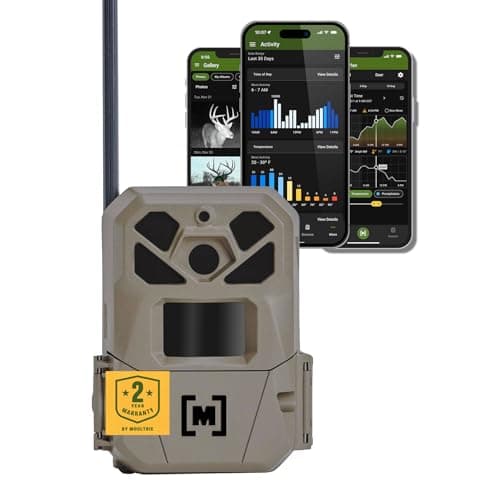 Moultrie Edge 3 Pro 'All 4 Major Networks' with automatic connection is the broadest published claim in the category, on a no-glow camera with a 0.30 s trigger and built-in memory. Moultrie states that every cellular device requires a paid subscription, so there is no free route. | Best network coverage claimMoultrie Mobile | 8.0 /10 | $98.99Amazon |
| 4 | 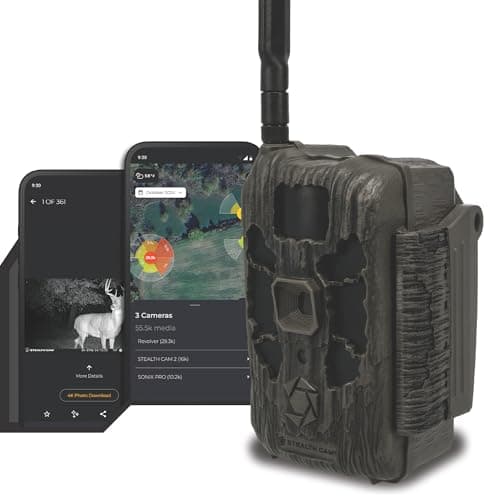 Stealth Cam Deceptor Max 3.0 A 36-LED 940nm array and PIR zone selection on a body HME explicitly lists for its external antenna, which states support for Verizon and AT&T networks. If your plan is 'camera plus antenna on a marginal AT&T set', this is the pairing with the fewest unknowns. | Best camera to pair with an antennaStealth Cam Command | 7.6 /10 | $115.00Amazon |
| 5 | No image Reconyx HyperFire 4K Covert IR Cellular 'Multi-SIM 4G LTE Cellular AT&T / Verizon (active plan required for operation)' is published on the spec sheet. If you want the carrier in writing rather than implied, this is it. The $250-a-year Freedom Plan is the price. | The only camera that names AT&TReconyx | 6.8 /10 | Check price · Amazon |
#ad · Prices come live from Amazon, last checked October 12, 2026. Scores are ours, built from published specs, verified plan prices and cited independent tests, not our own field measurements. Row photos are Amazon's own product images where a listing supplies one, and a blank panel where the maker sells elsewhere and supplies none. Tap a row for the full write-up.
What "for AT&T" actually means now
Search for an AT&T trail camera and you will find plenty of listings that say AT&T. Almost none of them are cameras you choose a carrier for. We read the current product page for every cellular camera we rank on 2026-09-26, and here is what the volume brands publish: Moultrie says "All 4 Major Networks" with "automatic connection", Spypoint says "Dual-SIM technology automatically connects you to all major carriers and the strongest signal in the area", Tactacam says "Auto-Carrier Selection" with an "Integrated SIM Card", and Stealth Cam says "Automatic Network Coverage". Not one of those four names AT&T anywhere.
Two cameras do name it. Reconyx publishes "Multi-SIM 4G LTE Cellular AT&T / Verizon (active plan required for operation)" on the HyperFire 4K Cellular, and Browning publishes "Pre-Installed AT&T and Verizon SIM Cards" on the Defender Vision Pro LSF. The Browning was sold out with an "Available Late Summer 2026" note and its plan prices sit behind the Strike Force Wireless login, so we cover it below but do not rank it.
There is a third place AT&T shows up in writing on real hardware, and it is not a camera: HME's external booster antenna states it "works with Verizon and AT&T networks" and names Stealth Cam, Muddy and WGI cameras as compatible. That is worth knowing, because on a marginal AT&T set the antenna is the part that changes the outcome.
If you came here from our Verizon page, the underlying finding is the same and the retailers agree: Trailcampro tags the same single camera in both its Verizon and AT&T collections and states plainly that a camera "must operate on the same network as your current cell phone" is a misconception. Where this page differs is what it does with that: it looks at the SIM hardware, because that is the only lever you actually control.
One SIM, two SIMs, four networks: the difference that matters
These three architectures behave differently on an AT&T set, and the difference is only visible in the wording.
| Architecture | Who publishes it | What happens on an AT&T-strong set |
|---|---|---|
| Dual SIM (two carrier identities in the body) | Spypoint: "Multi-Network (Dual SIM)", "cross-carrier coverage that automatically connects to the strongest signal" | The camera can register on either network in its own right. AT&T is an option it holds, not one it borrows |
| Single SIM with auto-selection | Tactacam: "Integrated SIM Card", "Auto-Carrier Selection", carrier field "Major Cellular Networks" | One identity that attaches to whatever the maker's arrangements allow. Usually fine; when it settles on the weaker network you cannot override it |
| Multi-network claim, mechanism unstated | Moultrie: "All 4 Major Networks"; Stealth Cam: "Automatic Network Coverage", "Nationwide coverage" | Broadest reach on paper. Neither brand says how, so you learn the behavior after the first check-in |
| Multi-SIM with carriers named | Reconyx: "Multi-SIM 4G LTE Cellular AT&T / Verizon"; Browning: "Pre-Installed AT&T and Verizon SIM Cards" | Both carriers committed in writing. Reconyx is purchasable and expensive; the Browning was sold out when we checked |
Quoted from each maker's product or series page, read 2026-09-26. Full wording in our research log.
We rank dual-SIM above single-SIM on this page for one reason: a camera that can hold two identities has a second chance when the first network degrades, and network quality at a fixed tree changes with leaf-on, weather and tower load through a season. That is a mechanism argument, not a measurement, and we say so.
How we ranked them
The six-metric cellular rubric from how we rank, read for someone whose set is AT&T-dependent:
- SIM and network hardware, read into the app and reliability metric. Dual SIM beats single SIM; a named carrier beats an unnamed one; a stated mechanism beats a coverage claim.
- Battery and solar life (20%). Weighted heavily here, because a camera on a marginal network keeps its radio on far longer than one with four bars. Integrated solar effectively removes the problem; Trailcampro's measured 12.4 months on the Reveal Pro 4.0 is the next best answer.
- Night image quality (20%) and trigger speed and recovery (20%). The axes that decide whether the camera earns its place once connected. Two of these five are 940nm no-glow.
- Real monthly plan cost (20%). You buy the maker's plan, not AT&T's. Spypoint's free 100-photo tier means you can test a doubtful set for nothing; Reconyx's $250 a year is the other end of the scale. See plans compared.
- Detection range and field of view (10%). Published PIR range and angle.
Every figure links to the maker's page or Trailcampro's published measurements, with the date we read it. Stock was checked at each maker and at Trailcampro on 2026-09-26.
The five, on network and the numbers that matter
When the camera picks the wrong network
This is the specific failure that sends people searching for an "AT&T camera", and it has a real shape. A single-SIM camera powers up, scans, attaches to a network that had two bars at that moment, and then stays there. Leaf-on arrives, or a tower gets busy, and now the camera is stuck on the weaker of two options with no menu to change it. Symptoms: check-ins that arrive late or not at all, batteries dropping far faster than the spec suggests, and photos that show up in batches hours after the event.
Pick by what the set needs
| Your situation | Buy | Because |
|---|---|---|
| AT&T and one other carrier both marginal at the set | Spypoint Flex-S-Dark | Dual-SIM hardware plus integrated solar, and a free tier to test the set with |
| AT&T strong, and you want one set of batteries to last a year | Tactacam Reveal Pro 4.0 | Trailcampro measured 12.4 months in photo mode; $55/yr Starter plan |
| You'd rather buy the broadest published coverage claim | Moultrie Edge 3 Pro | "All 4 Major Networks", 940nm no-glow to 100 ft, 0.30 s trigger, built-in memory |
| You're buying a camera and a booster antenna together | Stealth Cam Deceptor Max 3.0 + HME antenna | HME names Stealth Cam compatibility and states Verizon and AT&T support; 36-LED no-glow array on the camera |
| You want AT&T in writing on the spec sheet | Reconyx HyperFire 4K Cellular | "Multi-SIM 4G LTE Cellular AT&T / Verizon" is published. $250/yr Freedom Plan |
| No usable signal from any carrier at the tree | An SD camera | No plan, no tower, best night camera per dollar. See the non-cellular ranking |
Our recommendation for each buyer; specs and stock as of 2026-09-26. Prices are set by the seller and change; the buy buttons go to a tagged Amazon search for each model, not to a price we've cached.
AT&T vs Verizon: what we can and can't tell you
We will not tell you which carrier is better in your county, because we have not measured it and neither has anyone selling you a camera. What we can tell you is how to find out, and the answer is not a review site.
- Use AT&T's own wireless coverage map, zoomed to the field, not the town. Rural coverage changes over a few hundred yards in cut-up country. A map that shows service in the nearest town tells you nothing about a creek bottom four miles out.
- Read bars at the tree, at camera height, against the trunk. A phone at head height in the open reads differently from an antenna at chest height against bark. That second number is the one that matters.
- Compare two phones if you can. If an AT&T phone shows two bars and another network shows four, a dual-SIM or four-network camera will take the better one, and knowing that is worth the trip.
- Repeat after leaf-on. Wet foliage and summer tower load both cost signal. A set that checked in fine in March can go quiet in July, which is exactly when you want the photos.
Spypoint's own support material on optimizing signal strength is worth reading whichever brand you buy; the physics does not care about the badge. And if the honest answer at your set is "nothing reaches here", the right purchase is not a different carrier but a different architecture: see best trail cameras for remote areas and best cellular camera for low signal.
In detail
The picks, in full
Rank 1
Best cellular camera for AT&T areas
Spypoint Flex-S-Dark
The only camera here with dual-SIM hardware: two carrier identities in the body, so AT&T is one of two options rather than a coin toss. Integrated solar for the retry-heavy sets, no-glow to 100 ft, and a free 100-photo tier while you find out whether the set works at all.
Spec sheetSpec-checked · sources linked
| Plan ecosystem | Spypoint. The plan decides the running cost; see the plan explainer linked on this page. |
|---|---|
| Network | Dual-SIM, automatically connects to all major carriers |
| Plan | Free 100 photos/mo; Basic $5 ($4 annual); Standard $10 ($7); Premium unlimited $15 ($10); one plan per camera |
| Trigger speed | 0.3 s |
| Detection range | 100 ft |
| Flash | Low-glow and no-glow LEDs |
| Flash range | 100 ft; sixth overall in Trailcampro's 2026 flash-range shootout |
| Photo resolution | 40MP |
| Video | 1080p; livestreaming video (Spypoint lists it as coming spring 2026) |
| Solar | Built-in solar panel and battery; 'replaces up to 1,000 AA batteries' (maker claim) |
| App features | GPS locator on the in-app map, remote activation, over-the-air updates |
| Warranty | 2 years |
How the 8.8 score breaks down
- Trigger speed & recovery (20%)
- 8
- Night image quality (20%)
- 9
- Battery & solar life (20%)
- 9
- Real monthly plan cost (20%)
- 10
- Detection range & field of view (10%)
- 8
- App, setup & reliability (10%)
- 8
What the spec sheet supports
- Integrated solar with no cable to route or panel to aim
- Same 0.3 s / 100 ft / dual-LED spec as the Flex-Dark
- Free 100-photo tier; $10/mo annual unlimited
- $149.99 at Spypoint, under the Moultrie Edge 4 Solar
Where it falls short
- A camera-mounted panel only works where the camera faces the sun; shaded sets still starve
- No published recovery time or battery capacity figure
- Fits CAMLOCKbox box 11, a different box from the Flex-Dark, so boxes don't swap
- Out of stock at Spypoint on 2026-10-09; Trailcampro had it at $169.95 and Amazon stock was marked up well above list
Skip this if…
…your sets are in deep timber with no direct sun; a separate 10W panel you can aim (SPLB-22) beats a built-in one there.
#ad · Price as of October 12, 2026 · Disclosure for the link to Spypoint Flex-S-Dark
Rank 2
Best single-SIM camera
Tactacam Reveal Pro 4.0
One integrated SIM with Auto-Carrier Selection, and the longest measured battery life of any camera on this page: Trailcampro recorded 12.4 months in photo mode. Battery is what a marginal set spends, so this is the single-SIM camera that survives one.
Spec sheetSpec-checked · sources linked
How the 7.8 score breaks down
- Trigger speed & recovery (20%)
- 6
- Night image quality (20%)
- 8
- Battery & solar life (20%)
- 9
- Real monthly plan cost (20%)
- 8
- Detection range & field of view (10%)
- 7
- App, setup & reliability (10%)
- 9
What the spec sheet supports
- Live View sessions are unlimited once you add the $6/mo add-on, not metered in minutes
- Switch between no-glow and low-glow in the app instead of buying two cameras
- Side LCD screen means you can aim and confirm the frame without the phone
- 12.4 months of photo battery life measured by Trailcampro, plus a 12V jack and FlexPack support
Where it falls short
- Trailcampro measured an 11.0-second photo recovery: the slowest number on this page, and it will miss the second deer
- Tactacam publishes no trigger speed, recovery or detection figure of its own for the 4.0 line
- Live View is billed per camera, so a four-camera set adds $24/mo on top of the data plans
- The 4K photo mode is interpolated, not a 4K sensor
Skip this if…
…you watch a crossing where animals come through in groups; an 11-second recovery between photos is the wrong tool for that trail, and the Moultrie Edge 3 Pro is the faster camera.
#ad · Price as of October 12, 2026 · Disclosure for the link to Tactacam Reveal Pro 4.0
Rank 3
Best network coverage claim
Moultrie Edge 3 Pro
'All 4 Major Networks' with automatic connection is the broadest published claim in the category, on a no-glow camera with a 0.30 s trigger and built-in memory. Moultrie states that every cellular device requires a paid subscription, so there is no free route.
Spec sheetSpec-checked · sources linked
| Plan ecosystem | Moultrie Mobile. The plan decides the running cost; see the plan explainer linked on this page. |
|---|---|
| Network | All 4 major networks, Auto Connect |
| Plan | Standard $8.99/mo per camera; Unlimited $12.99/mo per camera; Pro Series $22.99/mo per camera |
| Trigger speed | 0.30 s |
| Detection range | 100 ft; winner of Trailcampro's 2026 cellular detection shootout |
| Flash | No-glow |
| Flash range | 100 ft |
| Photo resolution | 50MP |
| Video | 1440p QHD |
| External power | USB-C input; POWER MAG packs and 3.4W Solar Power Pack II |
| App features | GPS, Moultrie AI (switches to HD video on a buck), on-demand, Live Aim; 50° field of view; includes Easy Aim Mount |
| Storage | Built-in memory, no SD card required |
How the 8.0 score breaks down
- Trigger speed & recovery (20%)
- 9
- Night image quality (20%)
- 9
- Battery & solar life (20%)
- 7
- Real monthly plan cost (20%)
- 6
- Detection range & field of view (10%)
- 9
- App, setup & reliability (10%)
- 9
What the spec sheet supports
- First in Trailcampro's 2026 cellular detection shootout, an independent result
- No-glow with 0.30 s trigger and 100 ft on both detection and flash
- 1440p video and 50MP stills, the highest published numbers in this group
- Built-in memory and an Easy Aim Mount in the box
Where it falls short
- Per-camera plans with no free tier; four cameras on Unlimited is $51.96/mo
- USB-C power only; no AA tray means a POWER MAG or panel is the whole power plan
- 50MP is interpolated
Skip this if…
…you run four or more cameras on a budget; the plan cost outruns the camera price within a season.
#ad · Price as of October 12, 2026 · Disclosure for the link to Moultrie Edge 3 Pro
Rank 4
Best camera to pair with an antenna
Stealth Cam Deceptor Max 3.0
A 36-LED 940nm array and PIR zone selection on a body HME explicitly lists for its external antenna, which states support for Verizon and AT&T networks. If your plan is 'camera plus antenna on a marginal AT&T set', this is the pairing with the fewest unknowns.
Spec sheetSpec-checked · sources linked
| Plan ecosystem | Stealth Cam Command. The plan decides the running cost; see the plan explainer linked on this page. |
|---|---|
| Network | Automatic network coverage |
| Plan | Standard $5/mo (600 photos); Plus $8/mo; Unlimited $20/mo with descending multi-camera pricing ($15 second, $11 third to seventh); per camera |
| Trigger speed | < 0.3 s |
| Detection range | 100 ft |
| Flash | No-Glo, 36-piece 940nm LED array |
| Flash range | Out to 100 ft |
| Photo resolution | Up to 50MP, up to nine photos per burst |
| Video | 1440p at 30 fps |
| Batteries | 16 AA; recharge compatible |
| App features | Command AI: false image detection, PIR zone selection, Rack Alert; live view ready; camera sharing; dual-core processor |
| Storage | 16GB internal memory |
How the 7.6 score breaks down
- Trigger speed & recovery (20%)
- 8
- Night image quality (20%)
- 9
- Battery & solar life (20%)
- 7
- Real monthly plan cost (20%)
- 6
- Detection range & field of view (10%)
- 8
- App, setup & reliability (10%)
- 8
What the spec sheet supports
- 36 LEDs at 940nm: the largest no-glow array in this group
- PIR zone selection and false-image filtering cut wasted uploads on windy sets
- 16 AA bay for long runs; 16GB internal memory
- Stealth Cam's Standard plan is $5/mo per camera
Where it falls short
- Unlimited plan is $20/mo for the first camera, the priciest unlimited tier we verified
- 16 AA batteries is a lot of batteries to buy
- Stealth Cam does not publish a recovery time
Skip this if…
…you want unlimited photos on several cameras; the descending schedule still totals $57/mo for four.
#ad · Price as of October 12, 2026 · Disclosure for the link to Stealth Cam Deceptor Max 3.0
Rank 5
The only camera that names AT&T
Reconyx HyperFire 4K Covert IR Cellular
'Multi-SIM 4G LTE Cellular AT&T / Verizon (active plan required for operation)' is published on the spec sheet. If you want the carrier in writing rather than implied, this is it. The $250-a-year Freedom Plan is the price.
Spec sheetSpec-checked · sources linked
| Plan ecosystem | Reconyx. The plan decides the running cost; see the plan explainer linked on this page. |
|---|---|
| Network | Multi-SIM 4G LTE, AT&T / Verizon; active plan required for operation |
| Plan | Freedom Plan $250.00 per year (two-year agreement makes the camera free) |
| Detection range | Reconyx publishes no trigger or detection figure on this page; its HyperFire 4K Surveillance sibling won Trailcampro's 2026 transmission shootout |
| Flash | Covert IR (no-glow) |
| Photo resolution | Native 4K Ultra HD image and video |
| Video | 4K; 1080p HD livestream with audio |
| App features | AI-powered image recognition and filtering; livestream |
| Warranty | 5-year warranty; unconditional lifetime warranty with the Freedom Plan |
How the 6.8 score breaks down
- Trigger speed & recovery (20%)
- 7
- Night image quality (20%)
- 9
- Battery & solar life (20%)
- 7
- Real monthly plan cost (20%)
- 3
- Detection range & field of view (10%)
- 7
- App, setup & reliability (10%)
- 9
What the spec sheet supports
- Native 4K (not interpolated) and a 5-year warranty
- Built in the USA
- Multi-SIM with livestream and AI filtering
- Free-camera option if you'll keep the plan two years
Where it falls short
- $250 a year per camera is the most expensive plan we verified
- Reconyx publishes no trigger speed, detection range or battery spec on the product page
- Overkill for a feeder camera
Skip this if…
…you're price-sensitive on plans; four of these cost $1,000 a year before batteries.
#ad · Price as of October 12, 2026 · Disclosure for the link to Reconyx HyperFire 4K Covert IR Cellular
Buyer's guide: buying hardware, not a carrier
You cannot add these cameras to an AT&T account
Every camera on this page ships with the maker's SIM and runs on the maker's plan. You pay Spypoint, Tactacam, Moultrie, Stealth Cam or Reconyx, and they hold the wholesale arrangement with the carriers. That means the price has nothing to do with what AT&T charges you for a phone, and it means there is no menu anywhere that says "use AT&T". The camera decides. Our plans compared page lists every verified tier, and do you need a subscription covers the one brand that lets you run without paying.
Test the worst set first, on the free tier
Spypoint's free 100-photo plan is the cheapest diagnostic tool in this category. Hang one Flex-S-Dark on the set you are least confident about, run it on free for a month, and see what arrives. If it works there, the rest of the property is easy and you can buy with confidence. If it does not, you have learned it for the price of one camera rather than six, and the answer is probably an antenna or an SD camera rather than a different brand.
Budget for the antenna up front on a marginal set
A $49.99 to $54.95 antenna on a one-bar set does more for your photo delivery than $60 of extra camera does. Check one thing before you buy: whether your camera has a screw-on antenna connector at all. Herd360's unit "fits ALL cellular trail cameras with a screw on antenna", and HME's names Stealth Cam, Muddy and WGI. Cameras with a fully internal antenna cannot take either. The antenna ranking has the compatibility detail.
Solar is worth more on a weak network than on a strong one
Radio time is the hidden battery cost of marginal coverage, and it is invisible on a spec sheet. Integrated solar, as on the Flex-S-Dark and the Reveal Pro 4.0 Solar, makes it a non-problem; a bolt-on panel does the same job if the fit is right, which is brand-specific. Our solar cellular ranking and solar panel ranking cover both routes.
Don't buy an old carrier-badged body to solve this
Cameras listed as "AT&T model" are mostly older bodies from the era when each brand shipped one SKU per carrier. The current retail example is the Stealth Cam DS4K Transmit, which appears in both Trailcampro's AT&T and Verizon collections at $199.99 and scored 74/100, the lowest cellular score in their listing. A modern multi-network camera at the same money is a better camera and can still land on AT&T.
Read these five lines before you buy anything
- The network line, verbatim. "Dual SIM" is hardware. "Automatic network coverage" is behavior. "Nationwide" is marketing.
- Whether a plan is optional. Spypoint has a free tier; Moultrie states a paid subscription is required for every cellular device.
- Whether there is a screw-on antenna connector. This is what makes a marginal set fixable later.
- Solar, integrated or supported. The insurance policy against radio-heavy retries.
- Flash wavelength and range. 940nm no-glow or 850nm low-glow, and a distance in feet. Carrier questions are no reason to accept a worse camera.
Scored that way, the Flex-S-Dark publishes four of five clearly, the Edge 3 Pro publishes the network and flash lines and requires a paid plan, and Reconyx publishes the network line and very little else, which is exactly why it is ranked for the one thing it uniquely does.
How we scored this
The research behind these picks
Every pick here is built from documented evidence: the maker's published trigger speed, flash type, battery configuration and detection range; each brand's plan tiers verified on its own plan page and turned into the real monthly cost at one and four cameras; the independent shootouts (Trailcampro, Outdoor Life, Field & Stream, TechGearLab) cited by name for the measurements they published; and a public rubric applied the same way to every model. Every figure links to where it came from, so you can check our work in one click.
Scores are editorial judgments from that documented research. Commissions never set a score or decide a pick. The rubric and its weights are published.
Corrections & updates
- First published. Every SIM, network and carrier claim quoted from the maker's own product or series page, read on this date; Trailcampro's carrier-tag collections read the same day. Browning's Defender Vision Pro LSF names both carriers but was sold out and is covered, not ranked.
Questions
Frequently asked
Which trail cameras work on AT&T?
In practice, all of the modern ones: Moultrie ("All 4 Major Networks"), Spypoint ("Dual-SIM technology automatically connects you to all major carriers"), Tactacam ("Auto-Carrier Selection") and Stealth Cam ("Automatic Network Coverage") all scan and attach to the strongest available network. Only two cameras we checked name AT&T in writing: the Reconyx HyperFire 4K Cellular ("Multi-SIM 4G LTE Cellular AT&T / Verizon") and Browning's Defender Vision Pro LSF ("Pre-Installed AT&T and Verizon SIM Cards"), which was sold out when we looked.
Can I choose AT&T on my cellular trail camera?
No. None of the cameras here has a carrier menu. The only control you get is a fresh network scan, which happens when you power the camera up: pull the batteries, wait, and restart it where it will live. That is why dual-SIM hardware is worth paying for on a marginal set, since it can hold two carrier identities rather than settling on one.
Does a trail camera need to be on the same carrier as my phone?
No, and Trailcampro flags this as the most common misconception in the category: plans come from the camera maker, "allowing you to pick the network with the best reception in your scouting area". The useful thing about your phone is not its carrier but its signal meter, which tells you whether anything reaches the tree you want to hang a camera on.
What is the best cellular trail camera for AT&T?
The Spypoint Flex-S-Dark, on the hardware argument: it is the only camera we rank whose maker states dual-SIM technology, so AT&T is one of two carrier identities it holds. It also runs on integrated solar, which matters on the marginal sets where the carrier question arises, carries a 940nm no-glow flash to 100 ft, and has a free 100-photo tier so you can test a doubtful set for nothing. Trailcampro scored it 89/100.
Is AT&T or Verizon better for a trail camera?
We cannot answer that for your ground and nobody selling a camera can either. Check AT&T's own wireless coverage map zoomed to the field rather than the town, then read the bars at the tree at camera height against the trunk, then repeat after leaf-on. If one carrier is clearly better, a four-network or dual-SIM camera will find it; if neither reaches, the right answer is an SD camera, not a different carrier.
Will a booster antenna help on AT&T?
On a marginal set, yes, and it is usually the best value fix. HME's external booster states it "works with Verizon and AT&T networks" with a 6 ft armored cable at $49.99, in stock when we checked; Herd360's directional unit publishes 10 to 12 dBi on 15 ft of coax at $54.95 and fits any camera with a screw-on antenna. An antenna raises a weak signal and does not create one, so it fixes one bar and not zero.
Keep reading
Related on Cam & Canopy
- Best cellular trail cameras for VerizonThe same question from the other carrier's side.
- Best cellular booster antennasThe cheapest fix for a one-bar set.
- Best cellular camera for low signalThe cameras built for marginal coverage.
- Do cellular cameras need a subscription?You pay the maker, not the carrier.
- Camera not sending picturesThe settings behind a quiet camera.
- Best solar cellular trail camerasRadio time is the hidden battery cost.
Receipts
Sources
- Trailcampro — AT&T-tagged cellular cameras, and the carrier-matching misconception (checked 2026-09-26)
- Trailcampro — Verizon-tagged cellular cameras, and the carrier-matching misconception (checked 2026-09-26)
- Spypoint — FLEX-S-DARK product page (checked 2026-09-21)
- Spypoint — FLEX series overview (checked 2026-09-21)
- Spypoint — photo transmission plans (checked 2026-09-21)
- Spypoint — support article: how to optimize signal strength (checked 2026-09-26)
- Trailcampro — store search "spypoint flex", prices, scores and stock (checked 2026-09-26)
- Tactacam — REVEAL Pro 4.0 product page (checked 2026-09-24)
- Tactacam — REVEAL X 4.0 product page (checked 2026-09-24)
- Trailcampro — Tactacam Reveal Pro 4.0 review, measured figures (checked 2026-09-24)
- Tactacam — REVEAL app plans page (checked 2026-09-21)
- Moultrie — EDGE 3 PRO product page (checked 2026-09-21)
- Moultrie Mobile — plans page (checked 2026-09-21)
- Stealth Cam — Deceptor Max 3.0 product page (checked 2026-09-21)
- Stealth Cam — Command data plans page (checked 2026-10-01)
- Reconyx — HyperFire 4K Covert IR Cellular product page (checked 2026-09-21)
- Browning Trail Cameras — Defender Vision Pro LSF product page (checked 2026-09-24)
- HME Products — External Antenna Signal Booster product page (checked 2026-09-21)
- Herd360 — Universal Directional High Gain Booster Antenna product page (checked 2026-09-26)
- Trailcampro — cellular trail camera collection, prices, scores and stock (checked 2026-09-26)
- AT&T — wireless coverage map (checked 2026-09-26)
Every number above is traceable: specs come from the maker's own product pages (linked on every product), plan prices from the maker's plan page with an “as of” date, and independent measurements are attributed to whoever made them. Amazon prices change often, so every buy button takes you to Amazon's current price for that listing. Read the full method.