Scouting · Guide
How trail cameras work, and how they see in the dark
A trail camera spends almost all of its life asleep. Understanding the three seconds it is awake explains nearly every complaint people have about them: the missed deer, the black night photo, the empty frame and the flat battery.
By Mike M.Updated Spec-checked · every figure sourced
#adReader-supported: we may earn a commission if you buy through our links, at no extra cost to you. It never decides a ranking. How we rank · Disclosure
The wake cycle, step by step
Everything a trail camera does happens in one short sequence, repeated for two years on eight AA cells.
- Sleep. The main processor, sensor and radio are powered down. Only the PIR sensor and a clock draw current, measured in microamps. This is why a camera can last thirty months.
- Detect. The PIR sensor registers a change in infrared energy across its zones and raises an interrupt.
- Wake and meter. The processor comes up, the image sensor powers on, and the camera decides whether it is dark enough to need the infrared array. That decision is made by a separate ambient light sensor, not by the image itself.
- Illuminate, if needed. At night the LED bank fires for the duration of the exposure. This is by far the largest current draw in the housing.
- Capture and write. The frame is read off the sensor, processed, compressed and written to a card or to internal memory.
- Transmit, on a cellular camera. The LTE modem wakes, finds a tower and uploads. On a weak signal this step costs more energy than everything above it combined.
- Recover and sleep. The camera finishes writing, arms the sensor again, and goes back to step one.
Two published specs describe that sequence. Trigger speed is steps 2 to 5: the fastest camera in our registry publishes 0.15 s and the slowest independently measured figure is 0.73 s. Recovery time is step 7: how long before the camera can fire again, which ranges from 0.35 s on a Browning to over 40 seconds on some cellular bodies. Both are explained at length in trigger speed explained.
The PIR sensor: heat, not shapes
Passive infrared means the sensor emits nothing; it only reads the infrared energy arriving at it. A Fresnel lens divides its view into alternating zones, and the sensor compares them. A warm body crossing from one zone into the next produces a difference. Enough difference, fast enough, and the camera wakes.
Three consequences follow directly, and they explain most of what frustrates people. Movement across the sensor is detected far better than movement straight toward it, which is why a camera aimed down a trail misses deer that a camera aimed diagonally across it catches. A warm background shrinks the contrast, which is why detection range falls in summer heat. And a stationary animal is invisible, however close, until it moves.
It also explains false triggers. A sunlit leaf moving in and out of shade is a moving heat differential, and the sensor has no way to know it is not a deer. The fix list is in trail camera false triggers, and the geometry of the detection fan is in detection range explained.
How a trail camera sees at night
It supplies its own light, in a part of the spectrum your eye cannot see. An array of infrared LEDs fires for the length of the exposure and the camera records the reflected infrared. Nothing else about the camera changes: the same sensor, the same lens, a longer exposure.
The practical limit is not the sensor, it is the light. Infrared illumination obeys the inverse square law, so doubling the distance to the animal cuts the light reaching it to a quarter. That is why flash range is the single most useful night-time spec on a trail camera, far more useful than resolution: a camera publishing 120 ft of night range produces a usable frame at eighty feet, and one publishing 80 ft produces a silhouette at the same distance. The published ranges across our registry run from 80 ft to 130 ft.
850nm vs 940nm, and the visible glow
Infrared LEDs come in two common wavelengths and the difference is the whole no-glow argument.
850nm sits just past the edge of human vision. It is efficient, so it throws light a long way for the current it draws, and the emitters are visibly red when they fire. Makers call this low glow or, on cheaper cameras, simply infrared. Our registry has cameras publishing 120 and 130 ft of illumination on 850nm arrays.
940nm is far enough into the infrared that the array is effectively invisible to a person standing in front of it. It is also less efficient: the same illumination costs more current, which is why no-glow cameras tend to publish shorter flash ranges and shorter battery life. The Stealth Cam Deceptor Max 3.0 compensates with a 36-piece 940nm array, the largest in our registry, and GardePro and Alpha Cam use 940nm emitters on their no-glow bodies.
Which to buy depends on who might walk past the camera rather than on what animals notice. The full argument is in no-glow vs low-glow, and the theft side of it is in how to keep a trail camera from being stolen.
Why night photos are black and white, and sometimes just black
An image sensor records color by filtering light through red, green and blue tiles. Infrared passes through all three roughly equally, so a frame lit only by infrared carries no usable color information — the camera writes it as monochrome because that is all there is. Cameras with a dedicated night sensor, such as the Bushnell CORE DS-4K and the Stealth Cam Spectre 4K Pro, get sharper monochrome rather than color.
A night frame that is entirely black usually means the array did not fire with enough power, and in nine cases out of ten that is the batteries rather than the camera. The flash is the biggest draw in the housing, and cells that still read partly charged at rest cannot always deliver that current — which is why the complaint appears first in cold weather. The diagnosis order is in trail camera not taking night pictures, and the cold version in batteries in cold weather.
What a cellular camera adds
A cellular trail camera is an ordinary trail camera with an LTE modem and a SIM. After writing the image it wakes the radio, registers on a network and uploads, usually a reduced-size copy rather than the original. That is the only difference in the hardware, and it produces three differences in behavior.
Battery life drops, because transmitting costs more than capturing: the longest measured cellular runtime in our registry is about fourteen months of photos against roughly thirty for a comparable card camera. Signal strength becomes a performance spec, because a camera on one bar transmits longer and at higher power. And there is a bill, which varies from a free 100-photo tier to over fifty dollars a month for four cameras depending on the brand. All three are covered in are cellular trail cameras worth it, and the ecosystem choice in best cellular trail cameras.
Modern cellular cameras also do things a card camera cannot: on-demand photo requests, live view sessions, GPS location reporting, and server-side AI that tags animals or discards empty frames. Whether those are worth a monthly fee is a genuine question, and the answer depends almost entirely on how far you have to walk.
Cameras that show the ideas clearly
Our picks for this
Four cameras that each illustrate one of the ideas above
Not a ranking. One camera for each of the four concepts on this page: dual sensors, no-glow illumination, measured detection, and a cellular camera with no card at all.
Best non-cellular trail camera
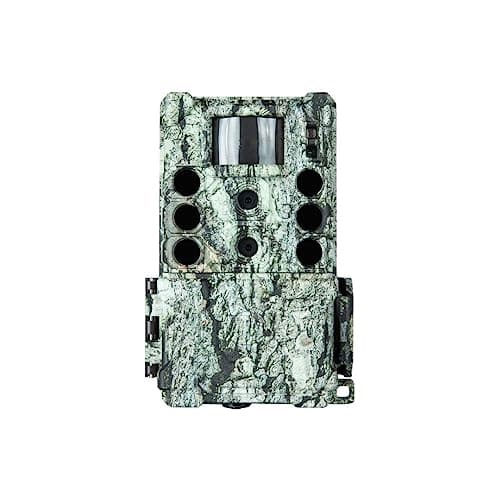
Bushnell CORE DS-4K No Glow
SD / Wi-Fi8.7/10Separate day and night sensors and 120 ft of no-glow range: the clearest example of solving night image quality with hardware instead of megapixels.
$159.99Amazon#ad · Price as of October 11, 2026 · Disclosure for the link to Bushnell CORE DS-4K No Glow
Best no-glow cellular camera
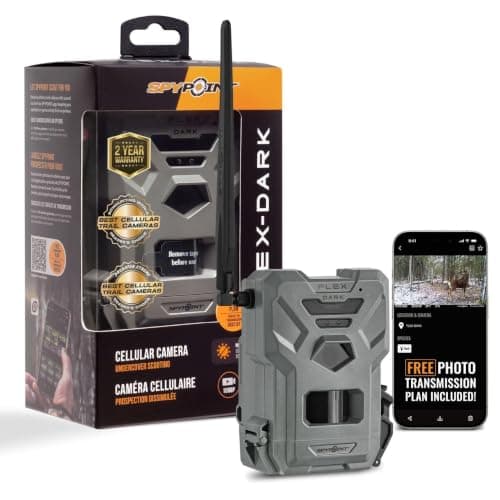
Spypoint Flex-Dark
Spypoint8.4/10Both low-glow and no-glow emitters in one housing, and first place in Trailcampro's 2026 cellular flash-range shootout. What it detects, it lights.
$98.00Amazon#ad · Price as of October 11, 2026 · Disclosure for the link to Spypoint Flex-Dark
- GardeProNo image
Best budget non-cellular camera
GardePro T5NG
SD / Wi-Fi8.5/10The camera with the most useful measured numbers in our registry: 110 ft of detection at a 55-degree angle and 31.1 months of photo-mode runtime.
Check price · Amazon#ad · Price as of October 11, 2026 · Disclosure for the link to GardePro T5NG
Best cheap multi-carrier camera
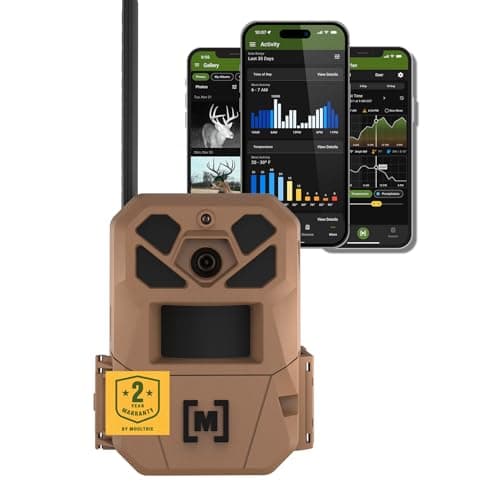
Moultrie Edge 3
Moultrie Mobile6.4/10Built-in memory and no SD card at all, with Auto Connect across four networks. The cellular wake cycle with the card step deleted.
$66.49Amazon#ad · Price as of October 11, 2026 · Disclosure for the link to Moultrie Edge 3
How we scored this
The research behind these picks
Every pick here is built from documented evidence: the maker's published trigger speed, flash type, battery configuration and detection range; each brand's plan tiers verified on its own plan page and turned into the real monthly cost at one and four cameras; the independent shootouts (Trailcampro, Outdoor Life, Field & Stream, TechGearLab) cited by name for the measurements they published; and a public rubric applied the same way to every model. Every figure links to where it came from, so you can check our work in one click.
Scores are editorial judgments from that documented research. Commissions never set a score or decide a pick. The rubric and its weights are published.
Questions
Frequently asked
How do trail cameras work at night?
They light the scene themselves with an array of infrared LEDs and record the reflected infrared. Because infrared carries no color information the sensor can separate, the resulting frame is monochrome. Flash range, not resolution, decides how far into the dark the camera can usefully see.
How does a trail camera know something is there?
A passive infrared sensor divides its view into zones and watches for a fast change in infrared energy between them. A warm animal crossing between zones produces that change. The sensor reads heat movement, not shapes, which is why it also fires on sunlit vegetation.
Can animals see trail camera infrared?
An 850nm array is visibly red to a person and is generally assumed to be noticeable to animals at close range. A 940nm array is effectively invisible to a human eye. Either way, the strongest practical reason to choose no-glow is people walking past the camera rather than deer.
Why are my trail camera night pictures black?
Almost always because the infrared array did not have the current to fire at full power. The flash is the biggest draw in the camera, and cells that read partly charged at rest often cannot sustain it, especially in cold weather. Replace with lithium AA cells before suspecting the camera.
What is the difference between a trail camera and a cellular trail camera?
Only the modem. A cellular camera is an ordinary trail camera that also uploads images over LTE, which costs battery life, makes signal strength a performance factor, and adds a monthly plan. Everything about how it detects and photographs is identical.
Keep reading
Related on Cam & Canopy
- Trigger speed explainedThe wake cycle, measured.
- Detection range explainedThe shape of the detection fan.
- No-glow vs low-glow850nm against 940nm, and who notices.
- Not taking night picturesWhen the night half of this page stops working.
- How to set up a trail cameraPutting all of this on a tree.
- Are cellular trail cameras worth it?What the modem costs you, and buys you.
Receipts
Sources
- Bushnell — CORE DS-4K No Glow product page (checked 2026-09-21)
- Spypoint — FLEX-DARK product page (checked 2026-09-21)
- Trailcampro — 2026 Trail Camera Shootout results (checked 2026-09-21)
- Trailcampro — GardePro T5NG review, measured figures (checked 2026-09-21)
- Moultrie — EDGE 3 product page (checked 2026-09-21)
- Moultrie Mobile — plans page (checked 2026-09-21)
- Stealth Cam — Deceptor Max 3.0 product page (checked 2026-09-21)
- Energizer — Ultimate Lithium AA product page (checked 2026-09-21)
Every number above is traceable: specs come from the maker's own product pages (linked on every product), plan prices from the maker's plan page with an “as of” date, and independent measurements are attributed to whoever made them. Amazon prices change often, so every buy button takes you to Amazon's current price for that listing. Read the full method.