Trail Cameras · Guide
Trail camera megapixels: why the big number on the box is not a sensor
Trail cameras advertise 32, 46, 50, 58 and 64 megapixels. Almost none of them capture that many pixels. The number is produced in software after the fact, and the specs that actually decide whether you can identify a deer at sixty feet are somewhere else on the sheet.
By Mike M.Updated Spec-checked · every figure sourced
#adReader-supported: we may earn a commission if you buy through our links, at no extra cost to you. It never decides a ranking. How we rank · Disclosure
What a megapixel figure measures
A megapixel is one million pixels in the finished image file. On a phone or a mirrorless camera that figure usually corresponds to the number of photosites on the sensor, so more megapixels genuinely means more captured detail. On a trail camera it usually does not.
Trail camera sensors are small, cheap and optimized for sensitivity rather than resolution, because the hardest job they have is making a usable frame by infrared light at sixty feet. A typical trail camera sensor captures something in the range of 2 to 8 real megapixels. The camera then runs that capture through an upscaler and writes a file at 32, 46 or 64 megapixels, because that is the number that sells the camera on a shelf.
Upscaling is not fraud and it is not useless — a larger file can print bigger and crop without visible pixel edges. But it cannot invent detail that the lens and sensor did not resolve. If a deer's ear tag is unreadable in the 5MP capture, it is unreadable in the 64MP file, only larger and softer.
Interpolation, and how to spot it
Three signals tell you a figure is interpolated. The first is language: “up to,” “maximum,” or a list of selectable sizes such as 32MP / 16MP / 8MP / 4MP. A sensor has one native resolution; a menu of four is a software scaler.
The second is arithmetic. A sensor's native resolution and its video resolution usually track each other, because they share the same readout. A camera that advertises 64MP stills but records 1080p video is capturing roughly two megapixels per video frame. The stills are not thirty times sharper than the video.
The third is an independent reviewer saying so. Trailcampro labels the GardePro T5NG's 32MP, the T5NG Pro's 48MP, the GardePro A60's 64MP, the Alpha Cam's 32MP and the Bushnell CelluCORE's 20MP figures as interpolated. Moultrie describes its own 50MP figure the same way. When a maker and a reviewer agree the number is synthetic, it is settled.
The claimed figures, compared
| Camera | Claimed stills | Video | What the claim is |
|---|---|---|---|
| Bushnell CORE DS-4K No Glow | Up to 32MP | 4K | Dual sensors, one tuned for day and one for night; the honest route to a sharper frame |
| Stealth Cam Spectre 4K Pro | Up to 58MP | 4K at 30 fps | Separate day and night sensors; the 58MP figure is a maximum output size |
| Alpha Cam Dual Lens No Glow | 32MP claimed, 30MP on the brand's own listing | 1080p at 30 fps | Interpolated per Trailcampro; a second lens dedicated to night does the real work |
| GardePro A60 4K | 64MP | 4K | Interpolated per Trailcampro; the Sony Starvis sensor behind it is the useful part |
| Moultrie Edge 3 Pro | 50MP | 1440p | Interpolated, as Moultrie states; 1440p video is the genuine upgrade over its siblings |
Read that table top to bottom and the pattern is clear: the two cameras with the lowest claimed megapixel counts are the two with the best imaging hardware. The sensor arrangement and the video spec tell you more than the headline number does.
The four specs that actually matter
A separate night sensor. This is the single biggest difference in trail camera image quality. One sensor has to compromise between daylight color and infrared sensitivity; two sensors do not. Bushnell calls it DS, Stealth Cam calls it separate day and night capture, Alpha Cam uses a second lens. All three are describing the same advantage.
Flash range. A photo is only as good as the light in it. A camera with 130 ft of illumination produces a usable frame of an animal at eighty feet; a camera with 80 ft of flash produces a dark silhouette at the same distance no matter what the sensor claims. This is why our night-image ranking leans on flash-range results rather than resolution: best trail camera for night pictures.
Trigger and recovery speed. A sharp photo of an empty trail is worth nothing. The fastest cameras in our registry publish 0.15 to 0.3 s triggers, and the slowest measured over 0.7 s. See trigger speed explained.
Video resolution, if you shoot video. Unlike stills, video resolution is hard to fake: 4K at 30 fps is a real readout requirement. It is also the most expensive mode in battery terms. The cameras worth buying for motion are in best trail cameras for video, and the 4K question specifically in best 4K trail cameras.
Cameras where the picture is the point
Our picks for this
Four cameras chosen on sensor arrangement rather than megapixel claims
Three of these have a dedicated night imager. The fourth has the biggest claimed number on this page and is here as the honest budget option, not as the sharpest.
Best non-cellular trail camera
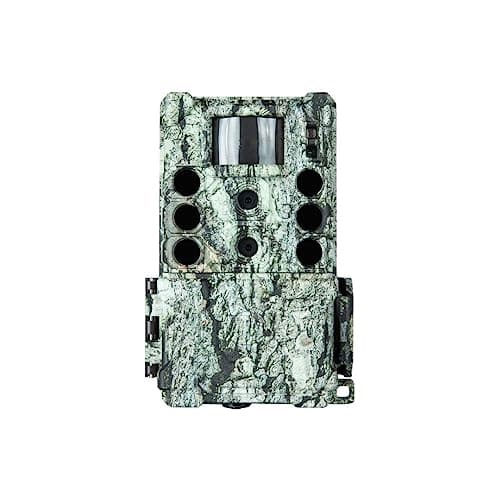
Bushnell CORE DS-4K No Glow
SD / Wi-Fi8.7/10Dual sensors, 120 ft of no-glow night range and a 0.15 s trigger. The lowest claimed resolution here and the best imaging hardware.
$159.99Amazon#ad · Price as of October 12, 2026 · Disclosure for the link to Bushnell CORE DS-4K No Glow
Best Stealth Cam cellular camera
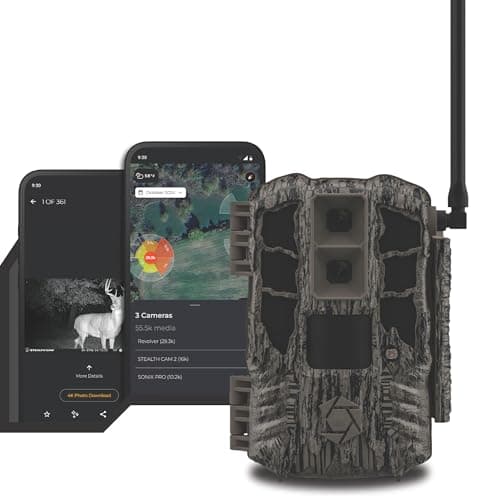
Stealth Cam Spectre 4K Pro
Stealth Cam Command7.7/10Separate day and night sensors with 4K at 30 fps. Trailcampro scored it 88/100, the best of any Stealth Cam.
$149.58Amazon#ad · Price as of October 12, 2026 · Disclosure for the link to Stealth Cam Spectre 4K Pro
Best dual-lens value
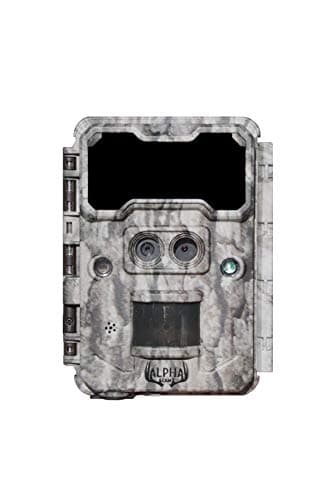
Alpha Cam Dual Lens No Glow
SD / Wi-Fi8.5/10A second lens dedicated to night, 29 months of measured photo runtime, and 86/100 at Trailcampro for about half the Bushnell's price.
$119.95Amazon#ad · Price as of October 12, 2026 · Disclosure for the link to Alpha Cam Dual Lens No Glow
Best budget 4K camera
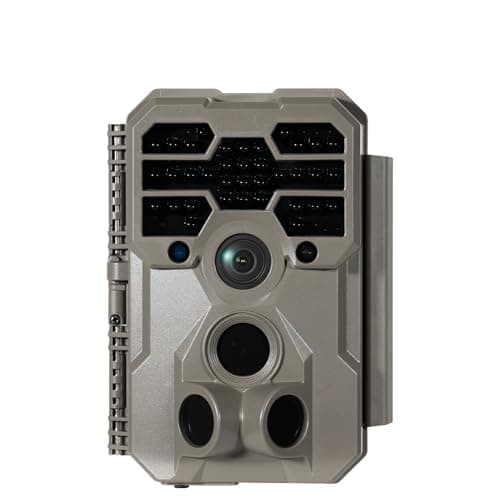
GardePro A60 4K
SD / Wi-Fi7.8/10A 64MP claim on a Sony Starvis sensor with 4K video and a 2.4-inch screen. Good value; not thirty-two times sharper than a 2MP frame.
$109.99Amazon#ad · Price as of October 12, 2026 · Disclosure for the link to GardePro A60 4K
What resolution to actually shoot
On a card camera, shoot the middle setting. The largest option gives you bigger files that fill the card faster with no extra detail; the smallest throws away real capture. If the camera offers 32 / 16 / 8 / 4, choose 16. You will fit far more images on the card, the camera writes faster between frames, and the picture will look the same.
On a cellular camera, shoot the smallest setting that lets you identify what you need to identify, and request a full-resolution original only for the frames you care about. Most apps support that, and it is the cheapest way to protect both battery life and a photo allowance. The plan side of that argument is in cellular trail camera plans compared.
And if the complaint that brought you here is that your night photos are blurry rather than small, resolution is not the problem at all. Blur at night is motion during a long flash exposure, and the fix is a closer set, a faster camera or a brighter flash — start with not taking night pictures and detection range.
How we scored this
The research behind these picks
Every pick here is built from documented evidence: the maker's published trigger speed, flash type, battery configuration and detection range; each brand's plan tiers verified on its own plan page and turned into the real monthly cost at one and four cameras; the independent shootouts (Trailcampro, Outdoor Life, Field & Stream, TechGearLab) cited by name for the measurements they published; and a public rubric applied the same way to every model. Every figure links to where it came from, so you can check our work in one click.
Scores are editorial judgments from that documented research. Commissions never set a score or decide a pick. The rubric and its weights are published.
Questions
Frequently asked
How many megapixels does a trail camera need?
Far fewer than the box advertises. Any camera capturing a genuine 4 to 8 megapixels produces an image you can identify a deer in at sixty feet, provided the flash reaches that far. Spend the money on flash range, trigger speed and a dedicated night sensor instead.
What does interpolated megapixels mean on a trail camera?
It means the camera captures a smaller image and software scales it up to the advertised size. The file gets bigger; the detail does not. Trailcampro labels the 32MP, 48MP and 64MP claims on several popular cameras as interpolated, and Moultrie states the same about its own 50MP figure.
Is a 64MP trail camera better than a 32MP one?
Not reliably. In our registry the camera with the best imaging hardware — the Bushnell CORE DS-4K, with dual sensors and 120 ft of no-glow range — claims only 32MP, while a 64MP claim appears on a budget camera recording the same sensor through an upscaler. Compare sensor arrangement and flash range instead.
What is the highest resolution trail camera?
By claimed stills, the Stealth Cam Spectre 4K Pro at up to 58MP and the GardePro A60 at 64MP are the highest figures we rank. By real captured resolution, the cameras that record 4K video at 30 fps — the Spectre, the Bushnell CORE bodies and the Stealth Cam DS4K Ultimate — are doing the most actual work.
Does higher resolution use more battery on a trail camera?
Yes, modestly on a card camera and substantially on a cellular one, because a larger file takes longer to upload and the radio is the biggest draw in the housing. Several brands default to a reduced upload size for exactly that reason.
Keep reading
Related on Cam & Canopy
- Best 4K trail camerasWhere video resolution is a real spec rather than an upscale.
- Best trail camera for night picturesThe ranking that uses flash range instead of megapixels.
- Trigger speed explainedThe spec that decides whether the animal is in the frame.
- Detection range explainedWhy angle matters more than distance.
- Best trail cameras for videoIf motion is what you are after.
- Trail camera SD card guideCard size and speed, now that you know file size matters.
Receipts
Sources
- Bushnell — CORE DS-4K No Glow product page (checked 2026-09-21)
- Stealth Cam — Spectre 4K Pro product page (checked 2026-09-26)
- Trailcampro — Alpha Cam Dual Lens No Glow review, measured figures, score and stock (checked 2026-09-28)
- Alpha Cam — brand's own Amazon listing, published specifications (checked 2026-10-03)
- GardePro — A60 4K product page (checked 2026-09-21)
- Trailcampro — GardePro T5NG review, measured figures (checked 2026-09-21)
- Trailcampro — GardePro T5NG Pro review, measured figures, score and stock (checked 2026-09-28)
- Trailcampro — Bushnell CelluCORE 20 Solar review, measured figures (checked 2026-09-21)
- Moultrie — EDGE 3 PRO product page (checked 2026-09-21)
- GardePro — X66 3.0 Ultra product page (checked 2026-09-21)
Every number above is traceable: specs come from the maker's own product pages (linked on every product), plan prices from the maker's plan page with an “as of” date, and independent measurements are attributed to whoever made them. Amazon prices change often, so every buy button takes you to Amazon's current price for that listing. Read the full method.