Cellular Trail Cameras · The rankings
Best trail cameras for remote areas: four failure modes, not one spec sheet
A remote camera has four ways to let you down. The signal is marginal, the batteries die between visits, nobody notices for two months, and somebody else finds it first. Every pick here is chosen against one of those, and the solar ones fix two at once.
By Mike M.Updated Spec-checked · every figure sourced
#adReader-supported: we may earn a commission if you buy through our links, at no extra cost to you. It never decides a ranking. How we rank · Disclosure
Quick picks
The rankings at a glance
| # | Product | Best for | Score | Price |
|---|---|---|---|---|
| 1 | 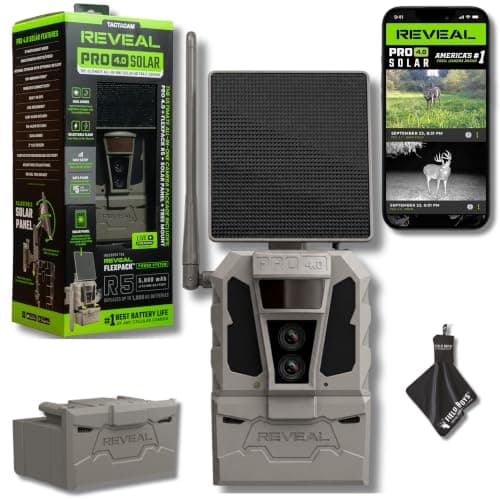 Tactacam Reveal Pro 4.0 Solar An all-in-one solar system with a 5,000 mAh FlexPack and a 12 AA backup bay, so it survives a bad panel week without a visit. Auto-carrier selection, 4K stills, built-in GPS tracking, and in stock at $199.99 at Tactacam when we checked. | Best trail camera for remote areasTactacam Reveal | 7.7 /10 | $199.99Amazon |
| 2 | 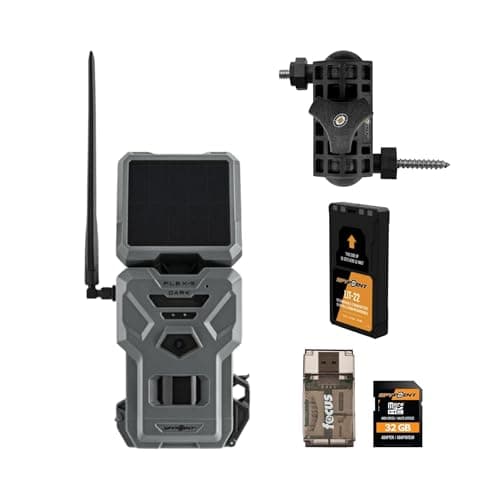 Spypoint Flex-S-Dark Integrated solar plus a genuinely free 100-photo tier. On a remote set you check twice a year, 100 photos a month for nothing is often exactly the right allowance, and dual-SIM hardware gives the signal two chances. 89/100 at Trailcampro. | Best remote camera with no monthly feeSpypoint | 8.8 /10 | $219.99Amazon |
| 3 | 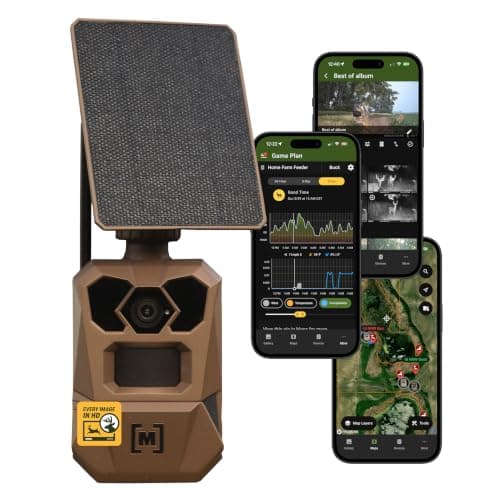 Moultrie Edge 4 Solar Built-in solar panel and a rechargeable lithium pack, no AA bay, IP67 sealing and built-in memory, so there is no card and no battery tray to fail. 'All 4 Major Networks' and in stock at $169.99. There is no free plan tier. | Best remote camera with no batteries at allMoultrie Mobile | 7.3 /10 | $153.24Amazon |
| 4 | No image GardePro T5NG Trailcampro's 91/100 with a 31-month photo-mode battery estimate on lithium AAs, for under $100. Where no carrier reaches, this is the camera that runs two full seasons between visits and costs nothing per month to do it. | Best for a genuine dead zoneSD / Wi-Fi | 8.5 /10 | Check price · Amazon |
| 5 | 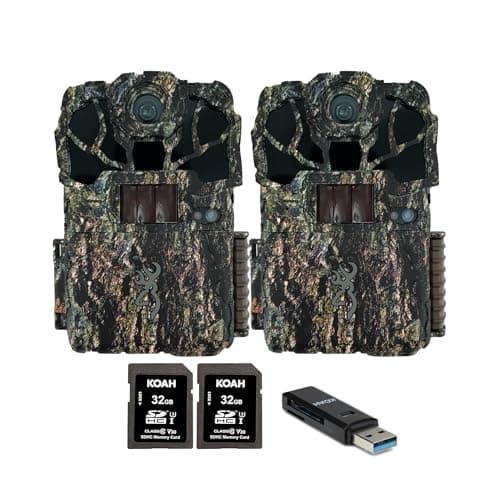 Browning Spec Ops Elite HP5 Ultra Invisible IR to 100 ft with an adjustable 0.1 to 0.7 s trigger and no radio, no SIM and no app to give away. On remote public ground, the camera that emits nothing is the camera that is still there in December. | Best remote camera nobody will findSD / Wi-Fi | 8.4 /10 | $389.99Amazon |
#ad · Prices come live from Amazon, last checked October 11, 2026. Scores are ours, built from published specs, verified plan prices and cited independent tests, not our own field measurements. Row photos are Amazon's own product images where a listing supplies one, and a blank panel where the maker sells elsewhere and supplies none. Tap a row for the full write-up.
The four ways a remote camera fails
Remote is not a spec, so no spec sheet addresses it. What "remote" means practically is that the consequences of every ordinary failure get multiplied by how long it takes you to notice. Four things go wrong, and they go wrong in a predictable order.
- The signal is marginal rather than absent. This is the worst case, not the best one. A camera with one bar connects, retries, drains its batteries doing it, and delivers half the photos late. A camera with no bars at least fails honestly and writes to the card.
- The batteries die between visits. Every published battery figure assumes photo mode, mild weather and a decent signal. Remove any of those and the real number drops hard: Trailcampro measured the same camera at 11 months of photos and 4.6 months of video, and cold knocks another chunk off alkaline capacity.
- Nobody notices for two months. A card that filled in week three, a strap that slipped, a lens a spider covered. On a set you walk past weekly this is a five-minute fix. On a set you visit in April and October it is half a year of nothing.
- Somebody else finds it first. Remote and unwatched are the same thing. A visible flash, a bright strap and a camera at eye height on a trail are an advertisement, and on public ground the finder may not be a thief so much as a person who resents the camera.
Notice that only the first of those is about cellular. The other three are the same problems an SD camera has, which is why two of the five picks below have no radio at all. If the honest answer at your set is "no carrier reaches here", a cellular camera is a very expensive SD camera with a subscription attached.
How we ranked them
Cellular cameras on the six-metric rubric and SD cameras on the five-metric one, both at how we rank, weighted for a set you cannot visit often:
- Battery and solar life, read first. Integrated solar with a backup battery bay is the strongest arrangement, because it survives a fortnight of cloud without a visit. A measured multi-month battery figure comes next. A maker's unmeasured claim counts least.
- Network behavior. Dual SIM or a four-network claim beats an unnamed auto-selection, because a remote set has no second chances. Whether the camera accepts a screw-on external antenna matters as much as the radio itself.
- Night image quality. 940nm no-glow anywhere people might walk, which on remote public ground is more places than you think.
- Real monthly plan cost. A remote camera taking 40 photos a month does not need an unlimited tier. Spypoint's free 100-photo plan is arguably the single best feature in this whole category for a remote set; see no monthly fee.
- Trigger, detection and value. The ordinary axes, applied last, because a fast camera that is flat in October has failed.
Every figure below links to the maker's page or Trailcampro's published measurements, with the date we read it. Stock was checked at each maker and at Trailcampro on 2026-09-26.
The five, on power and signal
| Evidence | GardePro T5NG | Browning Spec Ops Elite HP5 Ultra |
|---|---|---|
| Batteries | 8 AA; Trailcampro estimates 31.1 months in photo mode on Energizer Ultimate Lithium | 8 AA (alkaline, rechargeable or lithium) |
| External power | — | 12-volt external power jack |
| Trigger speed | 0.54 s photo / 0.85 s video, as measured by Trailcampro | Adjustable 0.1 to 0.7 s |
| Recovery time | 1.4 s photo / 2.4 s video, as measured by Trailcampro | 0.5 s |
| Flash | No glow IR; GardePro T5NG Pro won Trailcampro's 2026 non-cellular flash-range shootout | Invisible 'night vision' infrared LEDs |
| Flash range | — | 100 ft |
| Detection range | 110 ft at a 55° detection angle (48.2° field of view), per Trailcampro | Adjustable, up to 80 ft |
| Video | 1920x1080 | 1440p with sound, 5 s to 2 min |
| Score | 8.5/10 | 8.4/10 |
Pick by which failure you're solving
| The problem | Buy | Because |
|---|---|---|
| Six months between visits, signal is usable | Tactacam Reveal Pro 4.0 Solar | Solar plus a 5,000 mAh pack plus a 12 AA backup bay: three layers of power, not one |
| Remote set, and you refuse to pay monthly | Spypoint Flex-S-Dark | Integrated solar and a free 100-photo tier; dual SIM gives a marginal signal two chances |
| You want nothing to fail: no AAs, no card | Moultrie Edge 4 Solar | Built-in panel and lithium pack, built-in memory, IP67 sealing, all four major networks |
| Genuine dead zone, two seasons between visits | GardePro T5NG | Trailcampro's 31-month photo-mode estimate on lithium AAs, 91/100, under $100 |
| Remote public ground where cameras disappear | Browning Spec Ops Elite HP5 Ultra | Invisible IR, no radio, no SIM, nothing that announces itself; adjustable 0.1 s trigger |
| One bar, and the camera keeps going quiet | Any of the above plus a booster antenna | An antenna raises a weak signal for $50; see the antenna ranking |
Our recommendation for each buyer; specs and stock as of 2026-09-26. Prices are set by the seller and change; the buy buttons go to a tagged Amazon search for each model, not to a price we've cached.
Signal: check before you buy, fix with an antenna
Walk to the tree with a phone before you spend anything, and read the bars at camera height against the trunk rather than at head height in the open. Then look at the carrier's own coverage map zoomed to the field rather than the town, because rural coverage changes over a few hundred yards. If you can, compare two phones on different networks: a dual-SIM or four-network camera will take the better one, which tells you whether multi-network hardware is worth paying for here. Our Verizon and AT&T pages walk that check in detail, including the awkward truth that no volume brand lets you choose the carrier.
For a set that has one bar rather than none, an external antenna is the best value fix available. HME's passive booster is $49.99 with a 6 ft armored cable and states support for Verizon and AT&T networks; Herd360's directional unit publishes 10 to 12 dBi on 15 ft of coax and fits any camera with a screw-on antenna connector. The limit is honest and worth repeating: an antenna raises a weak signal and does not create one. In a true dead zone, nothing helps but a card. The booster antenna ranking has the compatibility detail, and best cellular camera for low signal ranks the cameras built for it.
Power: the visit interval sets the budget
Work out how often you will genuinely walk in, then buy power for one and a half times that interval. Three arrangements, in ascending order of how remote the set is:
- Lithium AAs only. Right for an SD camera on a quarterly visit. Trailcampro's 31-month photo-mode estimate for the T5NG is measured on Energizer Ultimate Lithium, and that is not a typo; a low-power SD camera in photo mode barely draws anything. Alkalines will not do this, especially below freezing. See battery ranking and cold weather.
- Integrated solar plus a backup bay. Right for a cellular camera on a six-month interval. The Reveal Pro 4.0 Solar's combination of panel, 5,000 mAh FlexPack and 12 AA bay is the belt-and-braces version; the Flex-S-Dark and Edge 4 Solar rely on the panel and their internal pack.
- A separate panel or a 12V box. Right when the camera you want has no integrated panel, or when the site is shaded and you need to put the panel somewhere the camera is not. Fit matters and is brand-specific: our solar panel, battery pack and 12V box rankings cover what plugs into what.
The point of that table on a remote-areas page is the second line. A camera you visit twice a year usually is not producing thousands of photos a month, because there is nobody walking the trail and nothing feeding at a plot. Spypoint's free tier covers a surprising number of genuinely remote sets, which makes the Flex-S-Dark the cheapest camera here to own over five years despite not being the cheapest to buy. Full totals in plans for multiple cameras.
Theft, and the camera that emits nothing
The further a camera is from anyone who cares about it, the more the theft calculation matters, and remote ground reverses the usual advice. On private land you control, a cellular camera is safer than an SD camera because you see the thief's photograph. On remote public ground, a cellular camera is a $200 box with a SIM in it that has to sit somewhere with sky visible, which is also somewhere visible to people.
One genuine advantage of the top pick here: Tactacam publishes built-in GPS tracking on the Reveal Pro 4.0 Solar, so a camera that walks off is at least locatable. Moultrie publishes GPS pinning on the Edge line too. Neither will get your camera back on its own, but both beat an SD camera's total silence.
In detail
The picks, in full
Rank 1
Best trail camera for remote areas
Tactacam Reveal Pro 4.0 Solar
An all-in-one solar system with a 5,000 mAh FlexPack and a 12 AA backup bay, so it survives a bad panel week without a visit. Auto-carrier selection, 4K stills, built-in GPS tracking, and in stock at $199.99 at Tactacam when we checked.
Spec sheetSpec-checked · sources linked
| Plan ecosystem | Tactacam Reveal. The plan decides the running cost; see the plan explainer linked on this page. |
|---|---|
| Network | LTE, major cellular networks |
| Plan | Starter $5/mo ($55/yr) to Pro $13/mo ($120/yr) unlimited; Live View add-on $6/mo or $72/yr per camera |
| Flash | Selectable No-Glow or Low-Glow IR |
| Flash range | Low glow 96 ft; no glow 80 ft |
| Photo resolution | 4K photo modes |
| Video | 1080p; Live View Mode, additional subscription required |
| Batteries | 12 AA tray (not included) as backup power |
| External power | DC 12V-2A input |
| Solar | Integrated 'All-in-One Solar Power System' with a rechargeable FlexPack R5 (5,000 mAh); Tactacam publishes no panel wattage |
| App features | Built-in GPS tracking, On-Demand requests, Live View Mode |
| Storage | 8GB internal, optional SD card slot |
| Warranty | 1 year from activation date |
How the 7.7 score breaks down
- Trigger speed & recovery (20%)
- 6
- Night image quality (20%)
- 8
- Battery & solar life (20%)
- 10
- Real monthly plan cost (20%)
- 8
- Detection range & field of view (10%)
- 6
- App, setup & reliability (10%)
- 7
What the spec sheet supports
- Four power routes on one camera: panel, 5,000 mAh FlexPack, 12 AA tray and a 12V jack
- Selectable no-glow or low-glow, like the Pro 4.0
- Live View sessions drain the pack instead of a set of AAs you have to hike in and replace
- Listed in stock at Tactacam at $199.99 when we checked
Where it falls short
- Tactacam publishes no panel wattage, no trigger speed and no detection figure for this SKU
- No independent measurements exist for the Solar body yet; the Pro 4.0's measured 11.0 s recovery is the closest proxy
- A body-mounted panel only charges where the camera faces the sun
- The most expensive Reveal on this page before you add the $6/mo Live View
Skip this if…
…your set is under closed canopy; an aimable panel on a standard Pro 4.0 collects more sun than a panel bolted to a camera pointed at a shaded trail.
#ad · Price as of October 11, 2026 · Disclosure for the link to Tactacam Reveal Pro 4.0 Solar
Rank 2
Best remote camera with no monthly fee
Spypoint Flex-S-Dark
Integrated solar plus a genuinely free 100-photo tier. On a remote set you check twice a year, 100 photos a month for nothing is often exactly the right allowance, and dual-SIM hardware gives the signal two chances. 89/100 at Trailcampro.
Spec sheetSpec-checked · sources linked
| Plan ecosystem | Spypoint. The plan decides the running cost; see the plan explainer linked on this page. |
|---|---|
| Network | Dual-SIM, automatically connects to all major carriers |
| Plan | Free 100 photos/mo; Basic $5 ($4 annual); Standard $10 ($7); Premium unlimited $15 ($10); one plan per camera |
| Trigger speed | 0.3 s |
| Detection range | 100 ft |
| Flash | Low-glow and no-glow LEDs |
| Flash range | 100 ft; sixth overall in Trailcampro's 2026 flash-range shootout |
| Photo resolution | 40MP |
| Video | 1080p; livestreaming video (Spypoint lists it as coming spring 2026) |
| Solar | Built-in solar panel and battery; 'replaces up to 1,000 AA batteries' (maker claim) |
| App features | GPS locator on the in-app map, remote activation, over-the-air updates |
| Warranty | 2 years |
How the 8.8 score breaks down
- Trigger speed & recovery (20%)
- 8
- Night image quality (20%)
- 9
- Battery & solar life (20%)
- 9
- Real monthly plan cost (20%)
- 10
- Detection range & field of view (10%)
- 8
- App, setup & reliability (10%)
- 8
What the spec sheet supports
- Integrated solar with no cable to route or panel to aim
- Same 0.3 s / 100 ft / dual-LED spec as the Flex-Dark
- Free 100-photo tier; $10/mo annual unlimited
- $149.99 at Spypoint, under the Moultrie Edge 4 Solar
Where it falls short
- A camera-mounted panel only works where the camera faces the sun; shaded sets still starve
- No published recovery time or battery capacity figure
- Fits CAMLOCKbox box 11, a different box from the Flex-Dark, so boxes don't swap
- Out of stock at Spypoint on 2026-10-09; Trailcampro had it at $169.95 and Amazon stock was marked up well above list
Skip this if…
…your sets are in deep timber with no direct sun; a separate 10W panel you can aim (SPLB-22) beats a built-in one there.
#ad · Price as of October 11, 2026 · Disclosure for the link to Spypoint Flex-S-Dark
Rank 3
Best remote camera with no batteries at all
Moultrie Edge 4 Solar
Built-in solar panel and a rechargeable lithium pack, no AA bay, IP67 sealing and built-in memory, so there is no card and no battery tray to fail. 'All 4 Major Networks' and in stock at $169.99. There is no free plan tier.
Spec sheetSpec-checked · sources linked
| Plan ecosystem | Moultrie Mobile. The plan decides the running cost; see the plan explainer linked on this page. |
|---|---|
| Network | Major US networks |
| Plan | Standard $8.99/mo per camera; Unlimited $12.99/mo per camera |
| Trigger speed | 0.40 s |
| Detection range | 100 ft |
| Flash | Low-glow |
| Flash range | 100 ft |
| Photo resolution | 40MP |
| Video | 1080p FHD |
| External power | USB-C |
| Solar | Built-in solar panel; rechargeable lithium battery included; no AA batteries required |
| App features | GPS, Moultrie AI, Buck Shot, on-demand, Live Aim; 50° field of view |
| Storage | Built-in memory, no SD card required |
How the 7.3 score breaks down
- Trigger speed & recovery (20%)
- 7
- Night image quality (20%)
- 6
- Battery & solar life (20%)
- 9
- Real monthly plan cost (20%)
- 6
- Detection range & field of view (10%)
- 8
- App, setup & reliability (10%)
- 9
What the spec sheet supports
- Every Edge 4 feature (GPS, Buck Shot, Live Aim) with the panel built in
- Rechargeable lithium included, no AAs
- USB-C backup input
Where it falls short
- $169.99: $40 more than the Spypoint Flex-S-Dark, which is no-glow and 0.3 s
- Low-glow only
- Moultrie publishes no battery capacity for this model
Skip this if…
…you'd trade Buck Shot for no-glow and a faster trigger; the Flex-S-Dark wins on the woods axes and on plan cost.
#ad · Price as of October 11, 2026 · Disclosure for the link to Moultrie Edge 4 Solar
Rank 4
Best for a genuine dead zone
GardePro T5NG
Trailcampro's 91/100 with a 31-month photo-mode battery estimate on lithium AAs, for under $100. Where no carrier reaches, this is the camera that runs two full seasons between visits and costs nothing per month to do it.
Spec sheetSpec-checked · sources linked
How the 8.5 score breaks down
- Trigger speed & recovery (25%)
- 6
- Night image quality (25%)
- 9
- Battery life (20%)
- 10
- Detection range & field of view (15%)
- 9
- Ease of use & value (15%)
- 9
What the spec sheet supports
- Trailcampro scored it 91/100 and called the picture quality best in class
- 110 ft detection with a wide 55° detection angle
- Extraordinary battery estimate in photo mode
- $89.95 at Trailcampro when checked
Where it falls short
- 0.54 s trigger is fine for scrapes and feeders, slow for a crossing
- Video mode cuts the battery estimate to 5.7 months
- Trailcampro notes iPhone users must use the Files app to view photos
Skip this if…
…you need sub-0.3 s at a pinch point; buy the Browning Strike Force Pro X instead.
#ad · Price as of October 11, 2026 · Disclosure for the link to GardePro T5NG
Rank 5
Best remote camera nobody will find
Browning Spec Ops Elite HP5 Ultra
Invisible IR to 100 ft with an adjustable 0.1 to 0.7 s trigger and no radio, no SIM and no app to give away. On remote public ground, the camera that emits nothing is the camera that is still there in December.
Spec sheetSpec-checked · sources linked
| Category | SD / Wi-Fi |
|---|---|
| Trigger speed | Adjustable 0.1 to 0.7 s |
| Recovery time | 0.5 s |
| Detection range | Adjustable, up to 80 ft |
| Flash | Invisible 'night vision' infrared LEDs |
| Flash range | 100 ft |
| Photo resolution | 46MP |
| Video | 1440p with sound, 5 s to 2 min |
| Batteries | 8 AA (alkaline, rechargeable or lithium) |
| External power | 12-volt external power jack |
| App features | 2-inch color viewing screen |
| Storage | Up to 512GB SDXC |
How the 8.4 score breaks down
- Trigger speed & recovery (25%)
- 9
- Night image quality (25%)
- 9
- Battery life (20%)
- 8
- Detection range & field of view (15%)
- 7
- Ease of use & value (15%)
- 8
What the spec sheet supports
- Trigger speed and detection range are both adjustable, so you can tune a set instead of living with it
- Invisible IR to 100 ft
- 1440p video and a 2-inch screen
- Accepts rechargeable AAs by Browning's own spec
Where it falls short
- 80 ft maximum detection is shorter than the CORE DS-4K's flash reach
- $179.99 list
- SD only
Skip this if…
…you never adjust settings after the first hang; the CORE S-4K gets you no-glow 4K for $30 less.
#ad · Price as of October 11, 2026 · Disclosure for the link to Browning Spec Ops Elite HP5 Ultra
Buyer's guide: setting a camera you won't see again for months
Set it up at home, then set it up again at the tree
Activate the camera, pair the app, format the card and shoot a test photo on the kitchen table, where a problem costs you five minutes. Then do the aiming and the signal check at the tree. Half the remote-camera failures we read about are setup failures that would have been obvious in a driveway. Our setup guide has the sequence.
Clear the frame ruthlessly, because nobody is coming back to trim it
One stem of grass in front of the sensor will produce thousands of photos on a sunny, windy day, eat a plan allowance in a week and flatten the batteries. On a set you visit weekly that is an annoyance. On a remote set it is the whole season. Cut everything inside about fifteen feet of the lens, look again from the camera's eye level, and cut what you missed.
Lengthen the check-in interval and shorten everything else
On a marginal signal, four check-ins a day instead of twenty-four cuts radio time enormously with almost no loss of useful information, because you are not hunting this spot tomorrow. Turn HD uploads off, keep bursts short, and leave video alone unless video is the point. Our settings guide has the per-brand menus and not sending pictures covers the diagnosis when it still goes quiet.
Card size for the visit interval, not for the camera's maximum
An SD camera you visit twice a year needs enough card for six months of photos plus the windy week you did not plan for. A 32GB card inside the camera's stated ceiling, formatted in the camera, is the reliable answer; the biggest card the camera will take is not, because some cameras behave badly near their limit. Read the SD card guide, and keep a field viewer or reader in the truck so a two-hour drive out ends with you knowing what you got.
Two cameras on one remote set beats one camera on two
If the drive is long, the marginal cost of a second camera at the same spot is close to zero and it doubles your chance of coming home with something. Hang one cellular camera where the sky is visible and one SD camera in the shade fifty yards away, aimed differently. The cellular one tells you whether the spot is worth the trip; the SD one is the insurance and often the better photograph.
Write down what you set
Batteries fitted, date, card size, check-in interval, plan tier, GPS coordinates, which tree. Six months later you will not remember, and the difference between "the batteries were old" and "the camera has a fault" is the note you did not write. This is also the point at which trail camera software starts paying for itself, because a remote spread is exactly where photo-by-photo memory stops working.
When to give up on cellular entirely
No usable bars from any carrier at camera height, or public ground with camera restrictions, or a budget that has to cover four sets. In all three cases the SD route is better and cheaper, and the cameras are genuinely good: the non-cellular ranking and no-glow ranking are the right lists. A hub-based WiFi camera is the middle path when the set is remote from you but not from a building you own.
How we scored this
The research behind these picks
Every pick here is built from documented evidence: the maker's published trigger speed, flash type, battery configuration and detection range; each brand's plan tiers verified on its own plan page and turned into the real monthly cost at one and four cameras; the independent shootouts (Trailcampro, Outdoor Life, Field & Stream, TechGearLab) cited by name for the measurements they published; and a public rubric applied the same way to every model. Every figure links to where it came from, so you can check our work in one click.
Scores are editorial judgments from that documented research. Commissions never set a score or decide a pick. The rubric and its weights are published.
Corrections & updates
- First published. Specs read from Tactacam, Spypoint, Moultrie, GardePro, Browning and HME pages and from Trailcampro's measurements on this date; stock checked at each maker and at Trailcampro. Plan prices from lib/plans.ts, verified 2026-09-21.
Questions
Frequently asked
What is the best trail camera for a remote area?
The Tactacam Reveal Pro 4.0 Solar, if the set has usable signal: it combines a solar panel, a 5,000 mAh FlexPack R5 and a 12 AA backup bay, so a fortnight of cloud does not end the set, and it selects its own cellular carrier. It was in stock at $199.99 at Tactacam and Trailcampro listed the solar combo at the same price with an 84/100 score on 2026-09-26. In a genuine dead zone, buy the GardePro T5NG instead.
Will a cellular trail camera work with no cell service?
No. It will write photos to its card or internal memory and nothing will reach your phone, and it will spend battery retrying. That is a very expensive SD camera. Check the bars at the tree at camera height before you buy, and if the answer is nothing from any carrier, buy an SD camera with a long battery instead.
How long can a trail camera run without being checked?
On an SD camera in photo mode with lithium AAs, genuinely a long time: Trailcampro's measured estimate for the GardePro T5NG is 31.1 months, and 5.7 months in video mode. On a cellular camera it depends on signal quality and check-in frequency, which is why integrated solar matters so much; Trailcampro measured 12.4 months of photo-mode life on the non-solar Reveal Pro 4.0. Card capacity and a spider on the lens are the other two limits, and neither is on a spec sheet.
Do I need solar for a remote trail camera?
If it is cellular and you visit less than every couple of months, effectively yes. A radio on a marginal signal is the biggest hidden draw a camera has. The strongest arrangement is integrated solar plus a battery bay you can load as backup, which the Reveal Pro 4.0 Solar has; the Flex-S-Dark and Edge 4 Solar rely on the panel and an internal pack. For an SD camera on lithium AAs, solar is usually unnecessary.
How do I stop a remote trail camera being stolen?
Use a 940nm no-glow camera so there is no red dot at night, put it in a steel box with a cable so a theft takes two noisy minutes instead of thirty seconds, and hang it above eye level angled down, off the trail, on the unlovely side of the tree. The Reveal Pro 4.0 Solar's built-in GPS tracking at least makes a stolen camera locatable. And check whether trail cameras are restricted on the public land you are hunting; several states and forests limit them during seasons.
Will a booster antenna make a cellular camera work in the backcountry?
It will turn one bar into two or three, which is often the difference between half your photos and all of them. It will not create a signal where there is none. HME's passive booster is $49.99 with a 6 ft armored cable and states support for Verizon and AT&T networks; Herd360's directional unit publishes 10 to 12 dBi on 15 ft of coax. Both need a camera with a screw-on antenna connector.
Keep reading
Related on Cam & Canopy
- Best cellular camera for low signalThe cameras built for one bar.
- Best solar cellular trail camerasPower on a set you can't visit.
- Best non-cellular trail camerasFor a genuine dead zone.
- Best cellular booster antennasThe $50 fix for a marginal set.
- Keeping a camera from being stolenRemote and unwatched are the same thing.
- Best batteries for trail camerasWhy every long battery figure says lithium.
Receipts
Sources
- Tactacam — REVEAL Pro 4.0 Solar product page (checked 2026-09-24)
- Tactacam — REVEAL camera store listing, stock and list prices (checked 2026-09-24)
- Tactacam — REVEAL app plans page (checked 2026-09-21)
- Trailcampro — Tactacam Reveal Pro 4.0 review, measured figures (checked 2026-09-24)
- Spypoint — FLEX-S-DARK product page (checked 2026-09-21)
- Spypoint — photo transmission plans (checked 2026-09-21)
- Trailcampro — store search "spypoint flex", prices, scores and stock (checked 2026-09-26)
- Moultrie — EDGE 4 SOLAR product page (checked 2026-09-21)
- Moultrie Mobile — plans page (checked 2026-09-21)
- Trailcampro — GardePro T5NG review, measured figures (checked 2026-09-21)
- Browning Trail Cameras — Spec Ops Elite HP5 Ultra product page (checked 2026-09-21)
- Trailcampro — store search "browning strike force pro x", prices, scores and stock (checked 2026-09-26)
- HME Products — External Antenna Signal Booster product page (checked 2026-09-21)
- Herd360 — Universal Directional High Gain Booster Antenna product page (checked 2026-09-26)
- Trailcampro — cellular trail camera collection, prices, scores and stock (checked 2026-09-26)
Every number above is traceable: specs come from the maker's own product pages (linked on every product), plan prices from the maker's plan page with an “as of” date, and independent measurements are attributed to whoever made them. Amazon prices change often, so every buy button takes you to Amazon's current price for that listing. Read the full method.