Mounts & Security · Guide
How to hide a trail camera: from people first, then from deer
Concealment is the cheapest security layer and the one most people skip. The flash gives a camera away at night, the mount gives it away by day, and the trail you walk to it gives it away every visit. Fix those three and the camo tape is optional.
By Mike M.Updated Spec-checked, not field-tested
#adReader-supported: we may earn a commission if you buy through our links, at no extra cost to you. It never decides a ranking. How we rank · Disclosure
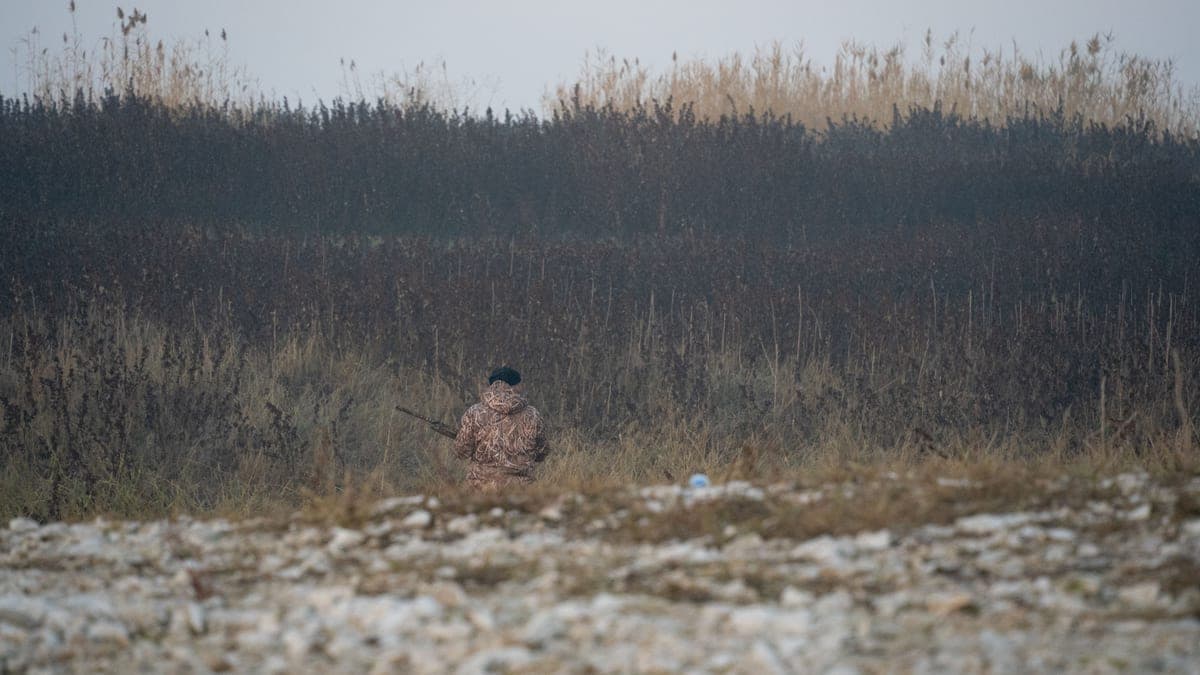
The flash is the tell
By day a well-placed camera is a dark rectangle on a dark trunk. By night a low-glow camera is a red glow every time something moves, including the person walking past. That's the single biggest reason cameras get found. No-glow (940nm) LEDs emit nothing visible. The trade is reach (Tactacam rates its low-glow X 3.0 at 96 ft and its no-glow Pro 3.0 at 80 ft), which on a concealment set is a trade worth making. Switchable cameras (Spypoint Flex-Dark, Tactacam Reveal Ultra) let you run no-glow on the sets people walk past and low-glow on the ones they don't. Details in no-glow vs low-glow.
Placement: off the human route
- Not on the two-track, the marked trail or the creek crossing people use. Twenty yards inside the edge on the deer trail is invisible to a hiker and better for pictures.
- Not facing the approach. A person walking toward a camera sees its face; walking past one mounted on the back side of a trunk, they see bark.
- Not where you'll wear a path. Your own boot trail to the camera is a signpost by mid-season. Vary the approach or set it where your normal route passes anyway.
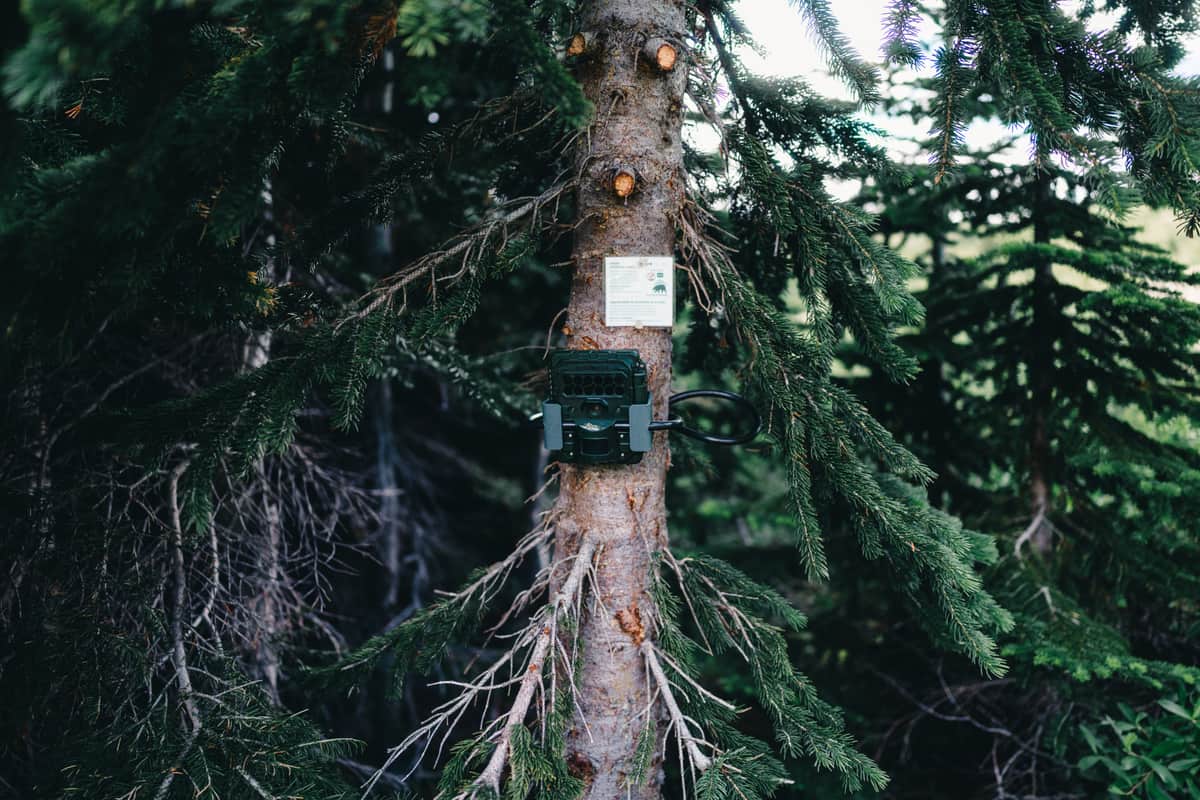
- Behind, not in front of, cover. A camera set back in a cedar or behind a deadfall, looking out through a gap, is far harder to see than one strapped to the front of an open trunk.
Mounting: back side, up high, on the right trunk
Mounts are ranked in best tree mounts; heights in trail camera height.
Cover: boxes, bark and branches
CAMLOCKbox's steel boxes ship "powder coated with a camo break-up paint applied," which breaks the rectangle better than most cameras' own housings. Beyond that, a few natural branches tucked into the strap above and beside the box, a piece of bark propped over the top edge, or a camera set into a bush with only the face clear all work. Aftermarket camo wraps and covers are fine on the body; the risk is that they migrate over the parts that must stay clear.
What never to cover
- The lens. Obviously, and yet a leaf across the top third of the lens is the most common self-inflicted blank set.
- The PIR window. The dark plastic panel below the lens is the motion sensor. Camo tape over it means no triggers.
- The IR array. Cover half the LEDs and you've halved the flash.
- The antenna. On a cellular camera, branches packed around the antenna cost signal. Browning's 2026 Defender has a folding antenna for transport; in the tree, it points up and stays clear.
- The solar panel. On an integrated-solar camera (Flex-S-Dark, Edge Solar), the panel is the battery. Hide the camera, not the panel.
Hiding it from deer
Deer notice new objects and, sometimes, low-glow flash. Hang the camera two or three weeks before you need it so the shape is old news. Mount it higher than eye level (deer look ahead and down more than up). Use no-glow on pressured bucks. And keep your scent off the set: gloves on the camera and the tree, minimal visits, and a cellular camera so you don't have to walk in for the card. The scent question is why the cellular roundup exists.
The gear
Our picks for this
Two no-glow cameras and a camo box
The Flex-Dark switches between arrays; the Pro 3.0 is no-glow with a screen for aiming from the back side of a trunk; the box is camo powder-coated steel.
 Stock photo
Best no-glow cellular camera
Spypoint Flex-Dark
Spypoint8.4/10No-glow and low-glow arrays, 0.3 s, 100 ft, free plan.
Check price · Amazon#ad · Price set by Amazon · Disclosure for the link to Spypoint Flex-Dark
- Stock photo
Best no-glow Tactacam
Tactacam Reveal Pro 3.0
Tactacam Reveal7.6/10No-glow to 80 ft with a 2-inch screen, so you can aim without a phone at an awkward angle.
Check price · Amazon#ad · Price set by Amazon · Disclosure for the link to Tactacam Reveal Pro 3.0
 Stock photo
Best security box for Spypoint Flex
CAMLOCKbox Spypoint Flex / Flex-M / Flex-Dark Security Box (Box 10)
Security box8.3/10Camo break-up powder coat; fits Flex, Flex-M and Flex-Dark (not M2).
Check price · Amazon#ad · Price set by Amazon · Disclosure for the link to CAMLOCKbox Spypoint Flex / Flex-M / Flex-Dark Security Box (Box 10)
How we scored this
Cameras we claim to have field-tested: none we don't own
Plenty of sites say they hung every camera on this list in a tree for a season. We don't say that, and we say so on every page. What we do instead: read the maker's published trigger speed, flash type, battery configuration and detection range; verify each brand's plan tiers on its own plan page and compute the real monthly cost at one and four cameras; cite the independent shootouts (Trailcampro, Outdoor Life, Field & Stream, TechGearLab) as their measurements, never ours; and score every pick on a public rubric. Every figure links to where it came from.
Scores are editorial judgments from that documented research, not lab results. Commissions never set a score or decide a pick. The rubric and its weights are published.
Questions
Frequently asked
How do you hide a trail camera from people?
No-glow flash, placement off the human route on the back side of the trunk, 8 to 10 feet up on sets people pass, a camo steel box, and a few natural branches. Never cover the lens, PIR window, IR array or antenna.
Can deer see trail cameras?
They see new objects and sometimes a low-glow flash. Hang the camera early, mount it above eye level, use no-glow on pressured deer, and keep your scent off the set.
Does camouflage tape work on a trail camera?
On the housing, it helps break the rectangle. The danger is covering the PIR window, lens edge or antenna. A camo-coated steel box does the same job with none of that risk.
How high should a trail camera be to hide it?
Eight to ten feet, angled down, on sets where people pass. Expect some loss of picture quality from the steep angle; on a gate or property line it's worth it.
Keep reading
Related on Cam & Canopy
Receipts
Sources
- Tactacam — REVEAL X 3.0 product page (checked 2026-09-21)
- Tactacam — REVEAL Pro 3.0 product page (checked 2026-09-21)
- Spypoint — FLEX-DARK product page (checked 2026-09-21)
- Tactacam — REVEAL Ultra product page (checked 2026-09-21)
- CAMLOCKbox — Tactacam Reveal X 3.0 Security Box product page (checked 2026-09-21)
- CAMLOCKbox — Spypoint box reference (checked 2026-09-21)
- HME Products — Trail Camera Holder Tree Mount product page (checked 2026-09-21)
- Browning Trail Cameras — 2026 cellular lineup announcement (checked 2026-09-21)
- Spypoint — FLEX-S-DARK product page (checked 2026-09-21)
We don't claim to have field-tested these cameras and we don't pretend to. Specs come from the maker's own product pages (linked on every product), plan prices from the maker's plan page with an “as of” date, and independent measurements are attributed to whoever made them. Amazon prices change often, so we don't print them. Where a figure isn't published, we say so. Read the full method.