Scouting · Guide
Public land trail camera strategy: check the rules, go invisible, and plan on losing one
Public ground punishes everything a private-land camera habit teaches you. The flash gets noticed, the track gets followed, the camera gets stolen, and in a growing number of places the camera is not legal to hang at all. Here is how to run cameras on it anyway.
By Mike M.Updated Spec-checked · every figure sourced
#adReader-supported: we may earn a commission if you buy through our links, at no extra cost to you. It never decides a ranking. How we rank · Disclosure
First: check whether it is legal where you are
This is the only part of this page that can get you a citation, so it goes first. Trail camera regulations on public land have changed substantially in recent years and they are not consistent between states, between agencies within a state, or between units within an agency. Restrictions in use somewhere include outright bans, bans during open hunting seasons, bans on transmitting (cellular) cameras specifically, requirements to label the camera with your name and contact details, and limits on how many you may place.
We are not going to print a state-by-state table, because a list like that is wrong within a year and being wrong here costs you a fine. Read your state wildlife agency's current regulations for the specific unit, and check the land manager too — national forest, BLM, state wildlife area, state forest and corps-of-engineers ground can all have different rules on the same drive. If a cellular ban applies, a card camera is often still permitted; if the ban is general, do not hang anything.
No-glow is not optional
On private ground, low-glow is a reasonable choice: the extra 20 to 40 ft of flash reach is free, and the only thing that might notice is a deer. On public ground, the thing that notices is a person. A faint red shine when the flash fires is a beacon that tells every other hunter walking that trail at dawn exactly where your camera is — and from there it is a short step to the camera being moved, turned, or taken.
So buy a 940nm no-glow camera, and accept the shorter reach. The cameras that do this best are the ones with large arrays: the Stealth Cam Deceptor Max 3.0 carries a 36-piece 940nm array rated to 100 ft, which is a brute-force answer to no-glow's dimness. The no-glow field is ranked in best no-glow trail cameras and best no-glow cellular trail cameras, and the wavelength argument in no-glow vs low-glow.
Hang it so the housing disappears too. Above eye level and angled down, behind a limb, on the side of the tree away from the trail, in a camo housing rather than a black one, with the strap trimmed so no tail flaps. The full set of techniques is in how to hide a trail camera, and the height and angle in trail camera height.
Steel and cable on everything
A camera on public land without a box and a cable is a camera you are lending to whoever finds it first. The two pieces together cost a fraction of the camera, and they change the calculation for an opportunist: a camera in a steel housing on a cable takes tools, time and noise to remove, and a thief on a trail at dawn has none of those.
Buy the box that fits your specific model — the housings are model-specific, not universal — and run a cable through the box and around the tree rather than through the camera's own lug, which is usually plastic. Use a python-style adjustable cable so you can wrap a trunk of any size. The options are in best trail camera security boxes and best trail camera locks and cables, and the whole theft problem in how to keep your trail camera from being stolen.
Go deep, not wide
The density of other people on public ground falls off sharply with distance from access, and so does the density of camera thieves. A camera three hundred yards from a parking area is in the most-walked square mile of the unit. A camera a mile and a half in, on the far side of a creek or a blowdown, is in a place almost nobody goes — which is also, not coincidentally, where the deer that survive the opening week are.
That argues for fewer cameras placed harder. Two cameras deep on genuine funnels will teach you more and survive longer than six spread across the accessible third of a unit. The camera-count argument generally is in how many trail cameras do I need, and funnel selection in trail camera placement.
Avoid the obvious: no cameras on marked trails, no cameras at gates or parking, no cameras on the first ridge. Those are the three places every camera on public land gets found.
Your track is the giveaway
The flash gets a camera noticed; your boots get it found. A repeated route to the same tree every two weeks writes a path in the leaves and the mud, and anybody who hunts that unit regularly will read it. That is the strongest practical argument for a transmitting camera on public land where they are legal: no route, no track.
If you are on cards, vary the approach every time, come in from a different direction than the trail the camera watches, and go at midday — which is also when you are least likely to bump deer. The visit discipline is in how often to check trail cameras.
Cellular on public land: the real trade
Where transmitting cameras are allowed, cellular solves the two biggest public-land problems at once: you never walk to the camera, so there is no track, and you know the day it goes offline rather than finding out a month later that it was stolen in week one.
The costs are real. It is a plan per camera, forever; signal deep in a unit is often the worst signal you will deal with; and a cellular camera is a more attractive theft target than a card camera because it is worth more. Our read: cellular is worth it on public ground specifically because of the track problem, and the right way to buy it is the cheapest-to-run ecosystem rather than the nicest app, because you are going to lose one eventually. The signal question is covered in best cellular trail camera for low signal and best cellular trail camera antennas; the plan arithmetic in cheapest cellular trail camera plans.
What to actually hang out there
Our picks for this
Two invisible cameras and the two things that keep them on the tree
Both cameras are no-glow, which is the non-negotiable part. The box and the cable are not optional on public ground, and together they cost less than replacing one camera.
Best no-glow flash array
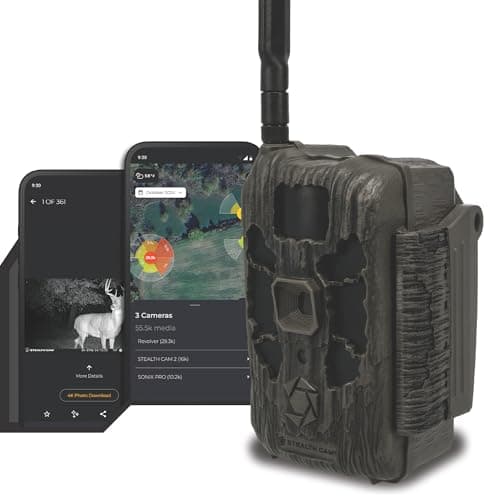
Stealth Cam Deceptor Max 3.0
Stealth Cam Command7.6/10The biggest no-glow array here: 36 LEDs at 940nm rated to 100 ft, a published sub-0.3 s trigger, and PIR zone selection plus AI filtering so a windy set does not burn your plan.
$99.99Amazon#ad · Price as of October 17, 2026 · Disclosure for the link to Stealth Cam Deceptor Max 3.0
Best no-glow cellular camera
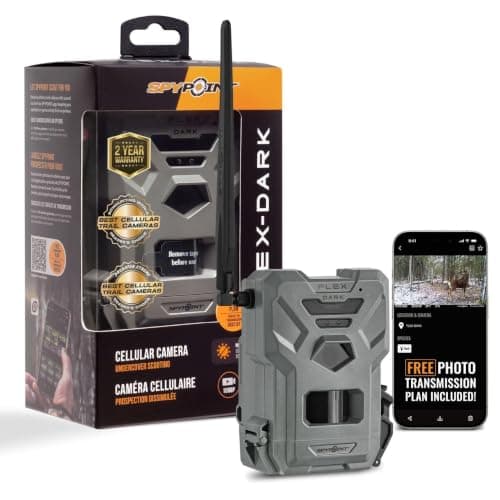
Spypoint Flex-Dark
Spypoint8.4/10The cheapest camera to run on ground where you may lose it: no-glow, 100 photos per camera per month at $0, $10/mo unlimited on annual billing.
$97.59Amazon#ad · Price as of October 17, 2026 · Disclosure for the link to Spypoint Flex-Dark
Best security box for Spypoint Flex
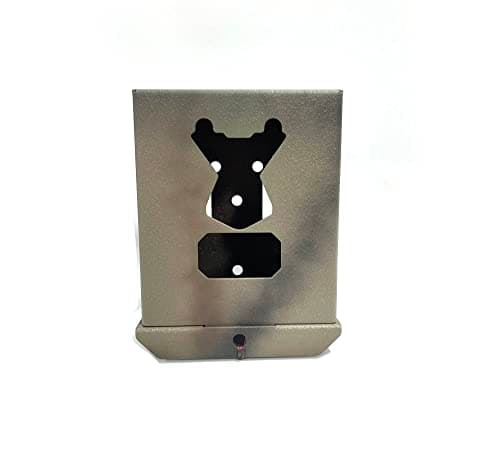
CAMLOCKbox Spypoint Flex / Flex-M / Flex-Dark Security Box (Box 10)
Security box8.3/10A model-specific steel housing. Run the cable through the box and around the trunk, not through the camera's plastic lug.
$42.95Amazon#ad · Price as of October 17, 2026 · Disclosure for the link to CAMLOCKbox Spypoint Flex / Flex-M / Flex-Dark Security Box (Box 10)
Best trail camera locking cable
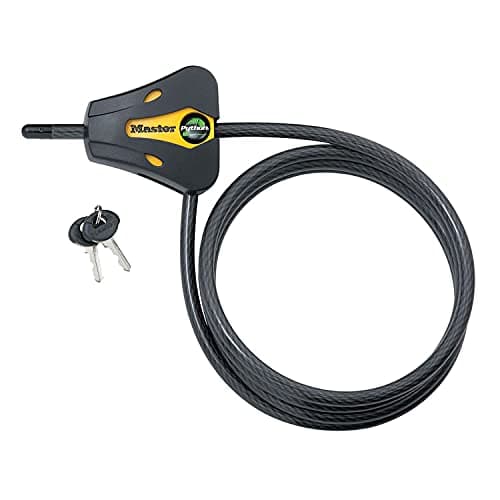
Master Lock Python 8419DPF Adjustable Cable Lock (6 ft)
Lock / cable8.4/10A 6 ft adjustable cable that wraps a trunk of any size and cinches down. The part that turns a two-second theft into a job with tools.
$21.77Amazon#ad · Price as of October 17, 2026 · Disclosure for the link to Master Lock Python 8419DPF Adjustable Cable Lock (6 ft)
Budget as though you will lose one
This is the unglamorous conclusion. Cameras disappear from public ground, and the people they disappear to are not deterred by anything you can buy at a reasonable price. So size the purchase accordingly: buy at the price point where losing a camera is irritating rather than painful, and put the money you save into the box, the cable and the depth of the hang.
Do not hang your best camera out there. A $400 body with a native 4K sensor belongs on ground you control. The value band is ranked in best trail cameras for the money and best trail cameras under $200, and the cameras built for hard, hard-to-reach ground in best trail cameras for remote areas.
One last thing: photograph the serial number and keep the receipt before the camera leaves your house. It is the only thing that makes a recovered camera provably yours.
How we scored this
The research behind these picks
Every pick here is built from documented evidence: the maker's published trigger speed, flash type, battery configuration and detection range; each brand's plan tiers verified on its own plan page and turned into the real monthly cost at one and four cameras; the independent shootouts (Trailcampro, Outdoor Life, Field & Stream, TechGearLab) cited by name for the measurements they published; and a public rubric applied the same way to every model. Every figure links to where it came from, so you can check our work in one click.
Scores are editorial judgments from that documented research. Commissions never set a score or decide a pick. The rubric and its weights are published.
Questions
Frequently asked
Are trail cameras legal on public land?
It depends entirely on the state, the agency and often the specific unit, and the rules have been changing. Restrictions in use somewhere include outright bans, bans during open seasons, bans on transmitting cameras specifically, labelling requirements and limits on how many you may place. Check your wildlife agency's current regulations and the land manager before you hang anything.
How do you keep a trail camera from being stolen on public land?
A no-glow camera so it is not noticed, a model-specific steel box with a cable around the trunk, a hang above eye level angled down and away from marked trails, and distance from parking and access. None of that defeats a determined thief; all of it defeats an opportunist. See how to keep a trail camera from being stolen.
Should I use a cellular camera on public land?
Where they are legal, yes — mainly because you never walk to the camera, so you leave no repeated track for other hunters to follow, and you know the day it goes offline. Expect poor signal deep in a unit and buy the cheapest-to-run ecosystem rather than the nicest app.
Where should you put a trail camera on public land?
Deep, on genuine funnels, away from marked trails, parking and the first ridge. Density of other people falls off sharply with distance from access, and so does the chance of your camera being found. Two cameras placed hard beat six placed conveniently.
Do I have to put my name on a trail camera on public land?
In some places, yes — identification requirements exist in a number of jurisdictions. Check the current regulation for your unit. Where it is required, permanent marker on the housing or a tag inside the strap satisfies it, and it also improves the odds of a lost camera coming back.
Keep reading
Related on Cam & Canopy
- How to hide a trail cameraThe hang that keeps it unnoticed.
- How to keep a trail camera from being stolenBoxes, cables and the realistic limits of both.
- Best no-glow trail camerasThe only flash class to use out there.
- Trail camera placementPicking funnels worth walking a mile for.
- How often to check trail camerasWhy your track matters more than your scent.
Receipts
Sources
- Stealth Cam — Deceptor Max 3.0 product page (checked 2026-09-21)
- Stealth Cam — Command data plans page (checked 2026-10-01)
- Spypoint — FLEX-DARK product page (checked 2026-09-21)
- Spypoint — photo transmission plans (checked 2026-09-21)
- CAMLOCKbox — Spypoint box reference (checked 2026-09-21)
- Master Lock — 8419DPF Python adjustable locking cable product page (checked 2026-09-21)
- CAMLOCKbox — homepage, American-made statement (checked 2026-09-21)
Every number above is traceable: specs come from the maker's own product pages (linked on every product), plan prices from the maker's plan page with an “as of” date, and independent measurements are attributed to whoever made them. Amazon prices change often, so every buy button takes you to Amazon's current price for that listing. Read the full method.