Scouting · Guide
Do deer avoid trail cameras? Three things they can detect, and only one is the camera
A deer that stops using a trail after you hang a camera is usually reacting to the hour you spent hanging it, not to the camera. But two camera properties are genuinely detectable, and on a mature buck they are worth engineering out.
By Mike M.Updated Spec-checked · every figure sourced
#adReader-supported: we may earn a commission if you buy through our links, at no extra cost to you. It never decides a ranking. How we rank · Disclosure
What we can and cannot tell you
This site does not run field trials, and we are not going to present an opinion about deer behavior as though it were a measurement. We have no study to cite that quantifies avoidance rates, and anyone who gives you a percentage is almost certainly inventing it.
What we can do is separate what is physically detectable from what is not, using the published specifications of the cameras themselves. That is a narrower claim and a more useful one: if a camera emits light a deer can see, that is a fact about the camera, and you can choose a camera that does not. The rest - whether a particular buck changes his route - is a judgement, and we will label it as one.
The three detectable things
A trail camera is a sealed plastic box that does nothing for twenty-three hours and fifty-nine minutes a day. In the second it is awake it can produce light, sound and, over time, a faint residue of the person who hung it. Those are the three channels, and they are not equally important.
1. The infrared glow
Infrared LEDs come in two common wavelengths and the difference is objective. An 850nm array sits just past the edge of human vision and is visibly red when it fires; makers describe these as low glow, or simply infrared. A 940nm array is far enough into the infrared that it is effectively invisible to a human eye, and makers call it no glow.
Both wavelengths are outside the range a deer eye is built for, but 850nm emitters are bright enough and close enough to the visible boundary that a sudden red flare at ten yards is a reasonable thing to assume an animal registers. It is also a flare that repeats every time the camera fires, which gives a deer that uses a trail nightly many opportunities to associate it with something.
This is the one factor you can remove with hardware. A 940nm camera emits nothing a person can see, and the published trade is efficiency: 940nm light costs more current for the same illumination, which is why no-glow cameras often publish shorter flash ranges. The Stealth Cam Deceptor Max 3.0 compensates with a 36-piece 940nm array, the largest in our registry, and the Alpha Cam lists 48 940nm emitters on its own listing. The full trade-off is in no-glow vs low-glow.
2. Shutter, motor and relay noise
A waking trail camera is not silent. There is a faint click as the circuit switches, and on cameras with a mechanical infrared cut filter there is a distinct snap as the filter moves in or out of the optical path - the same sound a security camera makes at dusk. In still air at ten yards, that is audible to a person, and a deer hears far better than a person.
Two design details reduce it. Cameras with separate day and night sensors, such as the Bushnell CORE DS-4K and the Stealth Cam Spectre 4K Pro, do not need to move a filter at all, because one imager handles daylight and the other handles infrared. And distance helps more than anything: a camera set twenty-five feet from the trail is quieter at the deer than one set eight feet away, and it also produces better night exposures.
3. You, which is the big one
Here is the uncomfortable part. Hanging a camera means walking to a specific tree, standing there for five to ten minutes, handling bark and vegetation, clearing a detection lane, and leaving. Then you come back to swap a card or change batteries and do it again. On a bedding-area edge in October, that is a far stronger signal than any LED.
This is the argument for cellular cameras that has nothing to do with convenience: a camera you never revisit is a set you contaminate once instead of monthly. It is also the argument for a camera with thirty months of battery life if you are running cards, and for solar if you are running cellular. The case either way is in are cellular trail cameras worth it, and the measured runtimes are in best trail cameras for battery life.
It is also why experienced people treat camera checks like hunts: wind in your face, midday rather than first light, in and out by the same route, gloves on the camera. None of that is about the camera. All of it is about you.
Cameras that remove the glow
Our picks for this
Four cameras with no visible flash
Each one publishes a no-glow emitter and a flash range to go with it, because an invisible flash that cannot reach the trail solves nothing.
Best no-glow cellular camera
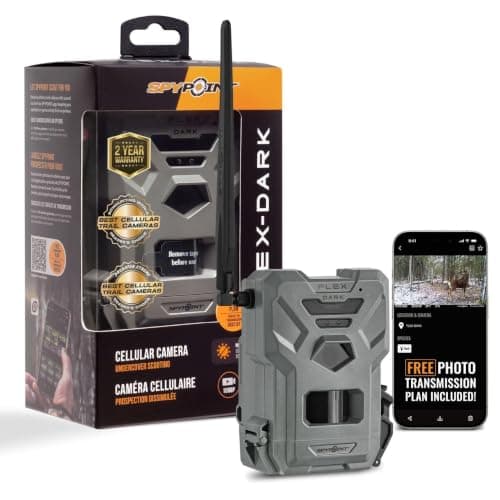
Spypoint Flex-Dark
Spypoint8.4/10Both no-glow and low-glow emitters in one housing, 100 ft of published flash range, and first place in Trailcampro's 2026 cellular flash-range shootout.
$100.04Amazon#ad · Price as of October 12, 2026 · Disclosure for the link to Spypoint Flex-Dark
Best no-glow flash array
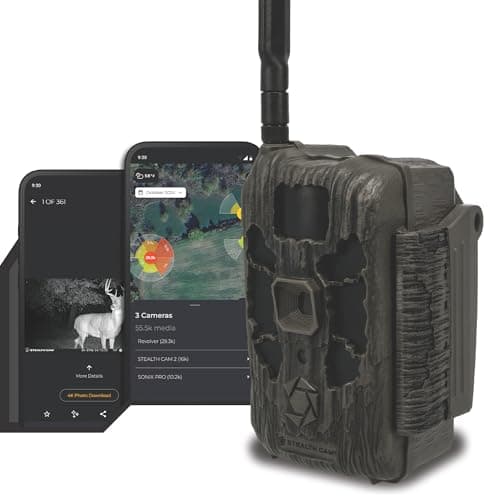
Stealth Cam Deceptor Max 3.0
Stealth Cam Command7.6/10A 36-piece 940nm array, the largest invisible-flash bank we have on file, out to a published 100 ft, with a sub-0.3 s trigger.
$115.00Amazon#ad · Price as of October 12, 2026 · Disclosure for the link to Stealth Cam Deceptor Max 3.0
Best dual-lens value
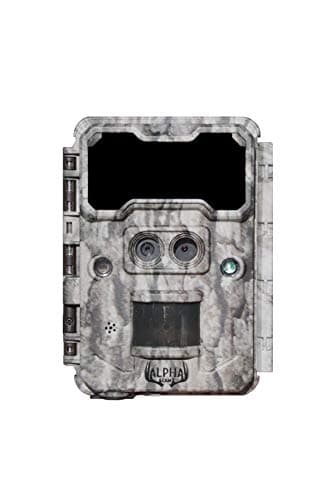
Alpha Cam Dual Lens No Glow
SD / Wi-Fi8.5/1048 940nm emitters per the brand's own listing, a second lens dedicated to night, and 29 months of measured photo-mode runtime.
$119.95Amazon#ad · Price as of October 12, 2026 · Disclosure for the link to Alpha Cam Dual Lens No Glow
Best non-cellular trail camera
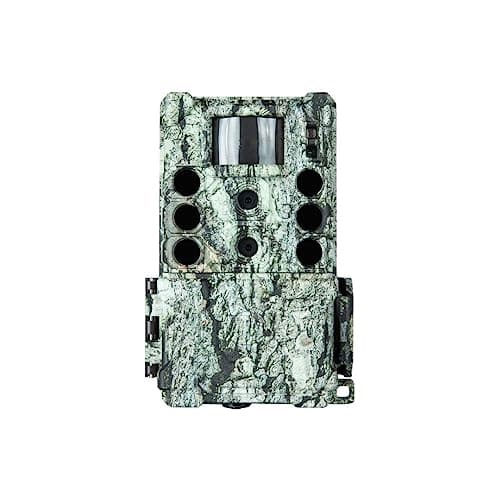
Bushnell CORE DS-4K No Glow
SD / Wi-Fi8.7/10No-glow with the longest published night range here at 120 ft, dual sensors so there is no filter to snap, and a 0.15 s trigger.
$159.99Amazon#ad · Price as of October 12, 2026 · Disclosure for the link to Bushnell CORE DS-4K No Glow
How to set a camera deer ignore
- Twenty to thirty feet back, angled along the trail. Further away means quieter at the animal and a wider usable frame. Angling along rather than across the trail also improves detection, because a PIR sensor reads movement between its zones. See placement.
- Above eye level, angled down. Deer look level and ahead. A camera above the sight line and tilted down is both less conspicuous and less prone to firing on grass - see camera height.
- No-glow if the set matters. On a staging area or a scrape you intend to hunt, buy out the visible flash. On a mineral site in July it hardly matters.
- Break the outline. A black box on a smooth gray trunk reads as an object. A camera tucked against a fork, behind a branch stub or inside a box painted to match bark does not. The practical methods are in how to hide a trail camera.
- Visit as rarely as the hardware allows. This is the whole ballgame. Long battery life, solar, or cellular - pick whichever one lets you leave the set alone.
One last thing worth saying plainly: a camera that spooks a deer once has not ruined the spot. Deer habituate to static objects, which is why the same camera that gets avoided in week one often photographs the same animals in week four. The behavior that does not habituate is repeated human intrusion. Fix that first and the camera question mostly answers itself.
How we scored this
The research behind these picks
Every pick here is built from documented evidence: the maker's published trigger speed, flash type, battery configuration and detection range; each brand's plan tiers verified on its own plan page and turned into the real monthly cost at one and four cameras; the independent shootouts (Trailcampro, Outdoor Life, Field & Stream, TechGearLab) cited by name for the measurements they published; and a public rubric applied the same way to every model. Every figure links to where it came from, so you can check our work in one click.
Scores are editorial judgments from that documented research. Commissions never set a score or decide a pick. The rubric and its weights are published.
Questions
Frequently asked
Do deer avoid trail cameras?
Some deer, particularly mature bucks, react to them. The camera is rarely the main cause: your scent and the disturbance of hanging and checking the camera are a far stronger signal than the hardware. Of the camera's own properties, a visible 850nm flash is the one worth engineering out.
Can deer see trail camera infrared?
An 850nm array produces a red flare that a person can see, so it is reasonable to assume an animal registers it at close range. A 940nm no-glow array emits nothing visible to a human eye. Neither wavelength is in the range a deer eye is built for, but the 850nm flare is bright and repeats every time the camera fires.
Can deer hear a trail camera?
Yes, at close range. Cameras make a faint switching click, and models with a mechanical infrared cut filter snap audibly when the filter moves. Cameras with separate day and night sensors avoid that noise entirely, and setting the camera further back reduces whatever is left.
Does a no-glow trail camera really help?
It removes the one camera property that is unambiguously detectable, which is worth doing on a set you intend to hunt. It does not remove the noise or your scent, so treat it as one of three fixes rather than the whole answer.
How often should I check a trail camera so I do not spook deer?
As rarely as the hardware forces you to. A card camera with thirty months of runtime can be left for a season; a cellular camera never needs a visit for data at all. Where you must visit, go midday with the wind in your face and keep the trip short.
Keep reading
Related on Cam & Canopy
- No-glow vs low-glow850nm against 940nm, and what the trade costs.
- Best no-glow trail camerasThe invisible-flash cameras, ranked.
- Trail camera placementDistance and angle, which do most of the work.
- How to hide a trail cameraBreaking the outline, from people and animals.
- How trail cameras workWhy the flash and the filter make noise at all.
- Are cellular cameras worth it?Buying your way out of the monthly visit.
Receipts
Sources
- Spypoint — FLEX-DARK product page (checked 2026-09-21)
- Trailcampro — 2026 Trail Camera Shootout results (checked 2026-09-21)
- Stealth Cam — Deceptor Max 3.0 product page (checked 2026-09-21)
- Alpha Cam — brand's own Amazon listing, published specifications (checked 2026-10-03)
- Trailcampro — Alpha Cam Dual Lens No Glow review, measured figures, score and stock (checked 2026-09-28)
- Bushnell — CORE DS-4K No Glow product page (checked 2026-09-21)
- Stealth Cam — Spectre 4K Pro product page (checked 2026-09-26)
- Trailcampro — GardePro T5NG Pro review, measured figures, score and stock (checked 2026-09-28)
Every number above is traceable: specs come from the maker's own product pages (linked on every product), plan prices from the maker's plan page with an “as of” date, and independent measurements are attributed to whoever made them. Amazon prices change often, so every buy button takes you to Amazon's current price for that listing. Read the full method.