Trail Cameras · Head to head
Trail camera vs security camera: the difference is power and internet, not picture quality
A security camera assumes mains power and a Wi-Fi router. A trail camera assumes neither and runs for months on AA batteries. Everything else people argue about follows from that one difference, and it decides which one belongs on your gate.
By Mike M.Updated Spec-checked · every figure sourced
#adReader-supported: we may earn a commission if you buy through our links, at no extra cost to you. It never decides a ranking. How we rank · Disclosure
The contenders
Side by side
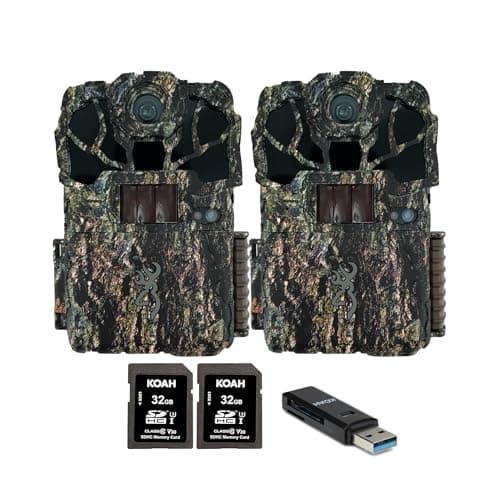
Best where there is no power and no signal
Browning Spec Ops Elite HP5 Ultra
SD / Wi-Fi8.4 /10Invisible IR to 100 ft, an adjustable 0.1 to 0.7 s trigger, 8 AAs and a 12V jack. It records to a card, so it works in a dead zone that defeats every security camera made.
$389.99Amazon#ad · Price as of October 11, 2026 · Disclosure for the link to Browning Spec Ops Elite HP5 Ultra
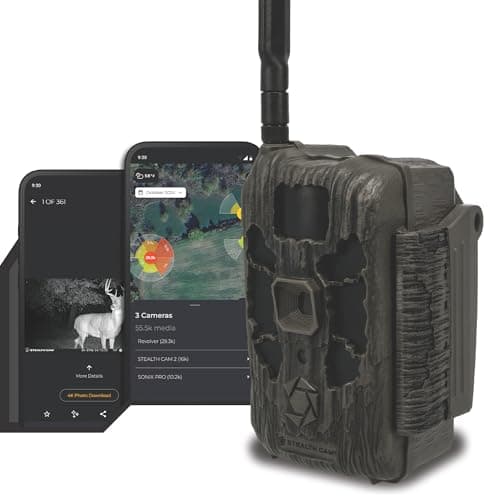
Best trail camera as a security camera
Stealth Cam Deceptor Max 3.0
Stealth Cam Command7.6 /10A 36-LED 940nm no-glow array, PIR zone selection and Command's AI filtering, sending images to your phone over cellular from a gate with no Wi-Fi anywhere near it.
$115.11Amazon#ad · Price as of October 11, 2026 · Disclosure for the link to Stealth Cam Deceptor Max 3.0
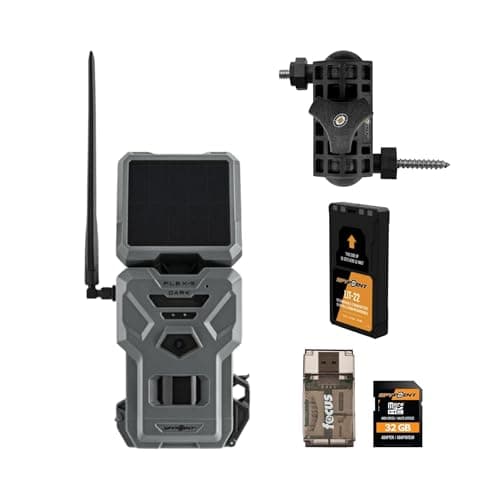
Best for a gate you visit twice a year
Spypoint Flex-S-Dark
Spypoint8.8 /10Integrated solar plus a free 100-photo plan tier: alerts on your phone with no mains power, no router and, if you stay inside the allowance, no bill.
$219.99Amazon#ad · Price as of October 11, 2026 · Disclosure for the link to Spypoint Flex-S-Dark
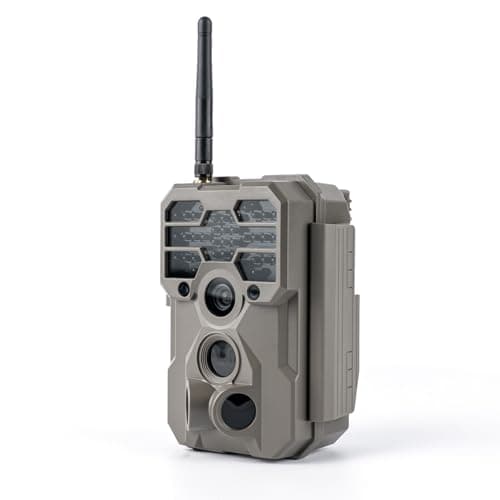
Best at the house, where a security camera also works
GardePro A80 (Wi-Fi)
SD / Wi-Fi8.7 /104K with audio, 940nm no-glow to 100 ft and Wi-Fi to your phone for $99.99. At the house it competes directly with a Blink or a Ring, with no subscription at all.
$99.99Amazon#ad · Price as of October 11, 2026 · Disclosure for the link to GardePro A80 (Wi-Fi)
The short verdict
The one difference everything follows from
Security cameras are designed around a house. The design brief is: there is power nearby, or at least a socket to recharge from; there is a router; the owner wants a live feed on demand and a recording in the cloud. Once you can assume mains power and broadband, you can afford a sensor that runs continuously, an always-on radio, and cloud storage paid for monthly.
Trail cameras are designed around a tree in a wood. The brief is: there is no power, there may be no cell signal at all, nobody will visit for weeks, and the camera must survive weather that would kill a doorbell. Once you cannot assume power, everything changes. The sensor has to sleep and wake on a passive infrared trigger. The radio, if there is one, fires in short bursts or does not exist. Storage is a card in the body.
The result is two products that photograph the same driveway and disagree about almost every design decision. Neither is better. They answer different questions.
Side by side, spec for spec
The security-camera column is Blink's published specification for the Outdoor 4, chosen because it is the battery-powered end of the security-camera market and therefore the closest thing to a fair comparison. The trail-camera column is the range across the cameras this site ranks.
| What you are comparing | Trail camera | Security camera (Blink Outdoor 4) |
|---|---|---|
| Power | 8 to 12 AA batteries, months to years; 12V jack and solar optional | Two AA lithium cells, “up to 2 years with default settings”, or a weather-resistant power adapter |
| Internet needed | None for card cameras. Cellular models use a carrier; Wi-Fi models talk to your phone | Yes: 2.4GHz 802.11b/g/n plus a high-speed broadband connection |
| Hub or base station | None, except the GardePro T6LRW which uses its own hub | A Blink Sync Module |
| Subscription | $0 on card and Wi-Fi cameras. Cellular plans run from a free tier to about $20/mo | Basic $3.99/mo or $39.99/yr for one device; Plus $11.99/mo or $119.99/yr for unlimited devices |
| Without a subscription | Everything still works; a card camera has no online component to lose | Motion notifications only, and live view limited to five minutes per device |
| Night vision | Its own infrared flash: 940nm no-glow or 850nm low-glow, rated 75 to 130 ft | Infrared night view with one red LED lit while recording |
| Trigger | Passive infrared heat-and-motion sensor, 0.1 to 0.7 s published trigger | Motion detection in the video stream, with person detection on a plan |
| Video | 1080p to 4K; Browning bodies record 1440p with sound at 60 fps | 1080p HD at up to 30 fps, 143 degree diagonal field of view, two-way audio |
| Still photos | 32MP to 64MP claimed (heavily interpolated), the primary output | 640 x 360, effectively a thumbnail |
| Storage | SD card up to 512GB in the camera, or internal memory | Cloud on a plan, or local via the Sync Module |
| Cold rating | Lithium AAs are specified to -40°F | -4 to 113°F (-20 to 45°C) operating range |
| Live view | Only on specific cellular models, usually as a paid add-on | Yes, and two-way talk |
Two rows deserve attention. The still photo row is the one people miss: a security camera's photo output is 640 x 360, because its job is video. If what you need is a readable image of a face or a plate, a trail camera's still is the better artefact. The without a subscription row is the other: a card-based trail camera has nothing to lose when you stop paying, because there was never anything to pay.
Night vision: IR flash vs IR illuminator
Both camera types “have night vision” and they mean different things by it. A trail camera fires a burst of infrared from an LED array at the moment of exposure, which is why it can light a subject at 100 to 130 feet on batteries. A security camera runs a continuous infrared illuminator while it records, which is why its useful night range is much shorter and why Blink notes a red LED is lit during night recording.
For security work that distinction matters twice. First, reach: if the subject is more than about thirty feet from the camera at night, the trail camera is the one that will show you anything. Second, visibility: a 940nm no-glow trail camera array is effectively invisible, which is the whole reason the Browning Spec Ops and the Stealth Cam Deceptor Max are on this page. A camera somebody notices is a camera somebody removes. How to hide a trail camera covers the rest of that problem.
PIR trigger vs video motion detection
A trail camera's passive infrared sensor detects a heat difference moving across its field. It ignores a swaying branch that is the same temperature as the air behind it, and it triggers on a warm body. A security camera analyzes pixels changing in a video frame, which is why it needs software (and usually a subscription) to tell a person from a shadow, and why Blink sells person detection as a plan feature.
Practically: PIR is better at ignoring weather and worse at ignoring sun-warmed vegetation. Video motion detection is better at classifying what it saw and worse at running on batteries for a season. Trail cameras publish a trigger figure (0.1 to 0.7 s on the Browning HP5 bodies); security cameras generally do not publish one at all, because the always-on stream makes it a different measurement. Trigger speed explained covers what the number means.
Five-year cost, both ways
So the cheapest way to watch a gate for five years is a card-based trail camera, and the second cheapest is a cellular camera on a free plan tier. A security camera is not expensive; it is just paying for cloud video you may not need on a spot that has no internet anyway. Every cellular plan, compared has the full arithmetic.
Four things a trail camera cannot do
This page is on a trail camera site, so it is worth being blunt about where the other product wins outright.
- Continuous recording. A trail camera captures events. If you need to know what happened between 2am and 3am with nothing triggering, you need a security camera and a wire.
- Two-way audio and a siren. No trail camera talks back or makes a noise. If deterrence in the moment is the point, this is not the product.
- Genuinely instant live view. A handful of cellular cameras offer live view as a paid add-on, on a delay, when signal allows. A security camera on your own Wi-Fi does it instantly, every time.
- Integration with a smart home. Lights, locks, routines, voice assistants. Trail camera apps are scouting tools, not home automation platforms.
Which one for which job
| The spot | Buy | Why |
|---|---|---|
| Gate or field entrance, no power, no Wi-Fi | Cellular trail camera | The only product that works there at all. Stealth Cam Deceptor Max 3.0 or Spypoint Flex-S-Dark |
| Remote barn or timber pile, no signal either | Card trail camera, no-glow | No network needed. Browning Spec Ops Elite HP5 Ultra |
| Long drive, house Wi-Fi does not reach | Cellular trail camera, or a Wi-Fi camera with a hub | See best WiFi trail cameras for the hub route |
| Front door, garage, inside Wi-Fi range | Security camera | Live view, two-way audio and continuous recording are worth having and the infrastructure is there |
| Back of the yard, Wi-Fi reaches, no socket | Either; a Wi-Fi trail camera is cheaper to run | GardePro A80 at $99.99 with no subscription against a security camera plus a plan |
| You need a readable face or plate at 60 ft at night | Trail camera | Its IR flash reaches; a 640 x 360 security-camera still does not resolve it |
| You need to see what happens continuously | Security camera | Trail cameras capture events, not timelines |
The trail cameras on this page, side by side
The verdict
In detail
The contenders, in full
Best where there is no power and no signal
Browning Spec Ops Elite HP5 Ultra
Invisible IR to 100 ft, an adjustable 0.1 to 0.7 s trigger, 8 AAs and a 12V jack. It records to a card, so it works in a dead zone that defeats every security camera made.
Spec sheetSpec-checked · sources linked
| Category | SD / Wi-Fi |
|---|---|
| Trigger speed | Adjustable 0.1 to 0.7 s |
| Recovery time | 0.5 s |
| Detection range | Adjustable, up to 80 ft |
| Flash | Invisible 'night vision' infrared LEDs |
| Flash range | 100 ft |
| Photo resolution | 46MP |
| Video | 1440p with sound, 5 s to 2 min |
| Batteries | 8 AA (alkaline, rechargeable or lithium) |
| External power | 12-volt external power jack |
| App features | 2-inch color viewing screen |
| Storage | Up to 512GB SDXC |
How the 8.4 score breaks down
- Trigger speed & recovery (25%)
- 9
- Night image quality (25%)
- 9
- Battery life (20%)
- 8
- Detection range & field of view (15%)
- 7
- Ease of use & value (15%)
- 8
What the spec sheet supports
- Trigger speed and detection range are both adjustable, so you can tune a set instead of living with it
- Invisible IR to 100 ft
- 1440p video and a 2-inch screen
- Accepts rechargeable AAs by Browning's own spec
Where it falls short
- 80 ft maximum detection is shorter than the CORE DS-4K's flash reach
- $179.99 list
- SD only
Skip this if…
…you never adjust settings after the first hang; the CORE S-4K gets you no-glow 4K for $30 less.
#ad · Price as of October 11, 2026 · Disclosure for the link to Browning Spec Ops Elite HP5 Ultra
Best trail camera as a security camera
Stealth Cam Deceptor Max 3.0
A 36-LED 940nm no-glow array, PIR zone selection and Command's AI filtering, sending images to your phone over cellular from a gate with no Wi-Fi anywhere near it.
Spec sheetSpec-checked · sources linked
| Plan ecosystem | Stealth Cam Command. The plan decides the running cost; see the plan explainer linked on this page. |
|---|---|
| Network | Automatic network coverage |
| Plan | Standard $5/mo (600 photos); Plus $8/mo; Unlimited $20/mo with descending multi-camera pricing ($15 second, $11 third to seventh); per camera |
| Trigger speed | < 0.3 s |
| Detection range | 100 ft |
| Flash | No-Glo, 36-piece 940nm LED array |
| Flash range | Out to 100 ft |
| Photo resolution | Up to 50MP, up to nine photos per burst |
| Video | 1440p at 30 fps |
| Batteries | 16 AA; recharge compatible |
| App features | Command AI: false image detection, PIR zone selection, Rack Alert; live view ready; camera sharing; dual-core processor |
| Storage | 16GB internal memory |
How the 7.6 score breaks down
- Trigger speed & recovery (20%)
- 8
- Night image quality (20%)
- 9
- Battery & solar life (20%)
- 7
- Real monthly plan cost (20%)
- 6
- Detection range & field of view (10%)
- 8
- App, setup & reliability (10%)
- 8
What the spec sheet supports
- 36 LEDs at 940nm: the largest no-glow array in this group
- PIR zone selection and false-image filtering cut wasted uploads on windy sets
- 16 AA bay for long runs; 16GB internal memory
- Stealth Cam's Standard plan is $5/mo per camera
Where it falls short
- Unlimited plan is $20/mo for the first camera, the priciest unlimited tier we verified
- 16 AA batteries is a lot of batteries to buy
- Stealth Cam does not publish a recovery time
Skip this if…
…you want unlimited photos on several cameras; the descending schedule still totals $57/mo for four.
#ad · Price as of October 11, 2026 · Disclosure for the link to Stealth Cam Deceptor Max 3.0
Best for a gate you visit twice a year
Spypoint Flex-S-Dark
Integrated solar plus a free 100-photo plan tier: alerts on your phone with no mains power, no router and, if you stay inside the allowance, no bill.
Spec sheetSpec-checked · sources linked
| Plan ecosystem | Spypoint. The plan decides the running cost; see the plan explainer linked on this page. |
|---|---|
| Network | Dual-SIM, automatically connects to all major carriers |
| Plan | Free 100 photos/mo; Basic $5 ($4 annual); Standard $10 ($7); Premium unlimited $15 ($10); one plan per camera |
| Trigger speed | 0.3 s |
| Detection range | 100 ft |
| Flash | Low-glow and no-glow LEDs |
| Flash range | 100 ft; sixth overall in Trailcampro's 2026 flash-range shootout |
| Photo resolution | 40MP |
| Video | 1080p; livestreaming video (Spypoint lists it as coming spring 2026) |
| Solar | Built-in solar panel and battery; 'replaces up to 1,000 AA batteries' (maker claim) |
| App features | GPS locator on the in-app map, remote activation, over-the-air updates |
| Warranty | 2 years |
How the 8.8 score breaks down
- Trigger speed & recovery (20%)
- 8
- Night image quality (20%)
- 9
- Battery & solar life (20%)
- 9
- Real monthly plan cost (20%)
- 10
- Detection range & field of view (10%)
- 8
- App, setup & reliability (10%)
- 8
What the spec sheet supports
- Integrated solar with no cable to route or panel to aim
- Same 0.3 s / 100 ft / dual-LED spec as the Flex-Dark
- Free 100-photo tier; $10/mo annual unlimited
- $149.99 at Spypoint, under the Moultrie Edge 4 Solar
Where it falls short
- A camera-mounted panel only works where the camera faces the sun; shaded sets still starve
- No published recovery time or battery capacity figure
- Fits CAMLOCKbox box 11, a different box from the Flex-Dark, so boxes don't swap
- Out of stock at Spypoint on 2026-10-09; Trailcampro had it at $169.95 and Amazon stock was marked up well above list
Skip this if…
…your sets are in deep timber with no direct sun; a separate 10W panel you can aim (SPLB-22) beats a built-in one there.
#ad · Price as of October 11, 2026 · Disclosure for the link to Spypoint Flex-S-Dark
Best at the house, where a security camera also works
GardePro A80 (Wi-Fi)
4K with audio, 940nm no-glow to 100 ft and Wi-Fi to your phone for $99.99. At the house it competes directly with a Blink or a Ring, with no subscription at all.
Spec sheetSpec-checked · sources linked
How the 8.7 score breaks down
- Trigger speed & recovery (25%)
- 8
- Night image quality (25%)
- 9
- Battery life (20%)
- 8
- Detection range & field of view (15%)
- 9
- Ease of use & value (15%)
- 10
What the spec sheet supports
- A named Sony Starvis sensor and an f/1.6 lens at $99.99, which is unusual under $100
- Wi-Fi 6 rather than the 2.4GHz radios the cheaper GardePros use
- 940nm no-glow with a stated 100 ft night range
- A 2.4-inch screen AND phone preview, so you can aim it either way
Where it falls short
- '0.1 s' is GardePro's claim with no independent measurement behind it
- No published recovery time
- 45 ft of Wi-Fi means you still walk to the set; nothing reaches the house
- Multi-camera and bundle variants read sold out even where the single camera is listed
Skip this if…
…you want photos at home without walking in; only the T6LRW (hub) and E9 3.0 Pro (router mode) do that.
#ad · Price as of October 11, 2026 · Disclosure for the link to GardePro A80 (Wi-Fi)
How we scored this
The research behind these picks
Every pick here is built from documented evidence: the maker's published trigger speed, flash type, battery configuration and detection range; each brand's plan tiers verified on its own plan page and turned into the real monthly cost at one and four cameras; the independent shootouts (Trailcampro, Outdoor Life, Field & Stream, TechGearLab) cited by name for the measurements they published; and a public rubric applied the same way to every model. Every figure links to where it came from, so you can check our work in one click.
Scores are editorial judgments from that documented research. Commissions never set a score or decide a pick. The rubric and its weights are published.
Questions
Frequently asked
What is the difference between a trail camera and a security camera?
A security camera assumes mains power or regular recharging and a Wi-Fi router, and it streams continuously to the cloud. A trail camera assumes neither: it sleeps, wakes on a passive infrared trigger, fires its own infrared flash, and writes to a card or sends over cellular. Everything else follows from that.
Can I use a trail camera as a security camera?
Yes, and for a gate, drive or outbuilding with no power it is usually the better choice. Use a 940nm no-glow model so it is not spotted, mount it high and angled, and lock it in a steel box. What you give up is live view, two-way audio and continuous recording.
Can I use a security camera as a trail camera?
Only where its Wi-Fi reaches, which rules out most land. Its night range is also far shorter than a trail camera's infrared flash, and its still-photo output on a battery model can be as low as 640 x 360, so it is a poor tool for identifying an animal at distance.
Do trail cameras need Wi-Fi or a subscription?
Card-based trail cameras need neither. Wi-Fi trail cameras use their own short-range radio to reach your phone at the set, with no subscription. Only cellular trail cameras need a plan, and Spypoint publishes a free 100-photo tier.
Which is better at night, a trail camera or a security camera?
A trail camera, by a wide margin, at anything beyond about thirty feet. It fires a high-power infrared array at the moment of exposure and the better models are rated to 100 to 130 ft. A security camera runs a continuous low-power illuminator.
Will a trail camera work in cold weather?
Yes, better than most security cameras, but only on the right batteries. Lithium primaries are specified to -40°F; alkalines lose capacity badly below freezing. Blink rates the Outdoor 4 to -4°F. See batteries in cold weather.
Keep reading
Related on Cam & Canopy
- Best trail cameras for securityThe cameras ranked for gates, drives and cabins.
- How to hide a trail cameraA camera nobody notices is a camera nobody takes.
- Best security boxesThe steel that keeps the camera on the post.
- Best WiFi trail camerasPhone delivery at the house with no monthly fee.
- Cellular vs Wi-Fi vs SDThe three architectures, and which suits your spot.
- Best no-glow trail camerasInvisible flash, ranked.
Receipts
Sources
- Blink Support — Outdoor 4 technical specifications (checked 2026-09-28)
- Blink — subscription plans and prices (checked 2026-09-28)
- Browning Trail Cameras — Spec Ops Elite HP5 Ultra product page (checked 2026-09-21)
- Trailcampro — store search "browning", prices, scores and stock (checked 2026-09-28)
- Stealth Cam — Deceptor Max 3.0 product page (checked 2026-09-21)
- Stealth Cam — Command data plans page (checked 2026-10-01)
- Spypoint — FLEX-S-DARK product page (checked 2026-09-21)
- Spypoint — photo transmission plans (checked 2026-09-21)
- Trailcampro — store search "spypoint flex", prices, scores and stock (checked 2026-09-28)
- GardePro — A80 Wi-Fi Trail Camera product page (checked 2026-09-28)
- GardePro — Wi-Fi trail camera collection, list prices and stock (checked 2026-09-28)
- Energizer — Ultimate Lithium AA product page (checked 2026-09-21)
Every number above is traceable: specs come from the maker's own product pages (linked on every product), plan prices from the maker's plan page with an “as of” date, and independent measurements are attributed to whoever made them. Amazon prices change often, so every buy button takes you to Amazon's current price for that listing. Read the full method.