Power · Guide
Are solar trail cameras worth it? It depends on which way the camera has to face
An integrated solar panel removes the battery bill and the battery trip, which is most of the reason people buy one. It also points wherever the lens points, and that single constraint decides whether a solar camera is a brilliant purchase or a camera you visit more often than a card camera.
By Mike M.Updated Spec-checked · every figure sourced
#adReader-supported: we may earn a commission if you buy through our links, at no extra cost to you. It never decides a ranking. How we rank · Disclosure
The short version
Solar on a trail camera does one thing: it removes the battery trip. It does not make the camera faster, sharper or better at night, and on a cellular camera it does nothing about the plan. So the value question reduces to a simple comparison: what does the trip cost you, and will the panel actually get the sun it needs?
If the answer to the second half is yes, solar is one of the best-value upgrades in this category. Spypoint claims its integrated panel and battery “replaces up to 1,000 AA batteries,” and while that is a maker claim rather than a measurement, the direction is right: a camera that never needs cells is a camera you stop thinking about.
The battery bill it replaces
Put real numbers on it before you decide. Independent testing puts the longest-running cellular camera in our registry at about fourteen months of photos on twelve lithium AA cells, and the best card cameras at roughly thirty months on eight. So a cellular camera on lithium primaries costs you one tray of twelve cells a year, plus the walk; a card camera costs you one tray of eight every two to three years.
That is the honest frame. On a cellular camera, solar replaces a yearly battery purchase and a yearly trip — genuinely worth paying for. On a card camera that already runs thirty months, solar replaces a trip you make once every two and a half years, and you have to visit the camera for the card anyway. That is why integrated solar is overwhelmingly a cellular-camera feature, and why on card cameras it makes most sense on a camera running video or time lapse, where runtime collapses to three to six months. The measured figures are in best trail cameras for battery life.
The integrated-panel problem
Every integrated-solar camera in our registry has the panel moulded into the front of the housing, above or around the lens. That is tidy, weatherproof and theft-resistant. It also means the panel and the lens are rigidly coupled: whatever direction you need the camera to watch, that is where the panel faces.
On a field edge or a plot where the camera faces south or west, this is a non-issue and the camera will run forever. On a trail in a north-facing hardwood bottom — which is where a lot of good sets are — you are asking a small panel to charge from skylight under a canopy. Those are the cameras people report dying in November, and the camera is not at fault.
What winter actually does
Three things change at once, and they compound. Daylight hours fall by about a third in the northern half of the country. The sun sits lower, so light arrives at a shallow angle to a vertically mounted panel and much of it reflects rather than converting. And snow sits on a flat or shallow panel until it melts, during which the camera is running entirely on stored charge.
The practical consequence is that a solar set which coasted through August can run down in January even though nothing broke. If your sets are in snow country, size for stored capacity, angle any panel you can angle steeply so snow slides off, and keep a charged spare pack in the truck. The cold-weather picks and the battery chemistry table are in best trail cameras for cold weather and batteries in cold weather.
When a separate panel is better
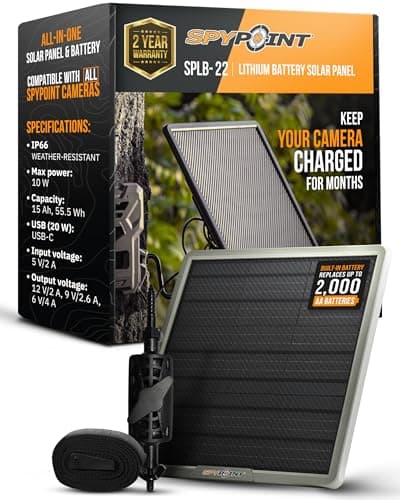
Almost always, on a shaded or awkward set. A separate panel on a cable can go up the trunk, out to the edge of the canopy gap, or on a fence post in full sun while the camera stays where the animals are. Spypoint's SPLB-22 is a 10-watt panel with a 15,000 mAh battery and a mounting bracket and strap, which is the shape of thing that fixes a problem an integrated panel cannot.
The trade is three-fold: a cable to hide, another object to steal, and a camera that must have the right input. A 12-volt jack is the most useful port here because it accepts panels and battery boxes without adapters, and four of the five Browning bodies we rank have one. The full panel comparison is in best trail camera solar panels, and the fixed-supply alternative in 12V battery boxes.
One genuine warning on mixing the two approaches: GardePro advises against using its SP350 panel with cameras that have built-in lithium packs, naming the R3 Pro, E8 2.0 Pro and X66 series, because of idle power draw. Check the maker's compatibility note before adding a panel to a camera that already has an internal pack.
Two cameras and two panels
Our picks for this
Two integrated-solar cameras and two aimable panels
Buy from the top two if the set gets sun and the camera can face it. Buy from the bottom two if the camera has to face into shade.
Best solar cellular camera
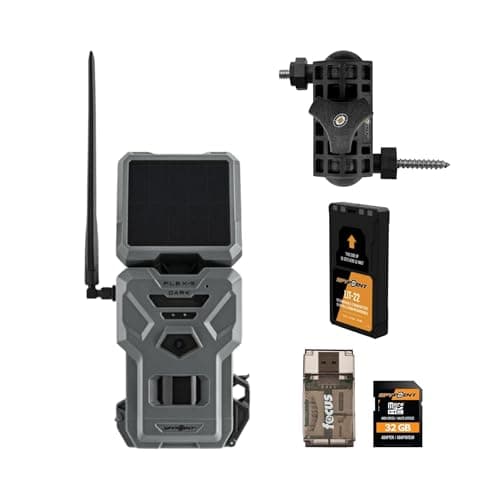
Spypoint Flex-S-Dark
Spypoint8.8/10Integrated panel and battery, no-glow and low-glow emitters, 0.3 s trigger, and a free 100-photo plan tier. The best-balanced integrated-solar camera we rank.
$219.99Amazon#ad · Price as of October 11, 2026 · Disclosure for the link to Spypoint Flex-S-Dark
Best feature-complete solar camera
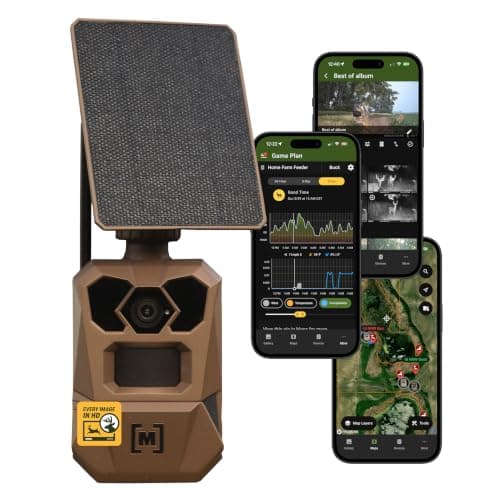
Moultrie Edge 4 Solar
Moultrie Mobile7.3/10Panel, lithium pack, GPS, Buck Shot and Live Aim in one housing, plus a USB-C input so a POWER MAG can back the panel up in shade.
$153.24Amazon#ad · Price as of October 11, 2026 · Disclosure for the link to Moultrie Edge 4 Solar
Best high-capacity aimable panel
Spypoint Lithium Battery Solar Panel (10W) SPLB-22
Solar panel8.3/1010 watts and 15,000 mAh with a bracket and strap, and four output cord choices. The fix for a camera that has to watch a shaded trail.
$129.99Amazon#ad · Price as of October 11, 2026 · Disclosure for the link to Spypoint Lithium Battery Solar Panel (10W) SPLB-22
Best panel for a Wi-Fi camera
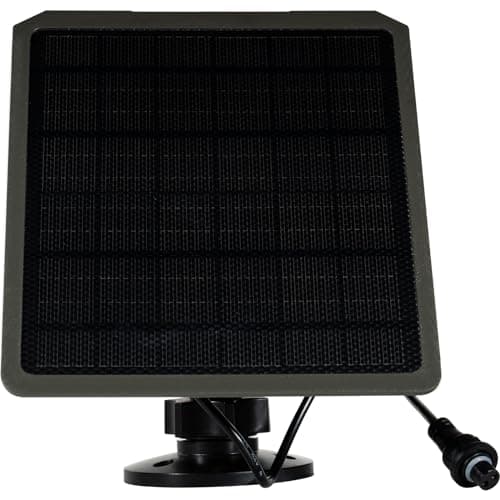
GardePro SP350 Solar Panel (5,200 mAh battery)
Solar panel8.0/10Selectable 6V, 9V or 12V output with a 5,200 mAh battery and a 13 ft cable. Check GardePro's own compatibility note before pairing it with an internal-pack camera.
$69.99Amazon#ad · Price as of October 11, 2026 · Disclosure for the link to GardePro SP350 Solar Panel (5,200 mAh battery)
The four mistakes that kill a solar set
- Mounting the panel at the camera's height. Put a separate panel higher than the camera, where the canopy is thinner, and run the cable down the trunk.
- Mounting it flat. A steeply angled panel sheds snow, rain and leaf litter and faces a low winter sun more directly.
- Aiming it once, in August. Re-aim any aimable panel in late autumn. The sun is in a different part of the sky.
- Treating solar as a substitute for capacity. A panel keeps a battery topped up; it does not carry a camera through a cloudy fortnight. Size the battery for the worst week, not the average one.
And one that is not about sun at all: a panel is a visible, valuable object hanging in a tree. On ground where theft is a risk, a solar camera advertises itself twice over. Box it, cable it, and read how to keep a trail camera from being stolen.
How we scored this
The research behind these picks
Every pick here is built from documented evidence: the maker's published trigger speed, flash type, battery configuration and detection range; each brand's plan tiers verified on its own plan page and turned into the real monthly cost at one and four cameras; the independent shootouts (Trailcampro, Outdoor Life, Field & Stream, TechGearLab) cited by name for the measurements they published; and a public rubric applied the same way to every model. Every figure links to where it came from, so you can check our work in one click.
Scores are editorial judgments from that documented research. Commissions never set a score or decide a pick. The rubric and its weights are published.
Questions
Frequently asked
Are solar trail cameras worth it?
On a set that gets a few hours of direct sun and that you would otherwise visit to change batteries, yes — particularly on a cellular camera, where cells are the yearly consumable. On a shaded set, no: an integrated panel faces wherever the lens faces, so a separate aimable panel is the better answer.
Do solar trail cameras work in the shade?
Poorly. An integrated panel under a closed canopy is charging from skylight, and the stored battery does the real work. If the camera has to watch a shaded trail, use a model with a 12V or USB-C input and put a separate panel higher up or out in a gap.
Do solar trail cameras still need batteries?
The integrated ones ship with a rechargeable lithium pack rather than disposable AAs, and makers such as Moultrie and Spypoint state no AA batteries are needed. Several still keep an AA tray or an external input as backup, which is a feature worth having on a marginal set.
Is an integrated solar panel better than a separate one?
It is tidier, weatherproof and harder to steal. A separate panel is more powerful, aimable independently of the camera, and the only option on a shaded set. If your sets get sun, buy integrated; if they do not, buy a camera with a 12V jack and a panel on a cable.
Do solar trail cameras save money on a cellular plan?
No. Solar replaces batteries, not the subscription. The plan is billed per camera regardless of how the camera is powered — see cellular plans compared.
Keep reading
Related on Cam & Canopy
- Best trail camera solar panelsThe aimable panels, ranked.
- Best solar cellular trail camerasIf the answer is yes, the cameras to buy.
- Edge Solar vs Flex-S-DarkThe two integrated-solar cameras, head to head.
- Best trail cameras for cold weatherWhat winter does to a solar set.
- External battery packsThe non-solar way to stop visiting.
- Battery life explainedThe runtime solar is replacing.
Receipts
Sources
- Spypoint — FLEX-S-DARK product page (checked 2026-09-21)
- Spypoint — FLEX-S-DARK product page, $149.99 price and out-of-stock status (checked 2026-10-09)
- Spypoint — Lithium Battery Solar Panel (10W) SPLB-22 product page (checked 2026-09-21)
- Spypoint — LIT-22 rechargeable lithium battery pack product page (checked 2026-09-21)
- Moultrie — EDGE 4 SOLAR product page (checked 2026-09-21)
- Moultrie — EDGE SOLAR product page (checked 2026-09-21)
- GardePro — SP350 solar panel with 5,200 mAh battery product page (checked 2026-09-28)
- GardePro — X66 3.0 Ultra product page (checked 2026-09-21)
- Tactacam — REVEAL Pro 4.0 Solar product page (checked 2026-09-24)
- Trailcampro — Tactacam Reveal X 4.0 product page, measured figures and stock (checked 2026-09-24)
Every number above is traceable: specs come from the maker's own product pages (linked on every product), plan prices from the maker's plan page with an “as of” date, and independent measurements are attributed to whoever made them. Amazon prices change often, so every buy button takes you to Amazon's current price for that listing. Read the full method.