Trail Cameras · The rankings
Best trail cameras for battery life: the measured numbers, not the box claims
Every maker claims up to a year. Independent testing puts the best SD-card cameras closer to thirty months in photo mode and the best cellular cameras at fourteen, and the same cameras drop to three to six months the moment you switch to video. These are the five with real numbers behind them.
By Mike M.Updated Spec-checked · every figure sourced
#adReader-supported: we may earn a commission if you buy through our links, at no extra cost to you. It never decides a ranking. How we rank · Disclosure
Quick picks
The rankings at a glance
| # | Product | Best for | Score | Price |
|---|---|---|---|---|
| 1 | No image GardePro T5NG Trailcampro estimates 31.1 months in photo mode on lithium AA cells, the longest figure in our registry. Eight cells, no plan, no panel, no excuses. | Longest measured runtimeSD / Wi-Fi | 8.5 /10 | Check price · Amazon |
| 2 | No image GardePro T5NG Pro 29.8 months in photo mode measured, plus an internal viewing screen so you can check the frame at the tree and never open it again. | Best runtime with a screenSD / Wi-Fi | 8.8 /10 | Check price · Amazon |
| 3 | 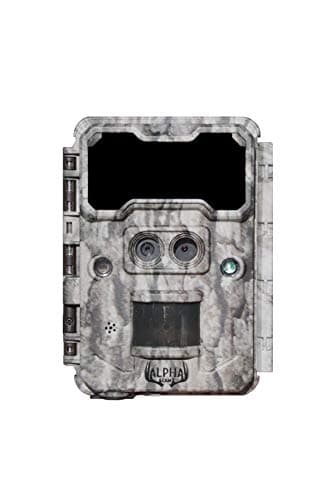 Alpha Cam Dual Lens No Glow 29 months in photo mode measured, with a second lens dedicated to night. The 3.2-month video figure shows exactly what video costs. | Best runtime with a night sensorSD / Wi-Fi | 8.5 /10 | $119.95Amazon |
| 4 | 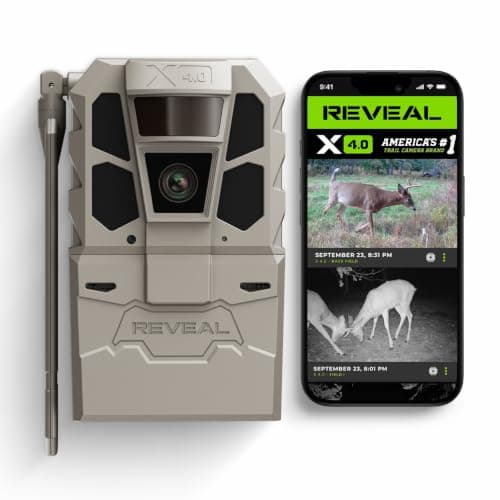 Tactacam Reveal X 4.0 14.1 months of photos measured on Energizer Ultimate Lithium. Twelve cells and a frugal upload schedule are why a cellular camera can run over a year. | Longest-running cellular cameraTactacam Reveal | 7.7 /10 | $129.97Amazon |
| 5 | 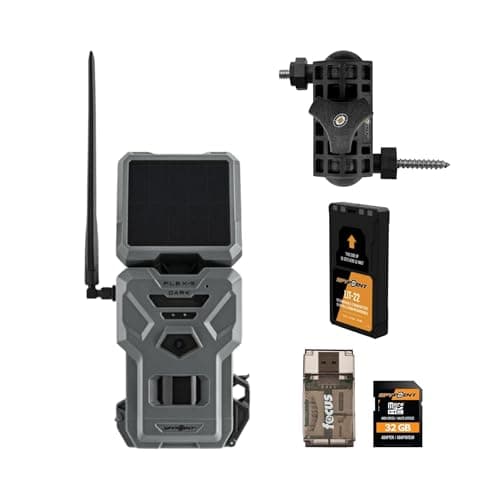 Spypoint Flex-S-Dark An integrated panel and battery Spypoint says replaces up to 1,000 AA batteries. Runtime stops being a number and becomes a question about sun. | Best with no cells at allSpypoint | 8.8 /10 | $219.99Amazon |
#ad · Prices come live from Amazon, last checked October 12, 2026. Scores are ours, built from published specs, verified plan prices and cited independent tests, not our own field measurements. Row photos are Amazon's own product images where a listing supplies one, and a blank panel where the maker sells elsewhere and supplies none. Tap a row for the full write-up.
Measured runtime, not claimed runtime
“Up to one year battery life” appears on the spec sheet of almost every trail camera sold, including several that will not reach a season. It is not usually a lie; it is an untestable claim about an unstated duty cycle. A camera that takes four photos a day in daylight will outlast one that takes two hundred photos a night with the flash at full power by a factor of twenty, and both claims can say “up to one year.”
So this page ranks the cameras for which somebody has published a figure with a stated mode and a stated cell type. Trailcampro's battery estimates are the source for four of the five picks: they state photo mode or video mode, and they state Energizer Ultimate Lithium cells. That makes them comparable with each other, which is the whole point. Where a maker claim is all that exists, we say so rather than ranking on it.
The measured figures, side by side
| Camera | Cells | Photo mode | Video mode | Source of the figure |
|---|---|---|---|---|
| GardePro T5NG | 8 AA | 31.1 months | Not published | Trailcampro estimate, lithium cells |
| GardePro T5NG Pro | 8 AA | 29.8 months | 6 months | Trailcampro estimate, lithium cells |
| Alpha Cam Dual Lens No Glow | 8 AA | 29 months | 3.2 months | Trailcampro estimate, lithium cells |
| Tactacam Reveal X 4.0 | 12 AA | 14.1 months | 4.1 months | Trailcampro measurement, Energizer Ultimate Lithium |
| Spypoint Flex-S-Dark | None required | Integrated panel and battery | Integrated panel and battery | Spypoint claim: replaces up to 1,000 AA batteries |
Two things jump out of that table. The three card cameras are all within about two months of each other despite different prices, which tells you the AA count and the duty cycle matter far more than the brand. And the drop from photo mode to video mode is between five and nine times on every camera where both figures exist.
Video is what kills batteries
A still photo is a short sensor read and, at night, one flash pulse. A ten-second night video is ten seconds of continuous illumination plus continuous encoding, which is why the Alpha Cam falls from 29 months to 3.2 and the T5NG Pro from 29.8 to 6. If your camera dies every eight weeks and you have video or hybrid mode switched on, you have found the reason, and you did not need a new camera.
The cameras, spec by spec
Why cellular cameras run shorter
A cellular camera does everything a card camera does and then powers a radio. Waking an LTE modem, negotiating with a tower and uploading an image costs more energy than taking the photo did, and a camera on a weak signal spends longer transmitting at higher power than one sitting under a tower. That is the mechanism behind the gap between 31.1 months and 14.1 months, and it is also why two identical cameras in different corners of the same property can differ by months.
Three things shorten it further: live view sessions, on-demand photo requests, and a per-photo plan generous enough that you leave the burst count high. Three things lengthen it: a stronger signal (an external antenna is the cheapest fix), fewer and smaller uploads, and an external pack or panel. The antenna options are in best cellular trail camera antennas, and the low-signal problem in general is in best cellular camera for low signal.
If the honest answer is that you will never get a year out of a cellular camera on cells, stop trying. An integrated-solar body such as the Flex-S-Dark, or any camera with a 12V jack and a panel behind it, changes the question from “how long do the batteries last” to “does this set get sun.” Both framings are compared in are solar trail cameras worth it.
In detail
The picks, in full
Rank 1
Longest measured runtime
GardePro T5NG
Trailcampro estimates 31.1 months in photo mode on lithium AA cells, the longest figure in our registry. Eight cells, no plan, no panel, no excuses.
Spec sheetSpec-checked · sources linked
How the 8.5 score breaks down
- Trigger speed & recovery (25%)
- 6
- Night image quality (25%)
- 9
- Battery life (20%)
- 10
- Detection range & field of view (15%)
- 9
- Ease of use & value (15%)
- 9
What the spec sheet supports
- Trailcampro scored it 91/100 and called the picture quality best in class
- 110 ft detection with a wide 55° detection angle
- Extraordinary battery estimate in photo mode
- $89.95 at Trailcampro when checked
Where it falls short
- 0.54 s trigger is fine for scrapes and feeders, slow for a crossing
- Video mode cuts the battery estimate to 5.7 months
- Trailcampro notes iPhone users must use the Files app to view photos
Skip this if…
…you need sub-0.3 s at a pinch point; buy the Browning Strike Force Pro X instead.
#ad · Price as of October 12, 2026 · Disclosure for the link to GardePro T5NG
Rank 2
Best runtime with a screen
GardePro T5NG Pro
29.8 months in photo mode measured, plus an internal viewing screen so you can check the frame at the tree and never open it again.
Spec sheetSpec-checked · sources linked
How the 8.8 score breaks down
- Trigger speed & recovery (25%)
- 6
- Night image quality (25%)
- 9
- Battery life (20%)
- 10
- Detection range & field of view (15%)
- 10
- Ease of use & value (15%)
- 10
What the spec sheet supports
- 91/100 at Trailcampro, from measured figures rather than a maker claim
- 120 ft of measured detection, the longest on the SD cameras we rank
- 29.8 months of photo-mode battery on 8 AAs by Trailcampro's estimate
- A screen on the camera, so you aim and check it without a laptop
Where it falls short
- 0.51 s trigger is a feeder-and-scrape figure, not a crossing figure
- Trailcampro flags it as sensitive to vegetation in the detection lane
- Video mode cuts the battery estimate to 6 months
- Trailcampro notes no hole to lock the latch, and that Apple users need the Files app
Skip this if…
…you are covering a pinch point where deer move through fast; a Browning HP5 Ultra body triggers in 0.1 to 0.7 s and you can set it.
#ad · Price as of October 12, 2026 · Disclosure for the link to GardePro T5NG Pro
Rank 3
Best runtime with a night sensor
Alpha Cam Dual Lens No Glow
29 months in photo mode measured, with a second lens dedicated to night. The 3.2-month video figure shows exactly what video costs.
Spec sheetSpec-checked · sources linked
How the 8.5 score breaks down
- Trigger speed & recovery (25%)
- 8
- Night image quality (25%)
- 9
- Battery life (20%)
- 9
- Detection range & field of view (15%)
- 7
- Ease of use & value (15%)
- 9
What the spec sheet supports
- Two lenses, one tuned for night, at a third of what dual-sensor cameras usually cost
- 0.3 s measured trigger with a 0.7 s measured recovery: both figures published, both measured
- Trailcampro praises the detection circuit and calls the battery life incredible
- 2.4-inch screen on the camera
Where it falls short
- 90 ft detection at 41.5° is a narrower cone than the GardePro T5NG Pro's
- 1080p video only, and video mode drops the battery estimate to 3.2 months
- Trailcampro's one complaint: the SD card is hard to remove
- Alpha Cam is a small brand: Trailcampro's measurements are the only independent data on it, and stock runs thin
Skip this if…
…you want the longest detection cone for a field edge; the T5NG Pro measured 120 ft at a wider angle for $20 less.
#ad · Price as of October 12, 2026 · Disclosure for the link to Alpha Cam Dual Lens No Glow
Rank 4
Longest-running cellular camera
Tactacam Reveal X 4.0
14.1 months of photos measured on Energizer Ultimate Lithium. Twelve cells and a frugal upload schedule are why a cellular camera can run over a year.
Spec sheetSpec-checked · sources linked
How the 7.7 score breaks down
- Trigger speed & recovery (20%)
- 7
- Night image quality (20%)
- 7
- Battery & solar life (20%)
- 9
- Real monthly plan cost (20%)
- 8
- Detection range & field of view (10%)
- 8
- App, setup & reliability (10%)
- 7
What the spec sheet supports
- 0.29 s measured trigger: the fastest figure on this page
- 14.1 months of photo battery life measured by Trailcampro, the longest here
- 90 ft measured detection, 10 ft further than the Pro 4.0
- Same unlimited Live View sessions as the Pro for less camera money
Where it falls short
- Low-glow only: a faint red glow at night, and no no-glow option in the app
- No screen at all, so aiming and every Live View session go through the phone
- 11.1-second measured photo recovery, the same weakness as the Pro 4.0
- Live View is still $6/mo per camera on top of the data plan
Skip this if…
…the set is a pressured public-land trail or a gate you're watching for people; buy the selectable-flash Pro 4.0 or a 940nm no-glow camera instead.
#ad · Price as of October 12, 2026 · Disclosure for the link to Tactacam Reveal X 4.0
Rank 5
Best with no cells at all
Spypoint Flex-S-Dark
An integrated panel and battery Spypoint says replaces up to 1,000 AA batteries. Runtime stops being a number and becomes a question about sun.
Spec sheetSpec-checked · sources linked
| Plan ecosystem | Spypoint. The plan decides the running cost; see the plan explainer linked on this page. |
|---|---|
| Network | Dual-SIM, automatically connects to all major carriers |
| Plan | Free 100 photos/mo; Basic $5 ($4 annual); Standard $10 ($7); Premium unlimited $15 ($10); one plan per camera |
| Trigger speed | 0.3 s |
| Detection range | 100 ft |
| Flash | Low-glow and no-glow LEDs |
| Flash range | 100 ft; sixth overall in Trailcampro's 2026 flash-range shootout |
| Photo resolution | 40MP |
| Video | 1080p; livestreaming video (Spypoint lists it as coming spring 2026) |
| Solar | Built-in solar panel and battery; 'replaces up to 1,000 AA batteries' (maker claim) |
| App features | GPS locator on the in-app map, remote activation, over-the-air updates |
| Warranty | 2 years |
How the 8.8 score breaks down
- Trigger speed & recovery (20%)
- 8
- Night image quality (20%)
- 9
- Battery & solar life (20%)
- 9
- Real monthly plan cost (20%)
- 10
- Detection range & field of view (10%)
- 8
- App, setup & reliability (10%)
- 8
What the spec sheet supports
- Integrated solar with no cable to route or panel to aim
- Same 0.3 s / 100 ft / dual-LED spec as the Flex-Dark
- Free 100-photo tier; $10/mo annual unlimited
- $149.99 at Spypoint, under the Moultrie Edge 4 Solar
Where it falls short
- A camera-mounted panel only works where the camera faces the sun; shaded sets still starve
- No published recovery time or battery capacity figure
- Fits CAMLOCKbox box 11, a different box from the Flex-Dark, so boxes don't swap
- Out of stock at Spypoint on 2026-10-09; Trailcampro had it at $169.95 and Amazon stock was marked up well above list
Skip this if…
…your sets are in deep timber with no direct sun; a separate 10W panel you can aim (SPLB-22) beats a built-in one there.
#ad · Price as of October 12, 2026 · Disclosure for the link to Spypoint Flex-S-Dark
Buyer's guide: buying runtime
Count the cells before you read the claim
Eight AA cells is the standard; twelve and sixteen exist and cost proportionally more to refill. A camera that reaches thirty months on eight cells is genuinely frugal. A camera that reaches a year on sixteen is not.
Lithium primaries, every time, for a long soak
Every measured figure on this page assumes lithium AA cells. Alkalines will not come close, and they leak when they are flat, which can end the camera rather than just the season. Rechargeable NiMH cells are excellent value on sets you service regularly. The comparison is in best batteries for trail cameras.
An external port is worth more than a bigger tray
A 12V jack or a USB-C input turns runtime from a hardware spec into a choice: a battery box, a panel, or a pack you swap. Cameras without one are permanently limited to whatever the tray holds. See external battery packs and 12V battery boxes.
Match the runtime to the trip, not to a record
Thirty months of runtime is only valuable if you were otherwise going to walk in. If the camera is two hundred yards from the truck, a twelve-month camera and a thirty-month camera cost you the same amount of effort, and you should spend the difference on trigger speed or flash instead.
Watch the battery meter, but do not trust it in the cold
A meter reads voltage, and cold cells read higher at rest than they can sustain under a flash load. A camera showing two-thirds charge in January may already be unable to light a night frame. The cold-weather version of this page is best trail cameras for cold weather.
How we scored this
The research behind these picks
Every pick here is built from documented evidence: the maker's published trigger speed, flash type, battery configuration and detection range; each brand's plan tiers verified on its own plan page and turned into the real monthly cost at one and four cameras; the independent shootouts (Trailcampro, Outdoor Life, Field & Stream, TechGearLab) cited by name for the measurements they published; and a public rubric applied the same way to every model. Every figure links to where it came from, so you can check our work in one click.
Scores are editorial judgments from that documented research. Commissions never set a score or decide a pick. The rubric and its weights are published.
Corrections & updates
- Published. Every runtime figure is a Trailcampro estimate or measurement with the mode and cell type stated, except the Spypoint integrated-panel claim, which is attributed to Spypoint.
Questions
Frequently asked
Which trail camera has the longest battery life?
The GardePro T5NG, at an estimated 31.1 months in photo mode on eight lithium AA cells per Trailcampro. The T5NG Pro is close behind at 29.8 months and adds an on-camera viewing screen.
How long do trail camera batteries actually last?
In photo mode on lithium AA cells, the best card cameras measure between 29 and 31 months and the best cellular cameras around 14. In video mode the same cameras measure three to six months. Alkaline cells and cold weather cut all of those figures substantially.
Why do cellular trail cameras have shorter battery life?
Because transmitting an image costs more energy than capturing it. The LTE modem has to wake, find a tower and upload, and on a weak signal it transmits longer and at higher power. A stronger signal, fewer uploads and no live-view sessions all extend runtime.
Does video mode drain a trail camera faster?
Dramatically. Across every camera in our registry with both figures published, video mode costs five to nine times what photo mode does: the Alpha Cam falls from 29 months to 3.2, the GardePro T5NG Pro from 29.8 to 6, and the Tactacam Reveal X 4.0 from 14.1 to 4.1.
Is a solar trail camera better than long battery life?
On a sunny set, yes, because the runtime becomes effectively unlimited. On a shaded set in winter, a camera with a thirty-month tray of lithium cells is the safer bet. Prefer a body that accepts both, so you can add a panel without replacing the camera.
Keep reading
Related on Cam & Canopy
- Trail camera battery life explainedThe arithmetic behind every figure on this page.
- Best batteries for trail camerasLithium, rechargeable and what not to buy.
- Best trail cameras for cold weatherThe same question when it is below freezing.
- External battery packsTurning a tray into a choice.
- Best trail cameras for the moneyWhere these cameras rank on value.
- Trail camera settingsThe four settings that decide runtime.
Receipts
Sources
- Trailcampro — GardePro T5NG review, measured figures (checked 2026-09-21)
- Trailcampro — GardePro T5NG Pro review, measured figures, score and stock (checked 2026-09-28)
- Trailcampro — Alpha Cam Dual Lens No Glow review, measured figures, score and stock (checked 2026-09-28)
- Trailcampro — Tactacam Reveal X 4.0 product page, measured figures and stock (checked 2026-09-24)
- Tactacam — REVEAL X 4.0 product page (checked 2026-09-24)
- Spypoint — FLEX-S-DARK product page (checked 2026-09-21)
- Energizer — Ultimate Lithium AA product page (checked 2026-09-21)
- MicroBattery — Panasonic eneloop pro AA BK-3HCCA spec listing (checked 2026-09-21)
Every number above is traceable: specs come from the maker's own product pages (linked on every product), plan prices from the maker's plan page with an “as of” date, and independent measurements are attributed to whoever made them. Amazon prices change often, so every buy button takes you to Amazon's current price for that listing. Read the full method.