Scouting · Guide
How many trail cameras do I need? Fewer good ones beat more cheap ones
The usual answer is one camera per 80 to 160 acres, which is a number without an argument behind it. The useful answer starts from how many distinct questions you are trying to answer, then checks what the plan bill looks like when you multiply.
By Mike M.Updated Spec-checked · every figure sourced
#adReader-supported: we may earn a commission if you buy through our links, at no extra cost to you. It never decides a ranking. How we rank · Disclosure
The short answer
Two to four. That covers almost everybody, and the people who genuinely need more usually know it already because they are managing ground rather than hunting it.
The reason the standard advice — one camera per 80 to 160 acres — does not help is that deer do not use acres evenly. A quarter-section with one creek crossing and one field edge has two camera sites and five hundred acres of nothing. A forty-acre block with three pinch points, a mineral site and a gate has five. Density is the wrong unit.
Count questions, not acres
Write down what you actually want to know this season. Each item on that list is one camera. Typical lists look like this:
- Inventory. What bucks are using this property. One camera on a mineral site or a feeder, where animals stop and the camera gets time to work. A slow camera is fine here.
- Entry and exit. Which trail they use coming into the food plot, and at what time. One camera on the heaviest trail, angled down it rather than across it. This needs a fast camera.
- Pressure. Who else is on the ground — other hunters, trespassers, dogs. One camera on the access road or the gate, in no-glow, in a security box.
- A specific animal. Is he still here, and where is he at daylight. One camera where you last had him, moved as the answer changes.
That is four cameras for a property most people hunt, and each one is a different camera spec. The inventory camera can be a cheap card camera; the gate camera should be invisible and locked; the trail camera needs the fastest recovery you can afford. Which spec suits which job is in how to choose a trail camera, and the placement for each is in trail camera placement.
What acreage actually tells you
Acreage is useful for one thing: an upper bound on how many camera sites exist. Walk the ground and count the features where animals are funnelled — creek crossings, saddles, fence gaps, field corners, gates, water, mineral, bedding edges. On most properties that number is smaller than people expect, and it does not scale linearly with size.
If you want a rule of thumb that is at least honest about its own limits: on 40 to 80 acres, two to three cameras will see nearly everything that matters. On 160 acres, three to five. Beyond that you are no longer trying to photograph every deer, you are sampling, and then camera count is a budget question rather than a coverage one.
The cost of the fourth camera
This is where camera count stops being a scouting question. On cellular, every camera you add carries its own plan, and the structures differ enough to change the answer.
| Ecosystem | 1 camera | 2 cameras | 4 cameras | Structure |
|---|---|---|---|---|
| Spypoint, free tier | $0 | $0 | $0 | 100 photos/mo per camera |
| Spypoint unlimited, annual | $10/mo | $20/mo | $40/mo | Flat per camera |
| Tactacam Pro unlimited | $13/mo | $25/mo | $49/mo | Discounted additional cameras |
| Moultrie Unlimited | $12.99/mo | $25.98/mo | $51.96/mo | Flat per camera |
| Stealth Cam Unlimited | $20/mo | $35/mo | $57/mo | Descending per camera |
Read the gap between the first and last rows. Four cameras is free on Spypoint's metered tier and $684 a year on Stealth Cam unlimited, for substantially the same photographs. If you are planning a four-camera set, choose the ecosystem for the four-camera total rather than for the first camera's price — switching later means replacing hardware. All verified tiers are in cellular plans compared and the multi-camera arithmetic in plans for multiple cameras.
The mix that covers more ground for less
Almost nobody needs every camera to be cellular, and the people who buy four cell cams usually did not do the arithmetic. The cheapest way to cover a property properly is a mix:
- One or two cellular cameras on the sets you most want live information from and can least conveniently reach — typically the gate and the main entry trail.
- Two or three card cameras on the sets you walk past anyway: the mineral site, the field corner, the back fence. Nothing per month, better imaging per dollar, and faster.
- Wi-Fi instead of cellular anywhere inside your own router's reach. A hub-based camera gives you remote photos with no subscription at all, and one hub carries up to sixteen cameras — see do trail cameras need Wi-Fi.
A two-cellular, three-card set costs $20 to $26 a month to run. Five cellular cameras on the same tier costs $60 or more. Same coverage. The honest case for and against going all-cellular is in are cellular trail cameras worth it.
What to buy at each camera count
Our picks for this
One card camera and three cellular bodies, for three different camera counts
The card camera is what to add once you already have a cell cam. The three cellular bodies are chosen for one camera, for a cheap four, and for a four you want an app for.
- GardeProNo image
Best measured value
GardePro T5NG Pro
SD / Wi-Fi8.8/10The camera to add for free running cost: 0.51 s and 120 ft measured, 91/100, an internal screen, at $99.95. Buy two of these before you buy a second cell cam.
Check price · Amazon#ad · Price as of October 17, 2026 · Disclosure for the link to GardePro T5NG Pro
Best cheap multi-carrier camera
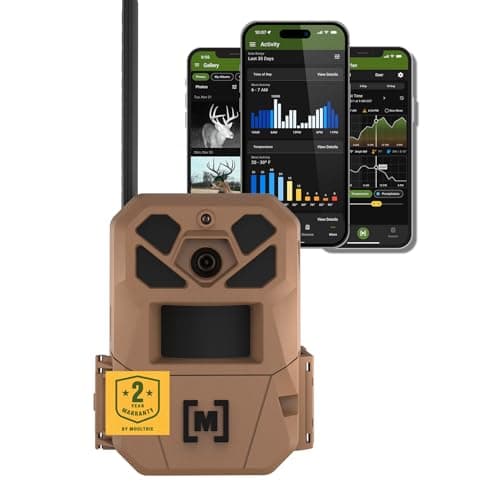
Moultrie Edge 3
Moultrie Mobile6.4/10The best single cellular camera: a roaming SIM and published tiers at $8.99 and $12.99 per camera. Right answer when the count is one or two.
$66.49Amazon#ad · Price as of October 17, 2026 · Disclosure for the link to Moultrie Edge 3
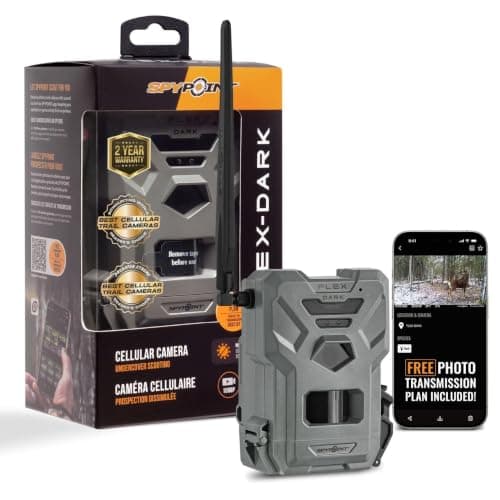
Best no-glow cellular camera
Spypoint Flex-Dark
Spypoint8.4/10The cheapest four-camera set anywhere: 100 photos per camera per month at $0, or $40/mo for four on annual unlimited, with a no-glow flash.
$97.59Amazon#ad · Price as of October 17, 2026 · Disclosure for the link to Spypoint Flex-Dark
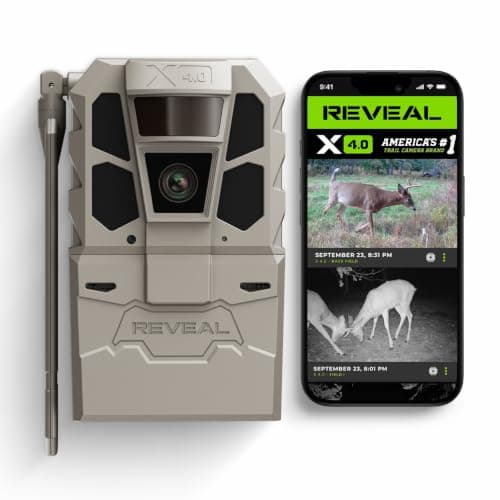
Best value live view
Tactacam Reveal X 4.0
Tactacam Reveal7.7/10If you want the app and four cameras: $49/mo for four on unlimited thanks to discounted additional cameras, and the fastest measured trigger in the Reveal line at 0.29 s.
$129.97Amazon#ad · Price as of October 17, 2026 · Disclosure for the link to Tactacam Reveal X 4.0
Three ways people over-buy
Buying cameras instead of moving one. A single camera moved three times in a season produces better information than three cameras left in mediocre spots, because you learn the ground. If you are not sure where to hang a camera, that is an argument for one camera and a month of patience, not for three.
Buying a camera for a question already answered. You do not need a second camera on the food plot. You need one on the trail leading into it.
Buying cheap to buy many. Four $40 cameras with slow triggers, visible flashes and no published specs produce four sets of useless frames. Two good cameras in the right places are worth more. The bottom of the market is surveyed honestly in best trail cameras under $50, and the value band in best trail cameras for the money.
Whatever count you land on, every camera you add is another thing to secure. Steel boxes and cables are cheap compared with replacing a camera and losing a season of data: see best trail camera security boxes and how to keep a trail camera from being stolen.
How we scored this
The research behind these picks
Every pick here is built from documented evidence: the maker's published trigger speed, flash type, battery configuration and detection range; each brand's plan tiers verified on its own plan page and turned into the real monthly cost at one and four cameras; the independent shootouts (Trailcampro, Outdoor Life, Field & Stream, TechGearLab) cited by name for the measurements they published; and a public rubric applied the same way to every model. Every figure links to where it came from, so you can check our work in one click.
Scores are editorial judgments from that documented research. Commissions never set a score or decide a pick. The rubric and its weights are published.
Questions
Frequently asked
How many trail cameras do I need per acre?
Acreage is the wrong unit. Walk the ground and count the places animals are funnelled — crossings, saddles, gaps, gates, water, mineral. On 40 to 80 acres that is usually two or three sites; on 160 acres, three to five. Buy one camera per question you want answered, not per unit of area.
Is one trail camera enough?
For a first season, often yes — and a single camera moved three or four times teaches you more about the property than three cameras left in guessed spots. Add the second once you know which question the first one cannot answer.
How much do four cellular trail cameras cost per month?
Between $0 and $57 a month depending on the brand and tier: free on Spypoint's 100-photo tier, $40 on Spypoint annual unlimited, $49 on Tactacam Pro, $51.96 on Moultrie Unlimited and $57 on Stealth Cam Unlimited. All read from the makers' own plan pages.
Should all my trail cameras be cellular?
Usually not. Put cellular on the one or two sets you cannot easily reach and card or Wi-Fi cameras on the rest. A mixed five-camera set runs $20 to $26 a month; five cellular cameras runs $60 or more for the same coverage.
Can you have too many trail cameras?
Yes, in two ways. Each camera is another visit, another set of batteries and another plan line, and more cameras mean more human traffic on the property. Beyond three or four, each additional camera typically tells you less than moving an existing one would.
Keep reading
Related on Cam & Canopy
- Trail camera placementWhere each of those cameras should go.
- Plans for multiple camerasThe bill behind the camera count.
- How to choose a trail cameraWhich spec each job needs.
- Are cellular trail cameras worth itWhether any of them should be cellular.
- How often to check trail camerasWhat more cameras cost you in visits.
Receipts
Sources
- Spypoint — photo transmission plans (checked 2026-09-21)
- Tactacam — REVEAL app plans page (checked 2026-09-21)
- Moultrie Mobile — plans page (checked 2026-09-21)
- Stealth Cam — Command data plans page (checked 2026-10-01)
- Trailcampro — GardePro T5NG Pro review, measured figures, score and stock (checked 2026-09-28)
- Trailcampro — Tactacam Reveal X 4.0 product page, measured figures and stock (checked 2026-09-24)
- Moultrie — EDGE 3 product page (checked 2026-09-21)
- Spypoint — FLEX-DARK product page (checked 2026-09-21)
- Trailcampro — GardePro T6LRW review, measured figures and stock (checked 2026-09-26)
Every number above is traceable: specs come from the maker's own product pages (linked on every product), plan prices from the maker's plan page with an “as of” date, and independent measurements are attributed to whoever made them. Amazon prices change often, so every buy button takes you to Amazon's current price for that listing. Read the full method.