Trail Cameras · Guide
How to choose a trail camera: five decisions, in the order that actually matters
Nobody picks a trail camera badly because they got the megapixels wrong. They pick badly because they bought a cellular camera for a spot with no signal, or a slow camera for a travel corridor, or a visible flash for a gate on public land. Here is the order to decide in.
By Mike M.Updated Spec-checked · every figure sourced
#adReader-supported: we may earn a commission if you buy through our links, at no extra cost to you. It never decides a ranking. How we rank · Disclosure
Decide in this order
Most trail camera buying guides start with specs and work outward. That gets it backwards, because four of the five decisions below are determined by where you are hanging the camera, not by what you would like it to do. Answer them in order and the shortlist writes itself.
- Delivery: cellular, Wi-Fi or card.
- Recovery time: how many animals per pass you need.
- Flash: whether being seen costs you anything.
- Power: batteries, 12V, or a panel.
- Plan: the monthly figure, multiplied by the camera count and the years.
1. How do the photos reach you
This single question eliminates most of the market, so ask it first. There are three mechanisms and they are not interchangeable.
SD card. You walk to the camera and pull the card. No plan, no app, no bill, and every spec dollar goes into the camera instead of the radio — which is why the fastest and best-imaging cameras on this site are card cameras. The cost is the walk, and the scent and disturbance that come with it.
Wi-Fi. Two different things get called Wi-Fi. Direct Wi-Fi means the camera makes its own hotspot and your phone joins it from 45 to 165 ft away — you still walk to the tree, you just do not unstrap the camera. Hub Wi-Fi, which GardePro's T6LRW does, means the camera reaches a hub on your home router and the hub pushes to the app from anywhere, with no subscription. If your set is inside your own Wi-Fi footprint, that is the cheapest remote camera there is.
Cellular. The camera has its own SIM and sends photos over LTE from anywhere with signal. This is the only option for a lease, for public land, or for a back forty with no power and no internet. It is also the only option with a permanent monthly bill. The three-way comparison is in cellular vs Wi-Fi vs SD card.
2. How fast does it recover
Trigger speed gets all the attention and recovery time decides the outcome. Trigger speed is how long the camera takes to fire after it detects something; recovery is how long before it can fire again. A camera does not usually miss the deer — it misses the second, third and fourth deer in the group, and the buck trailing the does by eight seconds.
The spread in this category is enormous. Browning publishes 0.35 and 0.5 second recoveries. An independent lab measured 0.7 s on the Bushnell CORE DS-4K and 1.9 s on its cheaper sibling. On cellular cameras the same lab measured 11.0 seconds on the Tactacam Reveal Pro 4.0 and 40.3 seconds on the Bushnell CelluCORE 20. Forty seconds is a different product category from seven tenths of a second.
So match the number to the set. A feeder, mineral site, food plot or gate — anywhere the animal stops — forgives a slow camera entirely. A pinch point, a creek crossing, a fence gap or a trail junction does not. Most makers do not publish recovery at all; Browning is the exception. The full argument, with the arithmetic in feet of walking deer, is in trigger speed explained, and the fast cameras are ranked in fastest trigger speed trail cameras.
3. What does the flash give away
Three classes. No-glow (940nm) produces no visible light at all, reaches 80 to 100 ft typically, and is what you want anywhere somebody might see the camera. Low-glow (850nm) shows a faint red shine when it fires and reaches further — 96 to 130 ft on the cameras we rank. White flash produces colour night images and announces itself to everything.
The decision is not about deer as much as people think. It is about people: a visible flash on public land tells every other hunter where your camera is, and a visible flash on a gate tells anybody with a screwdriver the same thing. On private ground nobody else walks, low-glow buys you real extra reach for free. The evidence on whether animals react is in do deer avoid trail cameras, and the flash comparison is in no-glow vs low-glow.
4. How will you power it
Count the batteries before you buy. Cameras on this site take 6, 8, 12 or 16 AA cells, and a handful have sealed rechargeable packs instead. Sixteen AAs is a real recurring cost at lithium prices, and lithium is what every battery-life claim assumes — alkalines in November do not get close, and the failure shows up as black night photos rather than a dead camera.
Two features change the arithmetic. A 12V external jack takes a battery box or a panel without an adapter, which turns a camera you visit monthly into one you visit twice a year. An integrated or aimable solar panel does the same thing with no hiking at all, provided the set actually gets sun — a panel bolted to a camera pointed at a shaded trail collects very little. Start with battery life explained, best batteries for trail cameras and are solar trail cameras worth it.
5. What does it cost per month, forever
If you chose cellular, this is the biggest number in the purchase and most people find it out afterwards. A $99 camera on a $14.99 plan has cost more in data than hardware after fourteen months. Four cameras on an unlimited tier runs between $40 and $59 a month depending on the brand.
The structures differ more than the headline prices. Some brands charge flat per camera; one discounts each additional camera and sells an account-wide add-on; one steps the price down as you add cameras; one has a permanent free tier of 100 photos per camera per month. At one camera those differences are small. At four they are hundreds of dollars a year. Do the arithmetic before you buy the first camera, because switching ecosystems later means replacing hardware. Everything verified is in cellular trail camera plans compared and plans for multiple cameras.
Four cameras, four answers
Our picks for this
One camera for each way the five decisions can land
Not a ranking. These are four cameras that answer the delivery, speed, flash and plan questions differently, so you can see what each answer costs.
Best non-cellular trail camera
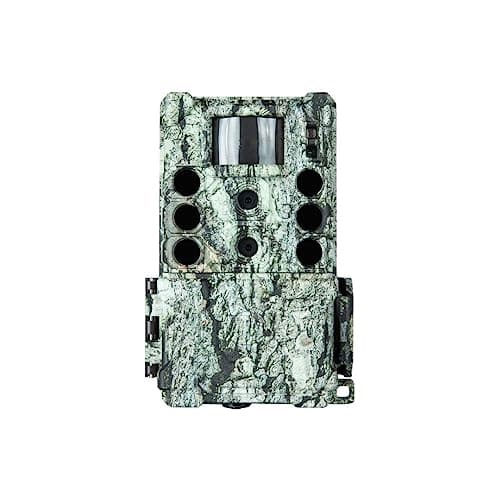
Bushnell CORE DS-4K No Glow
SD / Wi-Fi8.7/10Card camera, no plan: two sensors, a 0.15 s trigger, a measured 0.7 s recovery and 120 ft of no-glow range. The pick when you can walk to the camera and you want the best night frame.
$159.00Amazon#ad · Price as of October 17, 2026 · Disclosure for the link to Bushnell CORE DS-4K No Glow
- GardeProNo image
Best measured value
GardePro T5NG Pro
SD / Wi-Fi8.8/10Card camera, no plan, best value: 0.51 s and 120 ft measured, 91/100, an internal screen and a Trailcampro estimate of 29.8 months on lithium AAs, at $99.95.
Check price · Amazon#ad · Price as of October 17, 2026 · Disclosure for the link to GardePro T5NG Pro
Best cheap multi-carrier camera
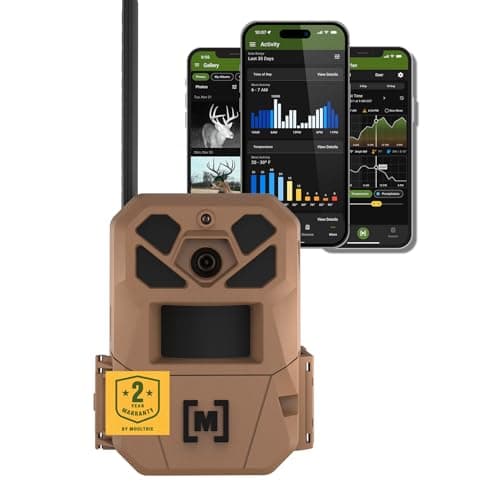
Moultrie Edge 3
Moultrie Mobile6.4/10Cellular, cheapest documented plan: a roaming SIM that picks its own network, and published tiers at $8.99 and $12.99 per camera. The default first cell cam.
$66.49Amazon#ad · Price as of October 17, 2026 · Disclosure for the link to Moultrie Edge 3
Best no-glow cellular camera
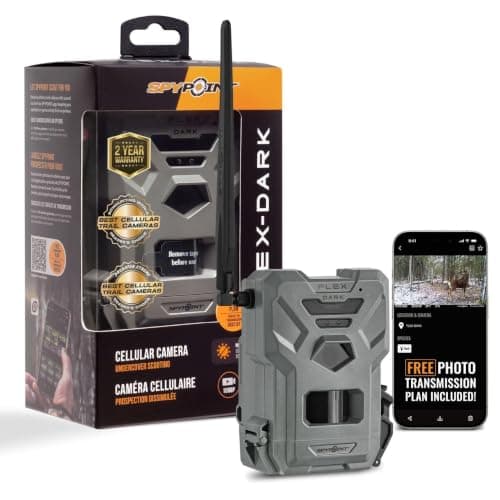
Spypoint Flex-Dark
Spypoint8.4/10Cellular, cheapest to run: a permanent free tier of 100 photos per camera per month, $10/mo unlimited on annual billing, and a no-glow flash.
$97.59Amazon#ad · Price as of October 17, 2026 · Disclosure for the link to Spypoint Flex-Dark
What to ignore
Megapixels. Trail camera sensors capture roughly 2 to 8 real megapixels. A 32MP, 48MP or 64MP figure is almost always an interpolated output size — software scaling a smaller capture up. An independent reviewer labels several of the popular claims interpolated and Moultrie says the same about its own 50MP number. Read the sensor arrangement and the flash range instead: trail camera megapixels explained.
Model year. New generations add app features more reliably than they add speed. In one family the cheaper previous-generation body measured faster, saw further and lasted longer than the new flagship.
Detection range alone. A 100 ft range at a 30-degree angle is a narrower working cone than 80 ft at 50 degrees, and the angle is what decides whether an animal crossing at forty feet actually trips the sensor: trail camera detection range.
Brand loyalty, unless it is cellular. With card cameras a card is a card, so mixing brands costs nothing. With cellular, staying inside one ecosystem means one app and sometimes a multi-camera discount, which is the one case where loyalty pays: best trail camera brands.
Once you have a camera, two things decide whether it earns its money: where you hang it and how you set it. Both are covered in trail camera placement, trail camera height and trail camera settings.
How we scored this
The research behind these picks
Every pick here is built from documented evidence: the maker's published trigger speed, flash type, battery configuration and detection range; each brand's plan tiers verified on its own plan page and turned into the real monthly cost at one and four cameras; the independent shootouts (Trailcampro, Outdoor Life, Field & Stream, TechGearLab) cited by name for the measurements they published; and a public rubric applied the same way to every model. Every figure links to where it came from, so you can check our work in one click.
Scores are editorial judgments from that documented research. Commissions never set a score or decide a pick. The rubric and its weights are published.
Questions
Frequently asked
What should I look for when buying a trail camera?
In order: how the photos reach you, recovery time between shots, flash type, power options and the monthly plan cost. Resolution and brand come last. The most common expensive mistake is buying a cellular camera for a location you never tested for signal.
Is a cellular trail camera worth it over an SD card camera?
It depends entirely on whether you can reach the camera. Cellular costs $5 to $20 a month per camera forever and spends part of its budget on a radio instead of a sensor. If the set is twenty minutes away, a card camera is faster, better and free to run. The full case is in are cellular trail cameras worth it.
How many megapixels do I need in a trail camera?
Far fewer than the box advertises. Any camera capturing a genuine 4 to 8 megapixels will let you identify a deer at sixty feet, provided the flash reaches that far. Spend the money on flash range, trigger speed and a dedicated night sensor instead.
What trigger speed do I actually need?
On a feeder, mineral site or food plot where animals stop, almost anything works — half a second is fine. On a trail, crossing or fence gap, look for a published figure under 0.3 s and, more importantly, a recovery time under a second. Most makers do not print recovery at all; Browning does.
Should I buy a no-glow or low-glow trail camera?
No-glow anywhere a person might see the camera — public land, a shared lease, a gate, a driveway. Low-glow on private ground nobody else walks, where the extra 20 to 40 ft of reach is free. See no-glow vs low-glow.
Keep reading
Related on Cam & Canopy
- Best trail camerasThe shortlist, once you know what you want.
- Cellular vs Wi-Fi vs SD cardDecision one, in full.
- Trigger speed explainedDecision two, with the arithmetic.
- Cellular plans comparedDecision five, every verified tier.
- Best trail cameras for the moneyIf budget is the first constraint rather than the last.
Receipts
Sources
- Bushnell — CORE DS-4K No Glow product page (checked 2026-09-21)
- Trailcampro — Bushnell Core DS-4K No Glow review, measured trigger, recovery, detection and scores (checked 2026-10-16)
- Trailcampro — GardePro T5NG Pro review, measured figures, score and stock (checked 2026-09-28)
- Moultrie — EDGE 3 product page (checked 2026-09-21)
- Moultrie Mobile — plans page (checked 2026-09-21)
- Spypoint — FLEX-DARK product page (checked 2026-09-21)
- Spypoint — photo transmission plans (checked 2026-09-21)
- Trailcampro — Tactacam Reveal Pro 4.0 review, measured figures (checked 2026-09-24)
- Trailcampro — Bushnell CelluCORE 20 review, measured trigger, recovery and detection figures (checked 2026-10-09)
- Browning Trail Cameras — Recon Force Elite HP5 Ultra product page (checked 2026-09-26)
- Trailcampro — GardePro T6LRW review, measured figures and stock (checked 2026-09-26)
Every number above is traceable: specs come from the maker's own product pages (linked on every product), plan prices from the maker's plan page with an “as of” date, and independent measurements are attributed to whoever made them. Amazon prices change often, so every buy button takes you to Amazon's current price for that listing. Read the full method.