Trail Cameras · Guide
Do trail cameras need Wi-Fi? No camera needs it to take a picture
Every trail camera ever made works with no internet, no Wi-Fi, no SIM and no phone. What a connection buys you is delivery: whether you walk to the tree, stand near it, reach it from your kitchen, or get a photo on your phone from two hundred miles away.
By Mike M.Updated Spec-checked · every figure sourced
#adReader-supported: we may earn a commission if you buy through our links, at no extra cost to you. It never decides a ranking. How we rank · Disclosure
The direct answer
A trail camera is a motion sensor, a lens, an infrared flash and a card slot. None of those four things needs a network. Hang any camera on this site in a hollow with no signal, no router and no phone within five miles, and it will photograph everything that walks past and store every frame. That is the baseline, and it is worth stating plainly because the marketing for connected cameras implies otherwise.
What a connection changes is the retrieval problem. Photographs are worthless until you see them, and the gap between the camera firing and you looking at the image is the thing all this technology is solving. Every option below is a different answer to “how far away can I be?”
The four kinds of connection
| Type | How far away you can be | Needs internet? | Monthly cost |
|---|---|---|---|
| SD card only | At the camera | No | $0 |
| Direct Wi-Fi (camera hotspot) | 45 to 165 ft, line of sight | No | $0 |
| Hub Wi-Fi (camera to home router) | Anywhere, via your own broadband | Yes, your house's | $0 |
| Cellular (own SIM, LTE) | Anywhere with signal at the camera | No — it is its own network | $5 to $20 per camera |
Two rows in that table get confused constantly, which is the whole reason this page exists: direct Wi-Fi and hub Wi-Fi are both sold as “Wi-Fi trail cameras” and do completely different jobs.
Direct Wi-Fi: the most misunderstood one
A direct Wi-Fi camera creates its own hotspot. Your phone joins that hotspot when you are standing near the tree, and you browse and download the images in an app. The camera is not on the internet; it is an access point broadcasting to whoever is in range.
Range is the spec to read, and it varies more than you would expect. GardePro publishes 45 ft for the E7 and A80, and 165 ft on the dual-antenna E8 2.0 bodies. One hundred and sixty-five feet is genuinely useful — it is the difference between walking to the tree and standing at the truck. Forty-five feet means you are under the camera anyway.
Hub Wi-Fi: remote photos with no plan
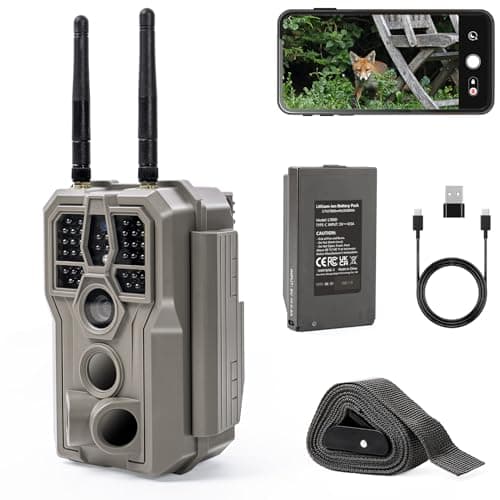
One camera we rank does something different. The GardePro T6LRW talks to a GardePro hub plugged into your home router, and the hub pushes images to the app from anywhere in the world. One hub carries up to sixteen cameras. There is no SIM, no carrier and no monthly fee of any kind.
The constraint is obvious: the camera has to be within radio range of a hub attached to your broadband. That rules out a lease two counties over and rules in a back forty, a barn, a driveway, a food plot behind the house, a fence line on your own ground. For those sets it is the cheapest remote camera in existence — and Trailcampro scored the T6LRW 93/100, the highest score on this site. The arithmetic against a cellular equivalent is in GardePro vs Tactacam.
Cellular: no Wi-Fi involved at all
A cellular camera does not use Wi-Fi, does not touch your router and does not care whether you have internet at the house. It carries its own SIM and connects to an LTE network exactly as a phone does, so the only requirement is signal at the tree.
Three things people get wrong about it. First, your own phone carrier is irrelevant — the camera brand sells you the data, so there is no AT&T or Verizon trail camera plan to buy. Second, a plan is mandatory on most brands: the camera will not transmit without one, and some will not operate at all. Third, signal at the tree is not the same as signal at the truck; two hundred yards and a ridge can be the whole difference. All three are covered in trail camera carriers explained, and the low-signal options in best cellular trail camera for low signal.
Do trail cameras need a SIM card?
Only cellular ones, and those ship with it already installed — you do not buy a SIM separately, and you cannot put your phone's SIM into a trail camera. Some cameras carry two SIMs and pick the stronger network automatically, which is the Bushnell CelluCORE 20's one real selling point. Card and Wi-Fi cameras have no SIM slot at all.
What every camera does need is a card or internal memory. Several cellular cameras have 8GB or 16GB built in, so a forgotten card does not cost you a season, but most cameras need one and will sit there doing nothing without it. Card size, speed and format are in the trail camera SD card guide.
One camera for each answer
Our picks for this
Four cameras, four connection types
Same brand for three of them on purpose: it shows how differently 'Wi-Fi' behaves within one range, and what a cellular plan buys over the top.
- GardeProNo image
Best Wi-Fi trail camera
GardePro T6LRW (Wi-Fi, hub)
SD / Wi-Fi8.2/10Hub Wi-Fi: photos on your phone anywhere, through your own router, with no subscription. One hub covers up to sixteen cameras. 93/100 at Trailcampro.
Check price · Amazon#ad · Price as of October 17, 2026 · Disclosure for the link to GardePro T6LRW (Wi-Fi, hub)
Best value Wi-Fi trail camera
GardePro E8 2.0 Pro (Wi-Fi)
SD / Wi-Fi8.1/10Direct Wi-Fi: 165 ft of dual-antenna range, so you pull images from the truck instead of the tree. 4K with audio, no monthly cost.
$98.99Amazon#ad · Price as of October 17, 2026 · Disclosure for the link to GardePro E8 2.0 Pro (Wi-Fi)
Best cheap multi-carrier camera
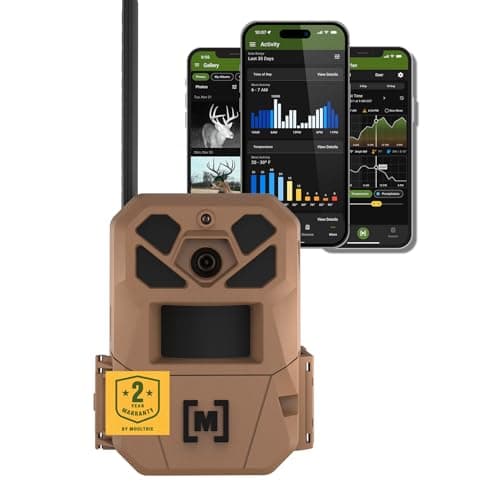
Moultrie Edge 3
Moultrie Mobile6.4/10Cellular: its own roaming SIM, photos from anywhere with signal, published plan tiers at $8.99 and $12.99 per camera.
$66.49Amazon#ad · Price as of October 17, 2026 · Disclosure for the link to Moultrie Edge 3
- GardeProNo image
Best measured value
GardePro T5NG Pro
SD / Wi-Fi8.8/10Card only: nothing to connect to, nothing to pay, and the best independently measured figures per dollar on this site - 0.51 s and 120 ft at $99.95.
Check price · Amazon#ad · Price as of October 17, 2026 · Disclosure for the link to GardePro T5NG Pro
Which one you actually need
- You can visit the camera every week or two. Card camera. It is faster, images better and costs nothing. Every spec dollar goes into the camera rather than the radio.
- You can visit, but you hate disturbing the set. Direct Wi-Fi with the longest range you can find.
- The camera is on your own property, within reach of your router. Hub Wi-Fi. Remote photos, zero monthly cost.
- The camera is somewhere you cannot get to. Cellular, and check the signal standing at the tree before you commit to an ecosystem.
One last honest note on cost. Four cameras on a cellular unlimited tier runs $40 to $59 a month depending on the brand, which is $2,400 to $3,540 over five years. Four hub Wi-Fi cameras sharing one hub is a one-time $719.75. If your ground allows Wi-Fi, that is the single biggest saving available in this hobby. The verified plan tables are in cellular plans compared, and the no-fee cellular routes in cellular trail cameras with no monthly fee.
How we scored this
The research behind these picks
Every pick here is built from documented evidence: the maker's published trigger speed, flash type, battery configuration and detection range; each brand's plan tiers verified on its own plan page and turned into the real monthly cost at one and four cameras; the independent shootouts (Trailcampro, Outdoor Life, Field & Stream, TechGearLab) cited by name for the measurements they published; and a public rubric applied the same way to every model. Every figure links to where it came from, so you can check our work in one click.
Scores are editorial judgments from that documented research. Commissions never set a score or decide a pick. The rubric and its weights are published.
Questions
Frequently asked
Do trail cameras need Wi-Fi to work?
No. Every trail camera records to a card or internal memory with no network of any kind. Wi-Fi only changes how you retrieve the photos — either from a phone standing near the camera, or through a hub on your home router.
Do trail cameras need internet?
Only hub-based Wi-Fi cameras, which use your own broadband to push images out. Card cameras, direct Wi-Fi cameras and cellular cameras all work with no internet at the property at all — a cellular camera carries its own LTE connection.
Do trail cameras need cell service?
Only cellular ones, and they need it at the camera rather than at your house. If the tree has no bars, a cellular camera is just an expensive card camera. Test the spot with your phone first, and consider a multi-carrier camera or a directional antenna for marginal locations.
Do trail cameras need a SIM card?
Only cellular ones, and the SIM is pre-installed — you do not buy one, and you cannot use your phone's. Some cameras carry two SIMs and automatically pick whichever network is stronger. Card and Wi-Fi cameras have no SIM at all.
Can a Wi-Fi trail camera send pictures to my phone when I am not home?
Only a hub-based one, such as the GardePro T6LRW, which relays through your home router. A direct Wi-Fi camera makes its own hotspot and reaches a phone only 45 to 165 ft away, so it cannot send you anything once you leave.
Keep reading
Related on Cam & Canopy
- Cellular vs Wi-Fi vs SD cardThe same decision, with the cameras ranked.
- Best Wi-Fi trail camerasEvery Wi-Fi camera we rank, direct and hub.
- Trail camera carriers explainedWhy your own phone carrier is irrelevant.
- Trail camera SD card guideThe one thing every camera does need.
- GardePro vs TactacamHub Wi-Fi against cellular, with the five-year arithmetic.
Receipts
Sources
- Trailcampro — GardePro T6LRW review, measured figures and stock (checked 2026-09-26)
- Trailcampro — store search "gardepro", prices, scores and stock (checked 2026-09-26)
- GardePro — E8 2.0 Pro Wi-Fi Trail Camera product page (checked 2026-09-26)
- GardePro — E7 Wi-Fi Trail Camera product page (checked 2026-09-28)
- GardePro — A80 Wi-Fi Trail Camera product page (checked 2026-09-28)
- Moultrie — EDGE 3 product page (checked 2026-09-21)
- Moultrie Mobile — plans page (checked 2026-09-21)
- Trailcampro — GardePro T5NG Pro review, measured figures, score and stock (checked 2026-09-28)
- Bushnell — CelluCORE 20 Dual Sim product page, published specs, $99.95 price and backorder status (checked 2026-10-16)
Every number above is traceable: specs come from the maker's own product pages (linked on every product), plan prices from the maker's plan page with an “as of” date, and independent measurements are attributed to whoever made them. Amazon prices change often, so every buy button takes you to Amazon's current price for that listing. Read the full method.