Scouting · Guide
How often should you check trail cameras? Less often than you want to, and only at the right time of day
Every visit leaves scent, noise and a track. The question is not how often you can check a camera but how much the information is worth against the disturbance of collecting it. For most card sets the answer is two to four weeks; for a cellular set it is when the batteries need it.
By Mike M.Updated Spec-checked · every figure sourced
#adReader-supported: we may earn a commission if you buy through our links, at no extra cost to you. It never decides a ranking. How we rank · Disclosure
The short answer, by camera type
| Camera type | Off-season interval | In-season interval | What forces the visit |
|---|---|---|---|
| SD card | 2 to 4 weeks | 3 to 4 weeks, or not at all | The card and the batteries |
| Direct Wi-Fi | 2 to 4 weeks, from 45 to 165 ft away | Same, without touching the camera | Batteries only |
| Hub Wi-Fi | Never, for images | Never, for images | Batteries only |
| Cellular | Never, for images | Never, for images | Batteries, a dirty lens, or a dead SIM |
That table is the entire argument for connected cameras in one block. A card camera on a hunted property costs you a dozen visits a year; a cellular camera on the same tree costs you two. Whether that is worth $5 to $20 a month per camera is the question answered in are cellular trail cameras worth it.
By season
Late winter and spring. Check as often as you like. Nothing you are going to hunt in November cares what you did in March, and this is the time to learn the ground, move cameras, test angles and find out which trees give you a clean frame.
Summer. Every three to four weeks is plenty. Bucks are predictable and in bachelor groups, mineral and water sites are producing, and the information changes slowly. This is also when the long-soak settings earn their keep: a camera on time-lapse or in a low-trigger mode at a field edge gathers a season of pattern data with no visits at all — see trail camera time lapse mode.
Early season and pre-rut. This is when the discipline matters. Patterns are forming, the information is at its most valuable, and so is your scent. Three to four weeks on cards, and move nothing on the sets you intend to hunt.
Rut. Deer are moving unpredictably and over long distances, which cuts both ways: your presence matters less because they are not holding tight patterns, and the information is less actionable for the same reason. If you are going to check a card camera mid-season, do it now.
Late season and post-season. Food sources concentrate everything, so cameras on the remaining food are productive, and deer are at their most pressure-sensitive. Check sparingly until the season closes, then go back to checking freely.
When in the day to go in
Midday, between roughly 10 a.m. and 3 p.m., when deer are least likely to be on their feet in the area you are walking through. Walking a trail at first light to pull a card is how you teach a mature buck that the trail has a person on it.
Better still, go in the rain. Wet weather kills scent faster than anything else you can arrange, covers the sound of your approach, and has the side benefit of being when you are least likely to be hunting anyway. If you can only get out once a month, pick the wet midday.
What a visit actually costs
Four things, every time you walk in:
- Scent, on the ground and at the tree. Where you stood is where you handled the camera, which is inside the detection zone by definition.
- Noise and movement. A strap unbuckled and a housing clicked shut is an unusual sound in the woods.
- A track in. On public land or a shared lease, your repeated route to a camera is a map for anybody who notices it. That is also the theft risk: see how to hide a trail camera.
- The chance you break something. A card put back wrong, a door not fully latched, an angle knocked. A meaningful share of “my camera stopped working” problems start at the last visit — see trail camera troubleshooting.
Let the batteries set the interval
Once images are coming to your phone, the only reason to walk in is power, and that is a problem you can buy your way out of. The measured runtimes are long: an independent lab estimated 29.8 months in photo mode for a GardePro T5NG Pro on 8 AA lithiums, 14.1 months for a Tactacam Reveal X 4.0 on 12, and 11 months for a GardePro T6LRW. Those are lithium figures; alkalines are nowhere close, and the first symptom of tired alkalines is black night photos from a camera still reporting charge.
So: lithium primaries or a 12V box or a panel, and the visit interval becomes a season rather than a month. Start with best batteries for trail cameras, battery life explained and best trail camera solar panels. The cameras that need the fewest refills are ranked in best trail cameras for battery life.
Three ways to check less
Our picks for this
Two connected cameras, a no-plan alternative, and the thing that makes a card visit quick
The first three remove the image-retrieval visit entirely. The last one is for people staying on cards, and it shortens the time you spend standing at the tree.
Best cheap multi-carrier camera
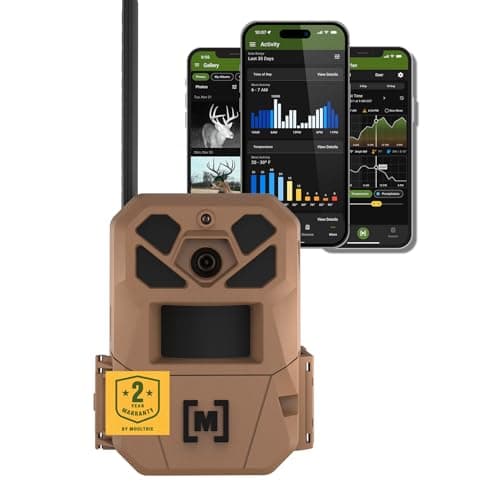
Moultrie Edge 3
Moultrie Mobile6.4/10Cellular with a roaming SIM and published tiers at $8.99 and $12.99 per camera. Photos arrive without you; you visit for batteries.
$66.49Amazon#ad · Price as of October 17, 2026 · Disclosure for the link to Moultrie Edge 3
- GardeProNo image
Best Wi-Fi trail camera
GardePro T6LRW (Wi-Fi, hub)
SD / Wi-Fi8.2/10Remote photos with no subscription at all, through a hub on your home router - if the set is within reach of your own Wi-Fi. 93/100 at Trailcampro.
Check price · Amazon#ad · Price as of October 17, 2026 · Disclosure for the link to GardePro T6LRW (Wi-Fi, hub)
Best no-glow cellular camera
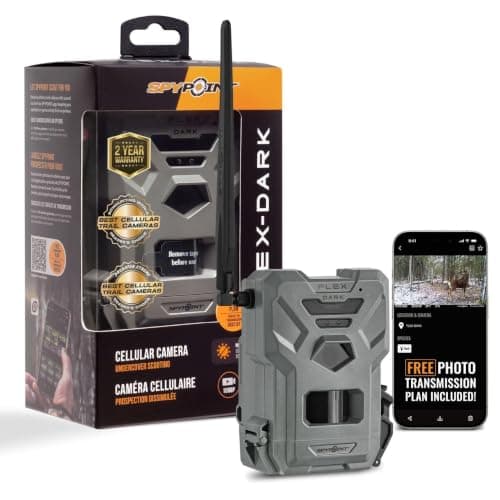
Spypoint Flex-Dark
Spypoint8.4/10The free-tier route to never walking in: 100 photos per camera per month at $0, no-glow flash, $10/mo unlimited on annual billing.
$97.59Amazon#ad · Price as of October 17, 2026 · Disclosure for the link to Spypoint Flex-Dark
Best reader for a Lightning iPhone
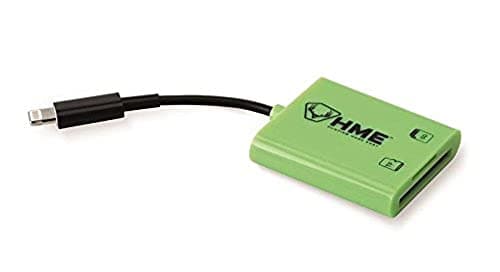
HME SD Card Reader for iOS
Accessory7.8/10If you are staying on cards, read them at the tree on your phone instead of carrying cards home and back. Thirty seconds at the camera instead of two trips.
$22.73Amazon#ad · Price as of October 17, 2026 · Disclosure for the link to HME SD Card Reader for iOS
A visit routine that leaves less behind
- Go at midday, in wet weather if you can choose.
- Walk a different route in than the trail the camera is watching.
- Carry a spare card and a spare set of cells so one visit does everything.
- Swap the card rather than reading it at the tree, or read it on your phone with a card reader.
- Wipe the lens and the sensor window. A spider web or a dew film is the commonest cause of blank frames and white night photos.
- Check the angle before you leave, using the camera screen or the app, so you do not discover a season of sky in February.
- Re-tighten the strap, latch the door firmly, and leave.
If you are getting a lot of empty frames rather than too few, the problem is the set rather than the schedule — start with trail camera false triggers and trail camera settings. And if the complaint is that a cellular camera has gone quiet rather than that you are visiting too often, work through cellular trail camera not sending pictures before you drive out.
How we scored this
The research behind these picks
Every pick here is built from documented evidence: the maker's published trigger speed, flash type, battery configuration and detection range; each brand's plan tiers verified on its own plan page and turned into the real monthly cost at one and four cameras; the independent shootouts (Trailcampro, Outdoor Life, Field & Stream, TechGearLab) cited by name for the measurements they published; and a public rubric applied the same way to every model. Every figure links to where it came from, so you can check our work in one click.
Scores are editorial judgments from that documented research. Commissions never set a score or decide a pick. The rubric and its weights are published.
Questions
Frequently asked
How often should you check trail cameras?
Every two to four weeks on a card camera outside the season, and every three to four weeks at most once you are hunting the area. On a cellular or hub Wi-Fi camera you never need to visit for images at all — only for batteries, a lens wipe or a fault.
What time of day should I check my trail camera?
Midday, roughly 10 a.m. to 3 p.m., when deer are least likely to be moving where you are walking. Rain is better than dry: it kills scent and covers sound. Avoid first and last light entirely on ground you intend to hunt.
Does checking trail cameras spook deer?
The camera itself is a minor factor; the visit is the real one. Every check leaves scent inside the detection zone, noise at the tree and a repeated track in. Mature deer respond to human traffic patterns more than to equipment, which is why the interval matters more than the camera brand.
Can I leave a trail camera out all year?
Yes, and most people should. On lithium AAs the measured photo-mode estimates run from 11 months to nearly 30 depending on the camera, and a 12V box or a solar panel extends that further. The limits are card capacity on an SD camera and plan allowance on a metered cellular tier.
How often do trail camera batteries need changing?
On lithium AAs, once or twice a year on most cameras and less on the efficient ones — an independent lab estimated 29.8 months of photo-mode runtime for one 8-AA card camera. On alkalines, expect a fraction of that, and expect the failure to look like black night photos rather than a dead camera.
Keep reading
Related on Cam & Canopy
- Trail camera placementWhere to hang it so you need fewer visits.
- Battery life explainedThe only thing that should force a visit.
- How many trail cameras do I needEvery camera you add is another visit.
- Are cellular trail cameras worth itWhat removing the visit is worth per month.
- Trail camera SD card guideCard size, so the card is not what forces the trip.
Receipts
Sources
- Trailcampro — GardePro T5NG Pro review, measured figures, score and stock (checked 2026-09-28)
- Trailcampro — Tactacam Reveal X 4.0 product page, measured figures and stock (checked 2026-09-24)
- Trailcampro — GardePro T6LRW review, measured figures and stock (checked 2026-09-26)
- Moultrie — EDGE 3 product page (checked 2026-09-21)
- Moultrie Mobile — plans page (checked 2026-09-21)
- Spypoint — FLEX-DARK product page (checked 2026-09-21)
- Spypoint — photo transmission plans (checked 2026-09-21)
- HME Products — SD Card Reader For IOS product page (checked 2026-09-26)
- Energizer — Ultimate Lithium AA product page (checked 2026-09-21)
Every number above is traceable: specs come from the maker's own product pages (linked on every product), plan prices from the maker's plan page with an “as of” date, and independent measurements are attributed to whoever made them. Amazon prices change often, so every buy button takes you to Amazon's current price for that listing. Read the full method.