Trail Cameras · The rankings
Best WiFi trail cameras: the range is the whole decision
A WiFi trail camera costs nothing per month, which is the appeal. What it costs you instead is distance: most of them only reach a phone standing 50 to 165 feet away. Two of the three here reach further than that, and one reaches your house.
By Mike M.Updated Spec-checked · every figure sourced
#adReader-supported: we may earn a commission if you buy through our links, at no extra cost to you. It never decides a ranking. How we rank · Disclosure
Quick picks
The rankings at a glance
| # | Product | Best for | Score | Price |
|---|---|---|---|---|
| 1 | No image GardePro T6LRW (Wi-Fi, hub) The only one here that genuinely reaches your house: it talks to a GardePro hub on your router from up to 2,100 ft through timber, carries up to 16 cameras per hub, and charges nothing monthly. Trailcampro scored it 93/100, the highest score of any camera on this site. | Best WiFi trail cameraSD / Wi-Fi | 8.2 /10 | Check price · Amazon |
| 2 | 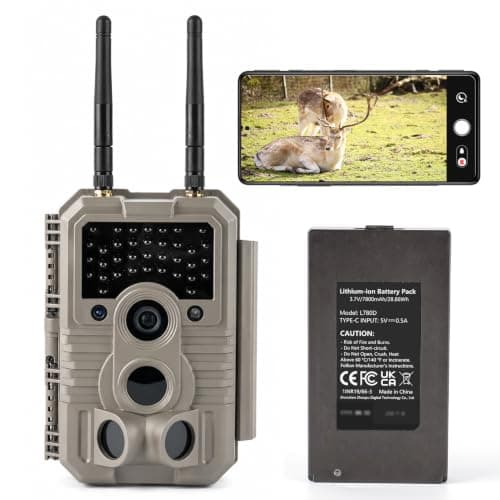 GardePro E9 3.0 Pro (Wi-Fi) Dual-mode WiFi: connect on site from 165 ft, or point it at a home router for alerts when you are away. A triple-PIR array with a human-versus-animal filter, for $119.99. GardePro publishes no trigger figure. | Best WiFi camera with remote alertsSD / Wi-Fi | 7.4 /10 | $119.99Amazon |
| 3 | 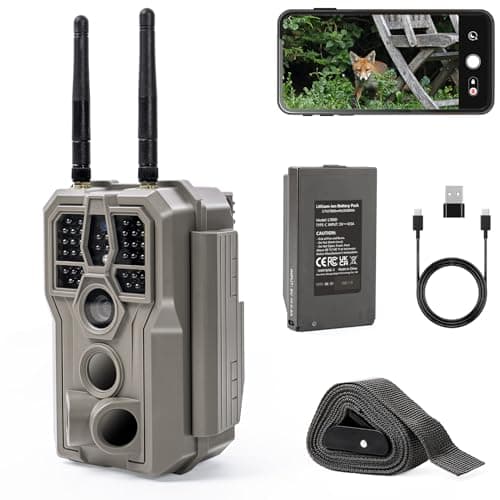 GardePro E8 2.0 Pro (Wi-Fi) A stated 0.1 s trigger, 4K video with audio and 165 ft of dual-antenna range for $99.99. It cannot reach a router, so you still walk to within range, but you no longer touch the camera. | Best value WiFi trail cameraSD / Wi-Fi | 8.1 /10 | $109.99Amazon |
#ad · Prices come live from Amazon, last checked October 11, 2026. Scores are ours, built from published specs, verified plan prices and cited independent tests, not our own field measurements. Row photos are Amazon's own product images where a listing supplies one, and a blank panel where the maker sells elsewhere and supplies none. Tap a row for the full write-up.
What WiFi actually means here
"WiFi trail camera" covers two completely different products, and the box rarely says which one you are holding.
A hotspot camera broadcasts its own private network. It does not touch the internet and it does not touch your router. You walk to the set, connect your phone to the camera, and pull photos off the card without opening the case or disturbing anything. GardePro's own collection page says so plainly: the cameras "function as a local hotspot for point-to-point connection", with a typical range of 30 to 50 feet. Their better models publish 165 ft with dual antennas. That is the whole promise, and it is a real one: the biggest reason a good set stops producing is the human who keeps walking up to it.
A hub camera is a different animal. It uses a long-range radio to reach a small box you plug into your home router, and the box puts the photos on the internet. Now the pictures arrive on your phone wherever you are, with no SIM, no carrier and no monthly bill. The GardePro T6LRW works this way; Trailcampro measured its camera-to-hub range at 480 yards in town and 2,100 ft rural through timber, and one hub carries up to 16 cameras.
Everything else on the spec sheet is secondary. A 64MP hotspot camera you have to stand beside is still a camera you have to stand beside. If you want to know which of the three architectures you actually need, our cellular vs WiFi vs SD card guide walks the decision from the other end.
How we ranked them
These use the same five-metric SD rubric as every non-cellular camera on this site, weighted for a WiFi buyer:
- Ease of use and value (15%), read as range first. Transmission distance is the metric that decides whether a WiFi camera changes your season or just saves you opening a latch. A measured figure beats a claimed one.
- Trigger speed and recovery (25%). This is where WiFi cameras are weakest and where the marketing is loudest. Trailcampro measured 0.56 s and 13.9 s on the T6LRW; GardePro claims 0.1 s on the E8 2.0 Pro and publishes no figure at all for the E9 3.0 Pro. See trigger speed explained.
- Night image quality (25%). All three are 940nm no-glow, which is the right choice on a camera near a house or a gate. Published night range where a maker states one.
- Battery life (20%). A hub camera has its radio on far more than an SD camera does. Trailcampro's 11 months of photo-mode life on eight AAs for the T6LRW is the only independently measured figure in this group.
- Detection range and field of view (15%). Published PIR range and angle. Two of the three publish nothing.
Every figure below links to the maker's page or to Trailcampro's published measurements, with the date we read it. Stock was checked at GardePro and at Trailcampro on 2026-09-26.
The three, on range and the numbers that matter
Read the Network and App features rows first, because that is the argument. The T6LRW's number is 2,100 ft to a hub that is on the internet. The E9 3.0 Pro's is 165 ft to your phone, plus a router mode that works only where your house WiFi already reaches. The E8 2.0 Pro's page states outright that it is "unable to connect to home router", so its 165 ft is 165 ft, full stop.
Then read Trigger speed and be honest with yourself about the set. The E8 2.0 Pro claims 0.1 s and the T6LRW measured 0.56 s, which looks like a rout until you notice that one number is a maker's best case and the other is a stopwatch. Trailcampro's 13.9 s recovery on the T6LRW is the figure that should actually worry you: a doe and her fawns walking through together will produce one photo.
Pick by where the camera hangs
| The set is | Buy | Because |
|---|---|---|
| Across the back forty, out of sight of the house, no cell service | GardePro T6LRW + hub | 2,100 ft rural range to a hub on your router; photos on your phone with no SIM and no plan |
| In the yard, on the barn, at the gate, inside your own WiFi | GardePro E9 3.0 Pro | Router mode sends alerts while you're away; triple PIR filters people from animals |
| On a feeder or a scrape you walk past weekly anyway | GardePro E8 2.0 Pro | 165 ft of range means you pull cards without touching the camera, for $99.99 |
| Four or six sets on one property | GardePro T6LRW, one hub | One $79.95 hub carries up to 16 cameras, so per-camera cost falls as you add sets |
| A pinch point where a buck crosses at a trot | Not a WiFi camera | Recovery times here run to 13.9 s; buy off the fastest-trigger ranking instead |
Our recommendation for each buyer; specs and stock as of 2026-09-26. Prices are set by the seller and change; the buy buttons go to a tagged Amazon search for each model, not to a price we've cached.
The WiFi cameras we didn't rank, and why the list is all one brand
This is the finding that surprised us, so we'll state it plainly: the four brands that dominate American trail cameras do not sell a local-WiFi camera. Browning, Bushnell, Moultrie and Stealth Cam all went cellular instead, because a plan is recurring revenue and a hotspot is not. Every camera on this page is a GardePro because GardePro is most of the category, not because we prefer the brand. If that changes, this page changes.
What WiFi saves you over five years
Multiply the cellular lines by your camera count and the gap stops being theoretical. Our plans for multiple cameras page runs the totals at one to six, and no monthly fee covers the one cellular exception worth knowing about: Spypoint's free 100-photo tier. The honest summary is that a hub-based WiFi system is the cheapest way to get photos on your phone, and the only way to do it with no account at all, provided the geometry works.
In detail
The picks, in full
Rank 1
Best WiFi trail camera
GardePro T6LRW (Wi-Fi, hub)
The only one here that genuinely reaches your house: it talks to a GardePro hub on your router from up to 2,100 ft through timber, carries up to 16 cameras per hub, and charges nothing monthly. Trailcampro scored it 93/100, the highest score of any camera on this site.
Spec sheetSpec-checked · sources linked
How the 8.2 score breaks down
- Trigger speed & recovery (25%)
- 5
- Night image quality (25%)
- 9
- Battery life (20%)
- 9
- Detection range & field of view (15%)
- 9
- Ease of use & value (15%)
- 10
What the spec sheet supports
- Trailcampro's 93/100, the highest independent score of any camera on this site
- A hub on your router means photos arrive at home with no cell plan and no monthly fee
- 120 ft detection at a wide 47.5° angle, and 11 months of photo-mode battery on AAs
- One hub covers up to 16 cameras, so the per-camera cost falls as you add sets
Where it falls short
- 13.9 s recovery is the slowest on this site; a second animal in the same minute is often missed
- 0.56 s trigger is a scrape-and-feeder figure, not a crossing figure
- The hub is the whole point and it is a separate $79.95 purchase; without it this is a local-Wi-Fi camera
- Range is line-of-sight-ish: 480 yards urban, 2,100 ft rural through timber
Skip this if…
…the set is miles from your house with no way to put a hub in between; that is a cellular camera's job, plan and all.
#ad · Price as of October 11, 2026 · Disclosure for the link to GardePro T6LRW (Wi-Fi, hub)
Rank 2
Best WiFi camera with remote alerts
GardePro E9 3.0 Pro (Wi-Fi)
Dual-mode WiFi: connect on site from 165 ft, or point it at a home router for alerts when you are away. A triple-PIR array with a human-versus-animal filter, for $119.99. GardePro publishes no trigger figure.
Spec sheetSpec-checked · sources linked
How the 7.4 score breaks down
- Trigger speed & recovery (25%)
- 6
- Night image quality (25%)
- 8
- Battery life (20%)
- 9
- Detection range & field of view (15%)
- 6
- Ease of use & value (15%)
- 8
What the spec sheet supports
- The only sub-$150 Wi-Fi camera here that can push alerts through a home router
- 940nm no-glow with a stated 30 m night range
- Triple PIR with a human/animal filter, which cuts false alerts on a yard or a gate
- Built-in 7,800 mAh pack, so there are no AAs to carry
Where it falls short
- GardePro publishes no trigger speed, no recovery time and no detection distance for it
- The home-router mode needs the camera inside your Wi-Fi footprint; on raw land that is nothing
- Bundle variants (2-pack, 4-pack, solar) read sold out even where the single camera is in stock
Skip this if…
…you need a published trigger figure before you buy; the T6LRW has Trailcampro's measured numbers.
#ad · Price as of October 11, 2026 · Disclosure for the link to GardePro E9 3.0 Pro (Wi-Fi)
Rank 3
Best value WiFi trail camera
GardePro E8 2.0 Pro (Wi-Fi)
A stated 0.1 s trigger, 4K video with audio and 165 ft of dual-antenna range for $99.99. It cannot reach a router, so you still walk to within range, but you no longer touch the camera.
Spec sheetSpec-checked · sources linked
How the 8.1 score breaks down
- Trigger speed & recovery (25%)
- 8
- Night image quality (25%)
- 8
- Battery life (20%)
- 9
- Detection range & field of view (15%)
- 6
- Ease of use & value (15%)
- 9
What the spec sheet supports
- 0.1 s is the fastest trigger figure any maker publishes for a Wi-Fi camera
- 4K video with audio, which the cellular brands do not deliver to a phone
- 165 ft of dual-antenna range: you can stand off the set and still pull files
- Under $100 with a rechargeable pack in the body
Where it falls short
- Explicitly cannot reach a home router, so nothing arrives unless you walk within range
- No published recovery time, detection range or night range
- 0.1 s is a maker figure with no independent measurement behind it
Skip this if…
…the point of buying Wi-Fi is checking from the house; only the T6LRW (hub) and the E9 3.0 Pro (router mode) do that.
#ad · Price as of October 11, 2026 · Disclosure for the link to GardePro E8 2.0 Pro (Wi-Fi)
Buyer's guide: making WiFi work on real ground
Measure the geometry before you buy the hub
A hub system lives or dies on one line of sight. Trailcampro's measured figures for the T6LRW are 480 yards in an urban setting and 2,100 ft rural through timber, which tells you that buildings hurt far more than trees. Stand where the hub will plug in, look toward the set, and count what is in the way: a hill, a steel barn or a stand of wet conifers will each cost you more than the open-air number suggests. Where you can, put the hub in an upstairs window facing the property rather than in a basement office.
165 feet is a real number, and it is not enough to stay in the truck
A hotspot camera's range is quoted in open air. Through brush, expect appreciably less. The practical test is whether 165 ft gets you far enough that your scent and your boots stay off the trail: usually yes if you can park on a road or sit on a field edge, usually no if the camera is 30 yards up a creek bottom. Walk it once with the app before you commit to a set.
Set recovery and burst to suit a slow camera
With a 13.9 s recovery, one photo per trigger is what you get. Use the camera's burst mode so that one trigger produces three frames a second apart, and you will identify the animal even though you only got one event. On the two E8-series cameras, use video sparingly: Trailcampro's battery estimate for the T6LRW falls from 11 months in photo mode to 4.6 months in video, and the same physics applies to a lithium pack. The settings guide has the per-brand menus.
Feed the radio
A WiFi camera's radio is the second biggest draw after the flash. The T6LRW takes eight AAs and a 12V jack; the E9 3.0 Pro and E8 2.0 Pro carry 7,800 mAh built-in packs and take GardePro's SP300, SP350 or SP1000 panels as bundles. If the camera is more than a short walk away, fit a panel on the first hang rather than the third visit. Our solar panel ranking and battery ranking cover what fits what, and cold weather covers what winter does to both.
Buy the card the 4K needs, and keep a reader in the truck
All three cameras record 4K, and 4K writes several times the data of 1080p. Use a V30-class card inside the maker's stated ceiling (512GB on the T6LRW) and format it in the camera. Even with WiFi, you will eventually pull a card, so keep a reader with you: our trail camera viewers and card readers page ranks them, and the SD card guide covers the format rules that cause most "the camera stopped working" calls.
No plan does not mean no account
Every camera here needs the GardePro app and a login. What it does not need is a SIM, a carrier or a subscription: the E8 2.0 Pro's page says "No Monthly Fees" and Trailcampro's T6LRW listing says "NO MONTHLY SUBSCRIPTION" in capitals. That also means no plan allowance to run out mid-rut, which is the failure mode that ruins more cellular seasons than dead batteries do.
Lock it down, because a WiFi camera is near people by definition
The sets that suit WiFi are the sets near houses, gates, driveways and barns, which are the sets that get stolen. Trailcampro lists a $34.95 security case for the T5 Pro and T6LRW bodies, and our security box and lock and cable rankings cover the rest. A no-glow flash helps here too, which is why all three picks are 940nm.
How we scored this
The research behind these picks
Every pick here is built from documented evidence: the maker's published trigger speed, flash type, battery configuration and detection range; each brand's plan tiers verified on its own plan page and turned into the real monthly cost at one and four cameras; the independent shootouts (Trailcampro, Outdoor Life, Field & Stream, TechGearLab) cited by name for the measurements they published; and a public rubric applied the same way to every model. Every figure links to where it came from, so you can check our work in one click.
Scores are editorial judgments from that documented research. Commissions never set a score or decide a pick. The rubric and its weights are published.
Corrections & updates
- First published. Specs and prices read from GardePro's product pages and Trailcampro's listings on this date; stock checked at both. The GardePro Link 1.0, E9PWF and E9PCF were sold out and are listed, not ranked.
Questions
Frequently asked
What is the best WiFi trail camera?
The GardePro T6LRW. It is the only WiFi camera we rank that reaches your house rather than your pocket: it pairs with a hub on your home router at up to 2,100 ft through timber, carries up to 16 cameras per hub and charges nothing monthly. Trailcampro scored it 93/100, the highest independent score of any camera on this site, and had it in stock at $159.95 on 2026-09-26.
Do WiFi trail cameras send pictures to your phone anywhere?
Only the hub kind. A hotspot camera broadcasts its own short-range network, so you must stand within 30 to 165 feet of it with your phone. A hub camera sends over a long-range radio to a box plugged into your home internet, and from there the photos reach you anywhere. The GardePro T6LRW is a hub camera; the E8 2.0 Pro is explicitly "unable to connect to home router". The E9 3.0 Pro sits in between: it can use your home WiFi if the camera is inside its range.
Do WiFi trail cameras need a subscription?
No. GardePro states "No Monthly Fees" on the E8 2.0 Pro and "No data plans or monthly subscription fees required" on the E8 2.0, and Trailcampro's T6LRW listing records "NO MONTHLY SUBSCRIPTION". You need the free app and a login, not a plan. That is the main financial argument for WiFi over cellular: five years of a cheap cellular plan runs $240 to $275 per camera, and unlimited tiers run to $1,200.
Is a WiFi trail camera better than a cellular one?
It is cheaper to run and needs no cell signal, which makes it better on a property you can reach with a hub or walk to regularly. A cellular camera is better anywhere you cannot put a hub in between and cannot visit: a lease two hours away, public land, a different state. The WiFi cameras here also have slower measured recovery times than the best cellular models, so a pinch point is not their strength.
How far does a WiFi trail camera reach?
It depends entirely on which kind you buy. GardePro's collection page describes typical hotspot range as 30 to 50 feet, with the better dual-antenna models rated 165 ft (50 m) in the open. The hub-based T6LRW was measured by Trailcampro at 480 yards urban and 2,100 ft rural through timber, and the sold-out Link 1.0 claims up to 3,000 ft open air with 1,600 ft "reliable range in typical use". Buildings cost you more range than trees do.
Why are all three picks the same brand?
Because the category is one brand deep in the US. Browning, Bushnell, Moultrie and Stealth Cam all build cellular cameras with a monthly plan instead of local-WiFi cameras without one. We rank what exists and can be bought, and on 2026-09-26 that was GardePro's lineup. We would rather say so than pad the list with a camera we could not source specs for.
Keep reading
Related on Cam & Canopy
- Cellular vs WiFi vs SD cardWhich architecture your ground actually needs.
- Best non-cellular trail camerasIf you'd rather have a fast trigger than a radio.
- Cellular with no monthly feeThe one cellular route that costs nothing per month.
- Best trail camera viewers and card readersYou'll still pull a card sometimes.
- Fastest trigger speed trail camerasWhere WiFi cameras lose.
- Best trail camera solar panelsFeeding a camera whose radio is always listening.
- Best WiFi trail cameras under $100Every Wi-Fi camera that clears the bar under $100.
- WiFi cameras with a solar panelThe panel route, and the pairing GardePro warns against.
Receipts
Sources
- Trailcampro — GardePro T6LRW review, measured figures and stock (checked 2026-09-26)
- Trailcampro — store search "gardepro", prices, scores and stock (checked 2026-09-26)
- GardePro — Wi-Fi trail camera collection, list prices and stock (checked 2026-09-26)
- GardePro — E9 3.0 Pro Home WiFi Trail Camera product page (checked 2026-09-26)
- GardePro — E8 2.0 Pro Wi-Fi Trail Camera product page (checked 2026-09-26)
- GardePro — E8 2.0 Wi-Fi Trail Camera product page (checked 2026-09-26)
- GardePro — Link 1.0 long-range Wi-Fi camera product page, stock (checked 2026-09-26)
- Spypoint — photo transmission plans (checked 2026-09-21)
- Tactacam — REVEAL app plans page (checked 2026-09-21)
- Moultrie Mobile — plans page (checked 2026-09-21)
- Stealth Cam — Command data plans page (checked 2026-10-01)
Every number above is traceable: specs come from the maker's own product pages (linked on every product), plan prices from the maker's plan page with an “as of” date, and independent measurements are attributed to whoever made them. Amazon prices change often, so every buy button takes you to Amazon's current price for that listing. Read the full method.