Cellular Trail Cameras · The rankings
Best cellular trail cameras for hunting: ranked on the trips into the woods they save you
A hunting camera is not a wildlife camera. It hangs on ground you intend to hunt, which means every visit to it is scent, noise and a blown set. These eight are ordered by how long each one runs without you, and how little it gives away while it does.
By Mike M.Updated Spec-checked · every figure sourced
#adReader-supported: we may earn a commission if you buy through our links, at no extra cost to you. It never decides a ranking. How we rank · Disclosure
Our top pick
Best cellular trail camera for hunting
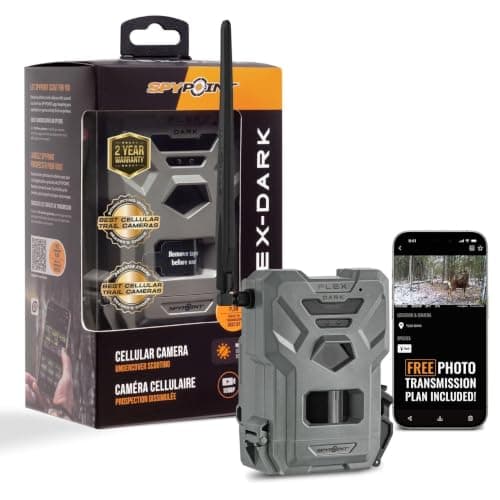
Spypoint Flex-Dark
SpypointTwo LED arrays in one body, so the same camera runs invisible on a pressured trail and switches to the longer-reaching low-glow array on a plot. A 0.3 s trigger, 100 ft on both detection and flash, first cellular camera in Trailcampro's 2026 flash-range shootout, and a genuinely free 100-photo tier that lets you run it from July to the opener for nothing per month.
#ad · Price as of November 21, 2026 · Disclosure for the link to Spypoint Flex-Dark
Read the full write-up or compare it with the rest below.
Quick picks
The rankings at a glance
| # | Product | Best for | Score | Price |
|---|---|---|---|---|
| 1 | Spypoint Flex-Dark Two LED arrays in one body, so the same camera runs invisible on a pressured trail and switches to the longer-reaching low-glow array on a plot. A 0.3 s trigger, 100 ft on both detection and flash, first cellular camera in Trailcampro's 2026 flash-range shootout, and a genuinely free 100-photo tier that lets you run it from July to the opener for nothing per month. | Best cellular trail camera for huntingSpypoint | 9.4 /10 | $79.99Amazon |
| 2 | 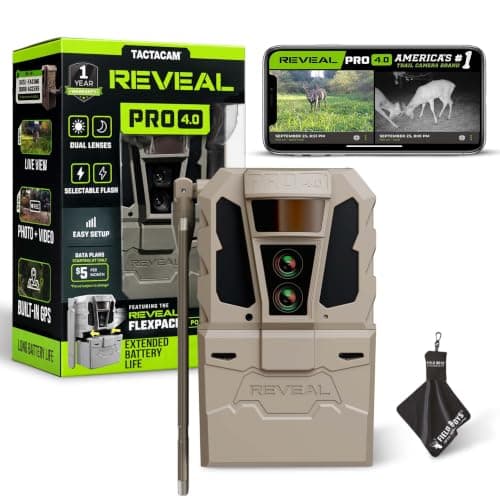 Tactacam Reveal Pro 4.0 Trailcampro measured 12.4 months of photo-mode battery on lithium cells, which is the single most useful number on this page: hang it in July and you are not going back. Selectable no-glow or low-glow, a side LCD so you can aim without the phone, and Live View once you add the $6/mo option. The 11.0-second measured recovery is the reason it is not first. | Best for a camera you hang once a yearTactacam Reveal | 9.2 /10 | $159.99Amazon |
| 3 | 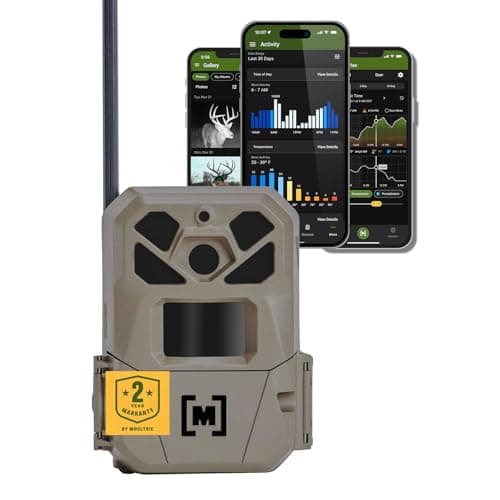 Moultrie Edge 3 Pro Winner of Trailcampro's 2026 cellular detection shootout, with a 0.30 s trigger, a no-glow array and 100 ft on both detection and flash. On a November crossing where deer come through moving and in groups, detection and trigger are the whole argument. Moultrie's plans start at $8.99 a month per camera with no free tier, and that is the honest cost of running it. | Best for rut crossingsMoultrie Mobile | 9.3 /10 | $99.00Amazon |
| 4 | 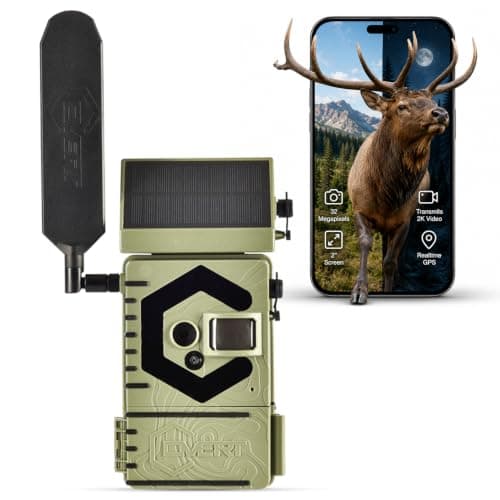 Covert Interceptor Solar The only camera here with a published third-party field test behind it: over a 60-day southeast Colorado run, Field & Stream reported the included panel held the battery above 60% on open plots and back to 80% daily even in shade, through hail and 50 mph winds. No-glow, 0.4 s, 32MP. Covert publishes no detection range and no plan tier table, which is a real gap. | Best for ground you cannot get back toCovert | 9.0 /10 | $189.99Amazon |
| 5 | 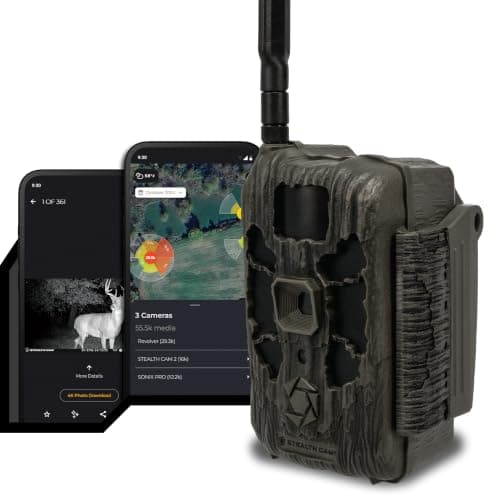 Stealth Cam Deceptor Max 3.0 A 36-piece 940nm array is the largest invisible flash in this group, and PIR zone selection plus onboard false-image filtering is exactly what a wide plot edge in the wind needs - it stops you paying plan photos for moving grass. Nine photos per burst, 1440p, sub-0.3 s trigger. Sixteen AA cells per camera is the trade. | Best for feeders and food plotsStealth Cam Command | 9.1 /10 | $99.99Amazon |
| 6 | 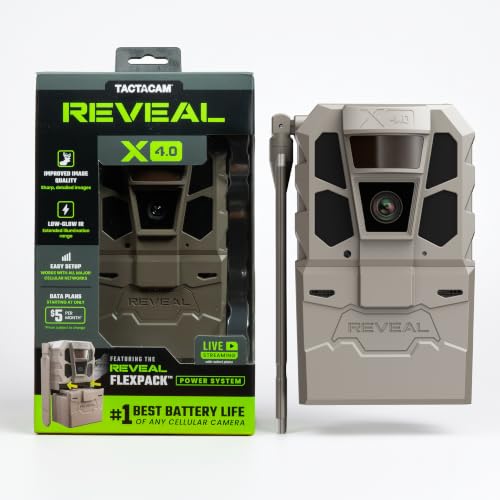 Tactacam Reveal X 4.0 Tactacam's Xtra add-on is billed per account rather than per camera, so the fourth camera on the property costs plan data and little else. Trailcampro measured 14.1 months of photo battery and a 0.29 s trigger, the fastest measured figure on this page. Low-glow only, no screen, and the same 11-second recovery as the Pro 4.0. | Best for a multi-camera spreadTactacam Reveal | 9.1 /10 | $128.99Amazon |
| 7 | 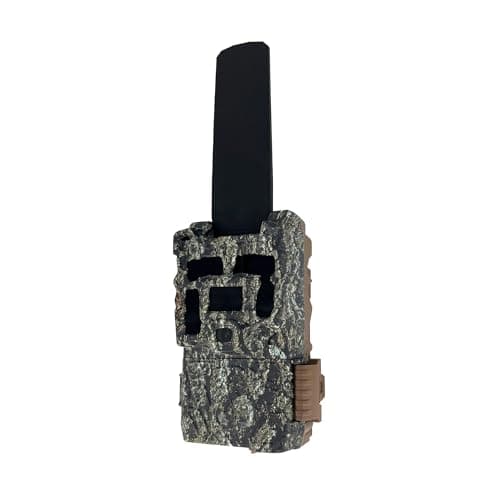 Browning Defender Pro Scout Max HD DV The only cellular camera on this site that publishes both halves of the speed question: 0.25 s to fire and 0.35 s to be ready again. Invisible IR with adjustable flash modes, direct 10-second video clips, and it reverts to a plain SD camera if you pause the plan for the off-season. Browning keeps its plan prices behind an account login, which we could not verify. | Fastest published trigger and recoveryBrowning (Strike Force Wireless) | 9.2 /10 | $149.99Amazon |
| 8 | 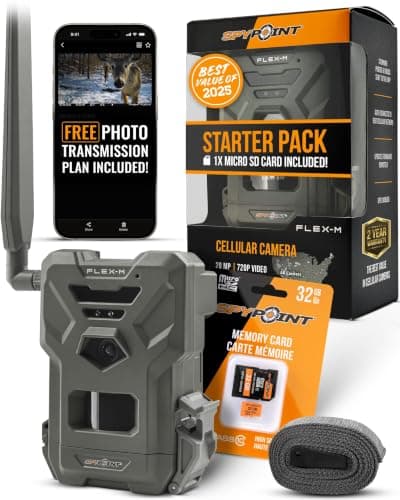 Spypoint Flex-M When the question is whether a new lease or a new property even holds deer, this is the camera to answer it with. Low-glow, a 0.4 s trigger, 90 ft on detection and flash, and the same free 100-photo Spypoint tier as the Flex-Dark, so a scouting camera on unfamiliar ground can cost nothing per month until it earns an upgrade. Single-SIM, so check coverage before you hang it. | Budget pick: cheapest way onto new groundSpypoint | 8.9 /10 | $49.99Amazon |
#ad · Prices come live from Amazon, last checked November 21, 2026. Scores are ours, built from published specs, verified plan prices and cited independent tests, not our own field measurements. Row photos are Amazon's own product images for the listing each row links. Tap a row for the full write-up.
Why this is not the deer-hunting page
This site already has two pages that look adjacent to this one, and it is worth saying plainly what each does so you land on the right one.
- Best trail cameras for deer hunting is organized by the phase of the season you are solving — summer inventory, October scrapes, rut crossings, late-season food — and it mixes card cameras in, because for pressured public ground a camera with no radio is sometimes the better answer.
- Best cellular trail cameras ranks the whole cellular category on the site's standard rubric, hunting or not. A security set on a gate and a mineral site in July are both in scope there.
- This page is cellular only, and it is ranked on one hunting-specific question: how many trips into your own ground each camera costs you between now and the end of the season. That is the thing cellular is actually sold for, and it is the axis the category is almost never ranked on.
If you have not decided between a cell plan and a card yet, start at are cellular trail cameras worth it instead — the arithmetic there is the honest version, and for some setups the answer is no.
How we ranked them for hunting
The site's five-metric rubric, with the weights applied the way a hunting set actually loads them. The full weights are published at how we rank; what changes on this page is which of those five decides a tie.
- Battery and solar life, weighted hardest. A hunting camera's job is to not need you. The two cameras with independently measured year-plus photo-mode battery life and the one with a published 60-day solar field test are at the top of this page for that reason, and the measured figures come from Trailcampro and Field & Stream respectively, not from us.
- Flash type. Invisible beats visible on hunted ground, and a camera that can switch between the two beats one that cannot. See the flash section for what that really buys, because the usual pitch is overstated.
- Trigger speed and recovery together. A fast first frame is worth little if the camera needs eleven seconds to be ready for the second deer. Only one camera here publishes both numbers; two more have had both measured independently. The rest publish a trigger and go quiet on recovery, and we say so in each card.
- Real monthly plan cost across a season. Not the sticker. A camera on a $12.99 unlimited tier from July to January costs more in plan than the cheapest body on this page costs to buy. The arithmetic is below.
- Detection range and angle. How much of a crossing or a plot edge the sensor actually covers, published distance and published angle together.
Every price on this page is read live from Amazon through the site's price pipeline, and no price is typed into the prose. Specs are quoted from the maker page or the independent test already cited for that camera in the registry. This site does not field-test cameras, and nothing here pretends otherwise.
The cost nobody puts on the spec sheet
The reason a hunting camera is a different purchase from a wildlife camera is that you are hunting the same ground the camera is watching. Walking in to swap a card or a set of AA cells leaves scent on the approach, noise in the timber and, in late October, a mature buck who now uses the next drainage over.
Cellular removes the card trip. It does not remove the battery trip, and that is the part the category marketing skates past. A cell cam on alkalines at a busy plot can want fresh cells inside two months; the cameras at the top of this page have either had a year-plus photo-mode runtime measured on lithium cells or ship with a panel that keeps the pack topped up.
So the hierarchy this page ranks by is simple: a camera you visit once a season beats a camera you visit monthly, and a camera that can be aimed and checked from the truck beats one you have to stand in front of. Three features move a camera up that list — a long measured battery figure, an integrated or compatible panel, and on-camera aiming or in-app live aim so the first visit is also the last.
Flash: the deer argument and the real one
Every brand on this page sells invisible infrared as a deer feature. The honest version is narrower than that.
A 940nm no-glow array emits above the range most eyes register, so it produces no visible flash. An 850nm low-glow array shows a dull red glow when it fires. Deer notice the red glow less than hunters generally believe — the animal that reliably notices a red light in the dark at a gate or a field edge is a person. Which makes no-glow mostly a theft and pressure feature rather than a biological one, and it is worth most exactly where you would least like to be noticed: a public-land trail, a lease boundary, a gate within sight of a road.
There is a trade, and it is physics rather than marketing: 940nm emitters put less usable light downrange than 850nm emitters of the same power, so an invisible array generally reaches shorter. That is why the Spypoint Flex-Dark — which carries both arrays and lets you choose — tops this page, and why the Tactacam Reveal Pro 4.0 publishes 96 ft on low glow and 80 ft on no glow for the same body. The full argument is in no-glow vs low-glow.
Practical read for hunting ground: run invisible on anything within reach of a road, a trailhead or a property line, and spend the extra flash range on interior plots and feeders where nobody is walking past.
What a hunting season on a plan costs
A cellular camera is two purchases. The second one repeats. Using each brand's own published tiers, here is what one camera costs to run from the first of July through the end of January — seven months, which is roughly a scouting-through-season cycle:
- Spypoint — free tier at 100 photos a month: $0. Basic is $5 a month, so $35 for the seven months; unlimited Premium is $15 a month, or $105.
- Tactacam Reveal — Starter at $5 a month is $35; Pro unlimited at $13 a month is $91. Live View, if you want it, adds $6 a month per camera, or $42 across the season.
- Moultrie Mobile — no free tier. Standard at $8.99 a month is $62.93; Unlimited at $12.99 is $90.93.
- Stealth Cam Command — Standard at $5 a month is $35; Unlimited at $20 for the first camera is $140.
- Covert and Browning — neither publishes a tier table. The only sourced Covert figure is the $4.99 a month a Field & Stream tester paid in March 2026, which would be about $35 for the season; Browning's prices sit behind a Strike Force Wireless account login and we have never been able to verify them.
Two conclusions fall straight out of that list. First, on a free or $5 tier the plan is a rounding error against the camera, and on an unlimited tier it is comparable to buying a second camera every season. Second, the brand you pick is a seven-year decision, not a one-season one, because moving brands means replacing hardware. Every tier at one and at four cameras is laid out in cellular trail camera plans compared, and if the monthly fee is the whole objection, cellular trail cameras with no monthly fee is the page that deals with it honestly.
The cameras, side by side
The row worth reading twice is Recovery time. The two Tactacams measured around eleven seconds between photos, which is fine on a feeder and wrong on a crossing where three does and then a buck walk through in twenty seconds. The Browning publishes 0.35 s and is the only camera here that states it at all.
Which one is for your ground
- One camera, mixed sets, tight budget. Spypoint Flex-Dark. Two flash arrays means one body covers the trail and the plot, and the free tier means the summer costs nothing.
- Hang it in July, pull it in January. Tactacam Reveal Pro 4.0, on lithium cells. Nothing else here has a measured runtime that long with a screen on the camera.
- A November crossing or a scrape line. Moultrie Edge 3 Pro. Best detection result of any cellular camera we have independent data for, and a 0.30 s trigger behind it.
- A back corner you genuinely cannot revisit. Covert Interceptor Solar, with the caveats: no published detection range, no public plan tiers, and Field & Stream calls it bulky.
- A feeder, a plot edge or anywhere the wind moves grass. Stealth Cam Deceptor Max 3.0, for the PIR zone selection and the false-image filter as much as for the 36-LED array.
- Four or more cameras on one property. Tactacam Reveal X 4.0, because the Xtra add-on is account-wide.
- Deer that travel in groups. Browning Defender Pro Scout Max HD DV, the only published 0.25 s / 0.35 s pair here.
- Proving out new ground. Spypoint Flex-M on the free tier, then upgrade the sets that turn out to matter.
If the budget is the starting point rather than the ground, best cellular trail cameras under $150 sorts the same field by price cap, and best budget cellular trail camera ranks on cost to run rather than cost to buy.
In detail
The picks, in full
Rank 1
Best cellular trail camera for hunting
Spypoint Flex-Dark
Two LED arrays in one body, so the same camera runs invisible on a pressured trail and switches to the longer-reaching low-glow array on a plot. A 0.3 s trigger, 100 ft on both detection and flash, first cellular camera in Trailcampro's 2026 flash-range shootout, and a genuinely free 100-photo tier that lets you run it from July to the opener for nothing per month.
Spec sheetSpec-checked · sources linked
| Plan ecosystem | Spypoint. The plan decides the running cost; see the plan explainer linked on this page. |
|---|---|
| Network | Dual-SIM, automatically connects to all major carriers |
| Plan | Free 100 photos/mo; Basic $5 ($4 annual); Standard $10 ($7); Premium unlimited $15 ($10); one plan per camera |
| Trigger speed | 0.3 s |
| Detection range | 100 ft |
| Flash | Low-glow and no-glow LEDs |
| Flash range | 100 ft; first cellular camera in Trailcampro's 2026 flash-range shootout |
| Photo resolution | 40MP |
| Video | 1080p |
| Batteries | AA tray; LIT-22 lithium pack and SPLB-22 solar panel compatible (Spypoint accessories list all Spypoint cameras) |
| App features | GPS locator, Buck Tracker AI, multishot, time-lapse, scheduling, over-the-air updates |
| Warranty | 2 years |
The rubric behind the 9.4
- Trigger speed & recovery (20%)
- 8
- Night image quality (20%)
- 9
- Battery & solar life (20%)
- 7
- Real monthly plan cost (20%)
- 10
- Detection range & field of view (10%)
- 8
- App, setup & reliability (10%)
- 8
Criterion scores are on the rubric's own 0–10 scale and weight to 8.4. The published 9.4 places that total on our 8.4-9.8 recommendation scale. How the scale works.
What the spec sheet supports
- Two LED arrays: run no-glow on pressured sets, low-glow where reach matters
- Trailcampro's 2026 cellular flash-range winner, an independent result
- 0.3 s trigger and 100 ft detection, the best published numbers in Spypoint's lineup
- Free 100-photo plan plus $10/mo annual unlimited
Where it falls short
- Spypoint publishes no recovery time
- 40MP is an interpolated figure
- HD photos and video cost extra ($5 per 50 HD photos, $5 per 20 videos)
Skip this if…
…you want to stop buying batteries entirely; the Flex-S-Dark adds a built-in solar panel and battery for about $10 more.
#ad · Price as of November 21, 2026 · Disclosure for the link to Spypoint Flex-Dark
Rank 2
Best for a camera you hang once a year
Tactacam Reveal Pro 4.0
Trailcampro measured 12.4 months of photo-mode battery on lithium cells, which is the single most useful number on this page: hang it in July and you are not going back. Selectable no-glow or low-glow, a side LCD so you can aim without the phone, and Live View once you add the $6/mo option. The 11.0-second measured recovery is the reason it is not first.
Spec sheetSpec-checked · sources linked
The rubric behind the 9.2
- Trigger speed & recovery (20%)
- 6
- Night image quality (20%)
- 8
- Battery & solar life (20%)
- 9
- Real monthly plan cost (20%)
- 8
- Detection range & field of view (10%)
- 7
- App, setup & reliability (10%)
- 9
Criterion scores are on the rubric's own 0–10 scale and weight to 7.8. The published 9.2 places that total on our 8.4-9.8 recommendation scale. How the scale works.
What the spec sheet supports
- Live View sessions are unlimited once you add the $6/mo add-on, not metered in minutes
- Switch between no-glow and low-glow in the app instead of buying two cameras
- Side LCD screen means you can aim and confirm the frame without the phone
- 12.4 months of photo battery life measured by Trailcampro, plus a 12V jack and FlexPack support
Where it falls short
- Trailcampro measured an 11.0-second photo recovery: the slowest number on this page, and it will miss the second deer
- Tactacam publishes no trigger speed, recovery or detection figure of its own for the 4.0 line
- Live View is billed per camera, so a four-camera set adds $24/mo on top of the data plans
- The 4K photo mode is interpolated, not a 4K sensor
Skip this if…
…you watch a crossing where animals come through in groups; an 11-second recovery between photos is the wrong tool for that trail, and the Moultrie Edge 3 Pro is the faster camera.
#ad · Price as of November 21, 2026 · Disclosure for the link to Tactacam Reveal Pro 4.0
Rank 3
Best for rut crossings
Moultrie Edge 3 Pro
Winner of Trailcampro's 2026 cellular detection shootout, with a 0.30 s trigger, a no-glow array and 100 ft on both detection and flash. On a November crossing where deer come through moving and in groups, detection and trigger are the whole argument. Moultrie's plans start at $8.99 a month per camera with no free tier, and that is the honest cost of running it.
Spec sheetSpec-checked · sources linked
| Plan ecosystem | Moultrie Mobile. The plan decides the running cost; see the plan explainer linked on this page. |
|---|---|
| Network | All 4 major networks, Auto Connect |
| Plan | Standard $8.99/mo per camera; Unlimited $12.99/mo per camera; Pro Series $22.99/mo per camera |
| Trigger speed | 0.30 s |
| Detection range | 100 ft; winner of Trailcampro's 2026 cellular detection shootout |
| Flash | No-glow |
| Flash range | 100 ft |
| Photo resolution | 50MP |
| Video | 1440p QHD |
| External power | USB-C input; POWER MAG packs and 3.4W Solar Power Pack II |
| App features | GPS, Moultrie AI (switches to HD video on a buck), on-demand, Live Aim; 50° field of view; includes Easy Aim Mount |
| Storage | Built-in memory, no SD card required |
The rubric behind the 9.3
- Trigger speed & recovery (20%)
- 9
- Night image quality (20%)
- 9
- Battery & solar life (20%)
- 7
- Real monthly plan cost (20%)
- 6
- Detection range & field of view (10%)
- 9
- App, setup & reliability (10%)
- 9
Criterion scores are on the rubric's own 0–10 scale and weight to 8.0. The published 9.3 places that total on our 8.4-9.8 recommendation scale. How the scale works.
What the spec sheet supports
- First in Trailcampro's 2026 cellular detection shootout, an independent result
- No-glow with 0.30 s trigger and 100 ft on both detection and flash
- 1440p video and 50MP stills, the highest published numbers in this group
- Built-in memory and an Easy Aim Mount in the box
Where it falls short
- Per-camera plans with no free tier; four cameras on Unlimited is $51.96/mo
- USB-C power only; no AA tray means a POWER MAG or panel is the whole power plan
- 50MP is interpolated
Skip this if…
…you run four or more cameras on a budget; the plan cost outruns the camera price within a season.
#ad · Price as of November 21, 2026 · Disclosure for the link to Moultrie Edge 3 Pro
Rank 4
Best for ground you cannot get back to
Covert Interceptor Solar
The only camera here with a published third-party field test behind it: over a 60-day southeast Colorado run, Field & Stream reported the included panel held the battery above 60% on open plots and back to 80% daily even in shade, through hail and 50 mph winds. No-glow, 0.4 s, 32MP. Covert publishes no detection range and no plan tier table, which is a real gap.
Spec sheetSpec-checked · sources linked
| Plan ecosystem | Covert. The plan decides the running cost; see the plan explainer linked on this page. |
|---|---|
| Network | Cellular; Covert does not name the carrier or carriers on the product page |
| Plan | Covert Wireless app subscription. Covert publishes no tier table on the product page; Field & Stream's tested unit ran on a $4.99 per month plan |
| Trigger speed | 0.4 s (maker spec) |
| Detection range | Not published by Covert on the product page |
| Flash | No-glow IR; Field & Stream's tester reported it stayed undetectable in use |
| Flash range | 90 ft (maker spec); Field & Stream photographed a doe at over 110 ft at night |
| Photo resolution | 32MP (maker spec) |
| Video | 2K transmission (maker spec) |
| Batteries | 8 AA (maker spec) |
| Solar | Solar panel included. Over a 60-day southeast Colorado test Field & Stream saw the battery stay above 60% on open plots and recover to 80% daily even in shade |
| App features | CovertWireless app, QR-code setup, GPS, Realtime capability, 2-inch screen |
| Warranty | 2 years (maker spec) |
The rubric behind the 9.0
- Trigger speed & recovery (20%)
- 7
- Night image quality (20%)
- 8
- Battery & solar life (20%)
- 9
- Real monthly plan cost (20%)
- 7
- Detection range & field of view (10%)
- 5
- App, setup & reliability (10%)
- 7
Criterion scores are on the rubric's own 0–10 scale and weight to 7.4. The published 9.0 places that total on our 8.4-9.8 recommendation scale. How the scale works.
What the spec sheet supports
- The one camera on this page a third party actually put in the woods: 60 days through hail, 50 mph winds and extreme heat with no failure reported
- Solar panel included rather than sold separately, and it kept the pack near full even in shade
- 32MP and 2K transmission is the highest resolution Covert currently sells
- 90 ft published flash range, and a night photo at over 110 ft in the Field & Stream test
- $179.99 at Covert against about $190 on Amazon, where it is actually in stock
Where it falls short
- Covert's own store lists it as a preorder shipping 2026-10-26, so Amazon is the only place to buy it today
- Field & Stream calls it larger and bulkier than most cellular competitors, with a solar cord that complicates a discreet set
- Covert publishes no detection range, so how wide and far the sensor reaches is unknown
- No public plan tier table: the $4.99 figure is a tester's, not a published price list
Skip this if…
…you need a small, low-profile body on a pressured public-land trail; this is the bulkiest camera Covert sells and the panel cord makes it worse.
#ad · Price as of November 21, 2026 · Disclosure for the link to Covert Interceptor Solar
Rank 5
Best for feeders and food plots
Stealth Cam Deceptor Max 3.0
A 36-piece 940nm array is the largest invisible flash in this group, and PIR zone selection plus onboard false-image filtering is exactly what a wide plot edge in the wind needs - it stops you paying plan photos for moving grass. Nine photos per burst, 1440p, sub-0.3 s trigger. Sixteen AA cells per camera is the trade.
Spec sheetSpec-checked · sources linked
| Plan ecosystem | Stealth Cam Command. The plan decides the running cost; see the plan explainer linked on this page. |
|---|---|
| Network | Automatic network coverage |
| Plan | Standard $5/mo (600 photos); Plus $8/mo; Unlimited $20/mo with descending multi-camera pricing ($15 second, $11 third to seventh); per camera |
| Trigger speed | < 0.3 s |
| Detection range | 100 ft |
| Flash | No-Glo, 36-piece 940nm LED array |
| Flash range | Out to 100 ft |
| Photo resolution | Up to 50MP, up to nine photos per burst |
| Video | 1440p at 30 fps |
| Batteries | 16 AA; recharge compatible |
| App features | Command AI: false image detection, PIR zone selection, Rack Alert; live view ready; camera sharing; dual-core processor |
| Storage | 16GB internal memory |
The rubric behind the 9.1
- Trigger speed & recovery (20%)
- 8
- Night image quality (20%)
- 9
- Battery & solar life (20%)
- 7
- Real monthly plan cost (20%)
- 6
- Detection range & field of view (10%)
- 8
- App, setup & reliability (10%)
- 8
Criterion scores are on the rubric's own 0–10 scale and weight to 7.6. The published 9.1 places that total on our 8.4-9.8 recommendation scale. How the scale works.
What the spec sheet supports
- 36 LEDs at 940nm: the largest no-glow array in this group
- PIR zone selection and false-image filtering cut wasted uploads on windy sets
- 16 AA bay for long runs; 16GB internal memory
- Stealth Cam's Standard plan is $5/mo per camera
Where it falls short
- Unlimited plan is $20/mo for the first camera, the priciest unlimited tier we verified
- 16 AA batteries is a lot of batteries to buy
- Stealth Cam does not publish a recovery time
Skip this if…
…you want unlimited photos on several cameras; the descending schedule still totals $57/mo for four.
#ad · Price as of November 21, 2026 · Disclosure for the link to Stealth Cam Deceptor Max 3.0
Rank 6
Best for a multi-camera spread
Tactacam Reveal X 4.0
Tactacam's Xtra add-on is billed per account rather than per camera, so the fourth camera on the property costs plan data and little else. Trailcampro measured 14.1 months of photo battery and a 0.29 s trigger, the fastest measured figure on this page. Low-glow only, no screen, and the same 11-second recovery as the Pro 4.0.
Spec sheetSpec-checked · sources linked
The rubric behind the 9.1
- Trigger speed & recovery (20%)
- 7
- Night image quality (20%)
- 7
- Battery & solar life (20%)
- 9
- Real monthly plan cost (20%)
- 8
- Detection range & field of view (10%)
- 8
- App, setup & reliability (10%)
- 7
Criterion scores are on the rubric's own 0–10 scale and weight to 7.7. The published 9.1 places that total on our 8.4-9.8 recommendation scale. How the scale works.
What the spec sheet supports
- 0.29 s measured trigger: the fastest figure on this page
- 14.1 months of photo battery life measured by Trailcampro, the longest here
- 90 ft measured detection, 10 ft further than the Pro 4.0
- Same unlimited Live View sessions as the Pro for less camera money
Where it falls short
- Low-glow only: a faint red glow at night, and no no-glow option in the app
- No screen at all, so aiming and every Live View session go through the phone
- 11.1-second measured photo recovery, the same weakness as the Pro 4.0
- Live View is still $6/mo per camera on top of the data plan
Skip this if…
…the set is a pressured public-land trail or a gate you're watching for people; buy the selectable-flash Pro 4.0 or a 940nm no-glow camera instead.
#ad · Price as of November 21, 2026 · Disclosure for the link to Tactacam Reveal X 4.0
Rank 7
Fastest published trigger and recovery
Browning Defender Pro Scout Max HD DV
The only cellular camera on this site that publishes both halves of the speed question: 0.25 s to fire and 0.35 s to be ready again. Invisible IR with adjustable flash modes, direct 10-second video clips, and it reverts to a plain SD camera if you pause the plan for the off-season. Browning keeps its plan prices behind an account login, which we could not verify.
Spec sheetSpec-checked · sources linked
| Plan ecosystem | Browning (Strike Force Wireless). The plan decides the running cost; see the plan explainer linked on this page. |
|---|---|
| Network | Pre-installed AT&T and Verizon SIMs, dual carrier technology |
| Plan | Month-to-month plans via Strike Force Wireless; prices require an account login and could not be verified |
| Trigger speed | 0.25 s |
| Recovery time | 0.35 s between images |
| Detection range | 100 ft |
| Flash | Invisible infrared, adjustable (Power Save, Fast Motion, Long Range), Illuma-Smart auto adjust |
| Flash range | 100 ft; ninth overall in Trailcampro's 2026 flash-range shootout |
| Photo resolution | 46MP, 'all HD all the time' images |
| Video | 1080p with sound, 5 s to 2 min; 10-second clips transmitted directly |
| Batteries | 8 AA (not included), up to 1 year battery life (maker claim) |
| External power | 12-volt external power jack |
| App features | GPS-tagged images, color view screen, Strike Force Wireless app; works as an SD camera without a plan |
The rubric behind the 9.2
- Trigger speed & recovery (20%)
- 10
- Night image quality (20%)
- 8
- Battery & solar life (20%)
- 8
- Real monthly plan cost (20%)
- 5
- Detection range & field of view (10%)
- 8
- App, setup & reliability (10%)
- 8
Criterion scores are on the rubric's own 0–10 scale and weight to 7.8. The published 9.2 places that total on our 8.4-9.8 recommendation scale. How the scale works.
What the spec sheet supports
- 0.25 s trigger with a published 0.35 s recovery, the only cell cam here that states both
- Invisible IR with adjustable flash modes
- Direct video: clips arrive without a separate request
- 8 AA plus a 12V jack; runs as a plain SD camera if you pause the plan
Where it falls short
- Browning's plan prices are behind the Strike Force Wireless login; we could not verify them
- Dual carrier means choosing AT&T or Verizon, not automatic hopping across all four networks
- $159.99 at Browning and sold out there on 2026-10-09; retail stock sits around $165-$170
Skip this if…
…you want to know the running cost before you buy; every other brand here publishes it and Browning doesn't.
#ad · Price as of November 21, 2026 · Disclosure for the link to Browning Defender Pro Scout Max HD DV
Rank 8
Budget pick: cheapest way onto new ground
Spypoint Flex-M
When the question is whether a new lease or a new property even holds deer, this is the camera to answer it with. Low-glow, a 0.4 s trigger, 90 ft on detection and flash, and the same free 100-photo Spypoint tier as the Flex-Dark, so a scouting camera on unfamiliar ground can cost nothing per month until it earns an upgrade. Single-SIM, so check coverage before you hang it.
Spec sheetSpec-checked · sources linked
| Plan ecosystem | Spypoint. The plan decides the running cost; see the plan explainer linked on this page. |
|---|---|
| Network | Single SIM (dual-SIM multi-network is on Flex-M2, Flex-Dark and Flex-S-Dark only) |
| Plan | Free 100 photos/mo; Basic 250 $5/mo ($4 annual); Standard 1,000 $10/mo ($7); Premium unlimited $15/mo ($10); one plan per camera |
| Trigger speed | 0.4 s |
| Detection range | 90 ft |
| Flash | Low-glow LED |
| Flash range | 90 ft |
| Photo resolution | 32MP |
| Video | 1080p |
| Batteries | AA tray or LIT-22 lithium pack (LIT-22 lists Flex-M compatibility) |
| Solar | Lithium Battery Solar Panel SPLB-22 compatible (all Spypoint cameras) |
| App features | Placed first in Trailcampro's 2024 cellular flash-range shootout and second in detection, per Spypoint |
| Warranty | 2 years |
The rubric behind the 8.9
- Trigger speed & recovery (20%)
- 6
- Night image quality (20%)
- 6
- Battery & solar life (20%)
- 7
- Real monthly plan cost (20%)
- 10
- Detection range & field of view (10%)
- 7
- App, setup & reliability (10%)
- 7
Criterion scores are on the rubric's own 0–10 scale and weight to 7.2. The published 8.9 places that total on our 8.4-9.8 recommendation scale. How the scale works.
What the spec sheet supports
- Free plan: 100 photos a month per camera with no card on file
- Spypoint's own page lists $59.99, the lowest of any camera here
- Annual-billed Premium is $10/mo unlimited, the cheapest unlimited tier we verified
- LIT-22 pack and SPLB-22 panel bolt on for long deployments
- The live Amazon listing is the camera plus an SD card, so the card is not a separate purchase
Where it falls short
- Single SIM: it does not hop carriers the way the M2 does, so check coverage first
- 0.4 s trigger is slower than the Flex-Dark's 0.3 s
- 32MP photos are interpolated marketing numbers; judge by samples, not MP
Skip this if…
…signal at your spot is marginal; the dual-SIM Flex-M2 is $20 more and picks the stronger carrier automatically.
#ad · Price as of November 21, 2026 · Disclosure for the link to Spypoint Flex-M
Buyer's guide: making a cellular camera last a hunting season
Lithium cells, not alkalines, and not as an upgrade
Every long runtime figure quoted on this page was measured on lithium AA cells. The same camera on alkalines will not come close, and in cold weather it will fall off a cliff — the voltage sags, the flash underexposes, and the symptom looks like a broken camera. If you are buying a camera to avoid trips into the woods, the cells are part of the camera: best batteries for trail cameras and trail camera batteries in cold weather.
Aim it once, properly, with live aim
The most common reason a cellular set wastes a season is a bad aim: too high, too square to the trail, or pointed at a sunrise. Five of the eight cameras here will send you a live aiming frame in the app, which means the only visit that matters is the one where you get it right: trail camera placement and trail camera height.
Set the plan tier to the set, not to the camera
A trail camera at a pinch point might send forty photos a week; a feeder in September can send four hundred a day. Running everything on unlimited is how hunters end up paying more in plan than in hardware. Put the busy sets on the bigger tier and leave the quiet ones on free or Basic, and re-check it in July rather than in November.
Turn off video unless you need it
Video is where both battery life and plan allowance go. Trailcampro's measurements on the Tactacam bodies here drop from over twelve months in photo mode to about four months in video mode on the same cells. Photo mode with a short burst tells you nearly everything about a deer's direction and timing.
Check signal before you commit the set
A camera in a hole with one bar will burn battery retrying uploads and still miss them. Walk the set with your phone first, and if the spot matters more than the signal, an external antenna is a real fix: best cellular trail camera antennas. If nothing works, best cellular trail camera for low signal ranks the bodies that cope with marginal coverage.
Lock it, and assume it will be found
A cellular camera is a more attractive theft target than a card camera, because it is worth more and because the thief knows it has been photographing them. On any set near access, budget for a box and a cable: best trail camera security boxes and how to keep your trail camera from being stolen.
Pause the plan in the off-season where the brand allows it
Several brands here bill month to month, and two of the cameras on this page work as plain SD cameras with the plan paused. If your ground goes quiet in February, there is no reason to pay for eleven months of photos you will not look at.
The short version
Our recommendation
Top pick
Spypoint Flex-Dark
Best cellular trail camera for hunting. Two LED arrays in one body, so the same camera runs invisible on a pressured trail and switches to the longer-reaching low-glow array on a plot. A 0.3 s trigger, 100 ft on both detection and flash, first cellular camera in Trailcampro's 2026 flash-range shootout, and a genuinely free 100-photo tier that lets you run it from July to the opener for nothing per month.
#ad · Price as of November 21, 2026 · Disclosure for the link to Spypoint Flex-Dark
Runner-up
Tactacam Reveal Pro 4.0
Best for a camera you hang once a year. Trailcampro measured 12.4 months of photo-mode battery on lithium cells, which is the single most useful number on this page: hang it in July and you are not going back. Selectable no-glow or low-glow, a side LCD so you can aim without the phone, and Live View once you add the $6/mo option. The 11.0-second measured recovery is the reason it is not first.
#ad · Price as of November 21, 2026 · Disclosure for the link to Tactacam Reveal Pro 4.0
Brands: want your product tested? For Brands.
How we scored this
The research behind these picks
Every pick here is built from documented evidence: the maker's published trigger speed, flash type, battery configuration and detection range; each brand's plan tiers verified on its own plan page and turned into the real monthly cost at one and four cameras; the independent shootouts (Trailcampro, Outdoor Life, Field & Stream, TechGearLab) cited by name for the measurements they published; and a public rubric applied the same way to every model. Every figure links to where it came from, so you can check our work in one click.
Scores are editorial judgments from that documented research. Commissions never set a score or decide a pick. The rubric and its weights are published.
Corrections & updates
- Published. Prices and availability for all eight cameras read live from Amazon through the price pipeline the same day; every spec quoted from the maker page or the independent test already cited for that camera in the registry; plan arithmetic computed from each brand's published tiers as recorded in lib/plans.ts.
Questions
Frequently asked
What is the best cellular trail camera for hunting?
The Spypoint Flex-Dark. It carries both a no-glow and a low-glow LED array, so one camera covers a pressured trail and an open plot; it publishes a 0.3 s trigger with 100 ft of detection and 100 ft of flash; it placed first among cellular cameras in Trailcampro's 2026 flash-range shootout; and Spypoint's free 100-photo tier means it can run through the summer at no monthly cost.
Do cellular trail cameras spook deer?
Less than the trips you make to check a card camera do. The camera itself is a quiet object; what educates deer is human scent and noise on the approach, which is the whole reason cellular exists. A visible low-glow flash is noticed by deer less than most hunters assume — the reliable observer of a red light in the dark is a person, which is why invisible flash is mostly a pressure and theft feature.
How much does a cellular trail camera cost to run for a hunting season?
Using each brand's published tiers across seven months, July through January: $0 on Spypoint's free tier, about $35 on a $5 entry tier, roughly $63 on Moultrie Standard, and $91 to $140 on an unlimited tier depending on brand. Covert and Browning do not publish tier tables at all. On an unlimited plan the running cost is comparable to buying another camera every season.
Is a cellular camera better than an SD camera for hunting?
For hunted ground, usually yes, because the card trip is the expensive part. There are two real exceptions: heavily pressured public land, where a camera with no radio, no SIM and no app is harder to find and worth stealing less; and any set with no usable signal. Both cases are worked through in cellular vs Wi-Fi vs SD card.
How often should I check a cellular trail camera in hunting season?
In person, twice: once to hang and aim it, once to pull it. Everything in between should arrive on your phone. If a camera is making you walk in more often than that, the usual cause is alkaline cells, video mode, or a set with marginal signal retrying uploads — all three are fixable without a new camera.
Which cellular camera has the longest battery life for a whole season?
Of the cameras here with independently measured runtimes, the Tactacam Reveal X 4.0 at 14.1 months and the Reveal Pro 4.0 at 12.4 months in photo mode, both measured by Trailcampro on Energizer Ultimate Lithium cells. If you would rather not think about cells at all, the Covert Interceptor Solar ships with a panel that Field & Stream saw hold the pack above 60% across a 60-day test.
Keep reading
Related on Cam & Canopy
- Best trail cameras for deer huntingThe same question organized by season phase, with card cameras included.
- Best cellular trail camerasThe whole cellular category on the standard rubric, hunting or not.
- Best cellular trail cameras under $150The same field sorted by price cap instead of by ground.
- Cellular trail camera plans comparedEvery published tier at one and four cameras.
- Are cellular trail cameras worth itThe cost-per-visit arithmetic before you commit to a plan.
- Best cellular trail camera for low signalIf the set you care about has one bar.
Receipts
Sources
- Spypoint — FLEX-DARK product page (checked 2026-09-21)
- Spypoint — FLEX-M product page (checked 2026-09-21)
- Spypoint — photo transmission plans (checked 2026-09-21)
- Tactacam — REVEAL Pro 4.0 product page (checked 2026-09-24)
- Trailcampro — Tactacam Reveal Pro 4.0 review, measured figures (checked 2026-09-24)
- Tactacam — REVEAL X 4.0 product page (checked 2026-09-24)
- Trailcampro — Tactacam Reveal X 4.0 product page, measured figures and stock (checked 2026-09-24)
- Tactacam — REVEAL app plans, Live View and Xtra add-ons (checked 2026-09-24)
- Moultrie — EDGE 3 PRO product page (checked 2026-09-21)
- Moultrie Mobile — plans page (checked 2026-09-21)
- Trailcampro — 2026 Trail Camera Shootout results (checked 2026-09-21)
- Stealth Cam — Deceptor Max 3.0 product page (checked 2026-09-21)
- Stealth Cam — Command data plans page (checked 2026-10-01)
- Browning Trail Cameras — Defender Pro Scout Max HD DV product page (checked 2026-09-21)
- Browning Trail Cameras — cell cam plans page (defers to Strike Force Wireless login; checked 2026-09-21)
- Covert (Feradyne) - Interceptor Solar product page: 32MP, 2K transmission, 0.4 s trigger, 90 ft flash, 8 AA, $179.99, preorder shipping 2026-10-26 (checked 2026-10-23)
- Field & Stream - "Covert Interceptor Solar Expert Tested", 60-day field test, published 2026-03-11 (checked 2026-10-23)
Every number above is traceable: specs come from the maker's own product pages (linked on every product), plan prices from the maker's plan page with an “as of” date, and independent measurements are attributed to whoever made them. Amazon prices change often, so every buy button takes you to Amazon's current price for that listing. Read the full method.