Trail Cameras · The rankings
Best trail cameras for deer hunting: buy for the phase of the season you're solving
Nobody needs the same camera in July and the first week of November. Summer inventory wants battery life and a free plan. Rut crossings want a fast trigger and an invisible flash. These six cover the season, and the order changes with it.
By Mike M.Updated Spec-checked · every figure sourced
#adReader-supported: we may earn a commission if you buy through our links, at no extra cost to you. It never decides a ranking. How we rank · Disclosure
Quick picks
The rankings at a glance
| # | Product | Best for | Score | Price |
|---|---|---|---|---|
| 1 | 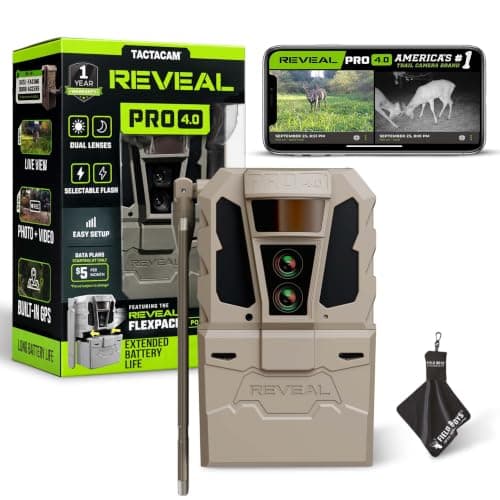 Tactacam Reveal Pro 4.0 The camera to run all season: 12.4 months of photo-mode battery measured by Trailcampro, 4K stills, auto-carrier selection, and Tactacam's Starter plan at $55 a year. In stock at $159.99 at Tactacam and Trailcampro when we checked. | Best trail camera for deer huntingTactacam Reveal | 7.8 /10 | $159.99Amazon |
| 2 | 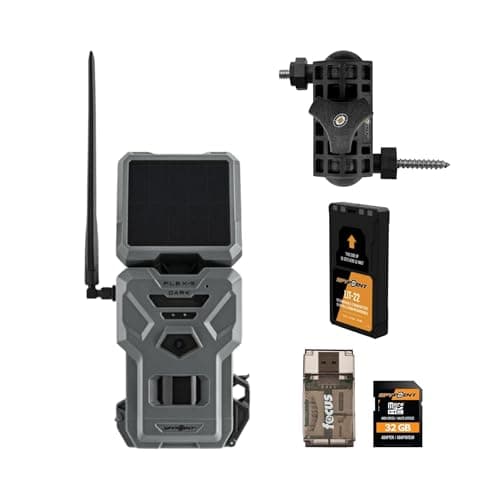 Spypoint Flex-S-Dark Integrated solar plus a genuinely free 100-photo tier makes this the camera you can leave on a mineral site from June to September for nothing per month. No-glow to 100 ft, 0.3 s trigger, 89/100 at Trailcampro. | Best for summer inventorySpypoint | 8.8 /10 | $219.99Amazon |
| 3 | 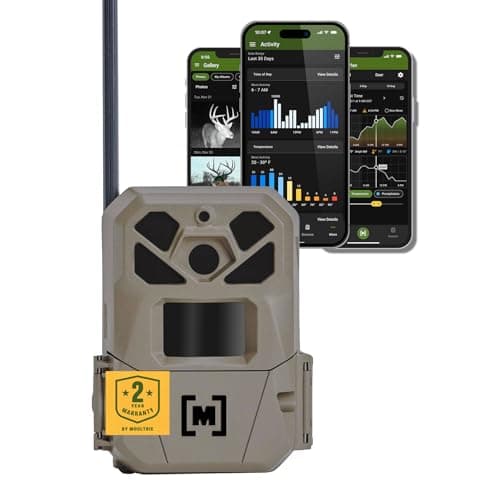 Moultrie Edge 3 Pro No-glow to 100 ft, a 0.30 s trigger, 1440p video and Moultrie's AI buck detection, on a camera that connects to all four major networks. The best no-glow cellular set for the four weeks that matter most. | Best for October scrapes and rut crossingsMoultrie Mobile | 8.0 /10 | $98.99Amazon |
| 4 | 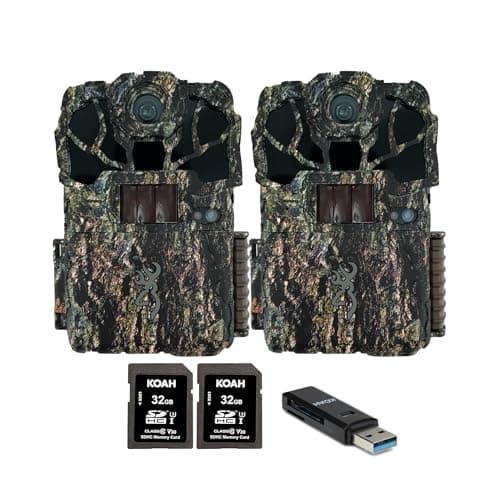 Browning Spec Ops Elite HP5 Ultra Invisible IR to 100 ft with an adjustable 0.1 to 0.7 s trigger and no radio, no SIM and no app to give the set away. On pressured ground, a camera nobody knows about beats a camera that texts you. | Best for pressured public groundSD / Wi-Fi | 8.4 /10 | $389.99Amazon |
| 5 | No image GardePro T5NG Trailcampro's 91/100 with a 31-month photo-mode battery estimate for under $100. When the question is six sets rather than one, this is the camera that makes six sets affordable. | Best value for a full camera spreadSD / Wi-Fi | 8.5 /10 | Check price · Amazon |
| 6 | 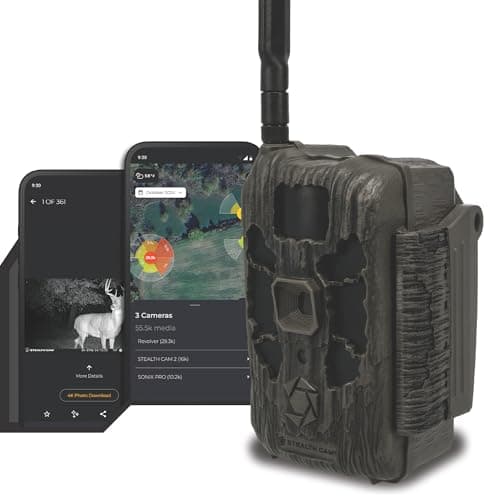 Stealth Cam Deceptor Max 3.0 A 36-LED 940nm array, up to nine photos per burst and PIR zone selection, which is what a wide feeder or plot edge actually needs. In stock at Trailcampro at $119.99 with an 85/100 score. | Best for food plots and feedersStealth Cam Command | 7.6 /10 | $115.00Amazon |
#ad · Prices come live from Amazon, last checked October 12, 2026. Scores are ours, built from published specs, verified plan prices and cited independent tests, not our own field measurements. Row photos are Amazon's own product images where a listing supplies one, and a blank panel where the maker sells elsewhere and supplies none. Tap a row for the full write-up.
The four phases, and what each one actually asks for
"Best trail camera for deer hunting" has four different right answers, because a deer season has four different jobs and they pull in opposite directions. This is what separates this page from our general best trail cameras ranking, which judges every camera on the same four axes regardless of when you'd hang it.
- Summer inventory (June to September). You want to know which bucks are on the property. Deer are on predictable food and water, they tolerate a camera, and you need the thing to run three months without a visit. What matters: battery or solar life, and plan cost, because you will take thousands of photos of does. What doesn't matter much: trigger speed. Animals stand still at a mineral site.
- Early season and October scrapes (late September to late October). Now you are watching individual scrapes and field entries, deer are getting nervous, and a visible flash starts to cost you. What matters: a no-glow flash and a detection pattern that covers a scrape from a safe distance. What doesn't matter: unlimited photo allowances.
- The rut (roughly the first three weeks of November). Bucks move fast, at odd hours, through crossings and funnels. A 0.5 s trigger photographs the back half of a deer. What matters: trigger speed, recovery time, and getting the photo without walking in. What doesn't matter: battery life; it is three weeks.
- Late season (December onward). Deer are back on concentrated food, it is cold, and cold is what kills batteries. What matters: lithium batteries, external power, and a wide detection pattern over a plot or a feeder.
Two cameras cover all four phases for most people: one solar cellular camera on food that stays up all year, and one fast no-glow camera you move to whatever the deer are doing this fortnight. That is the shape of the ranking below.
How we ranked them
Cellular cameras use our six-metric cellular rubric and SD cameras the five-metric one, both published at how we rank. For a deer hunter we read them in this order:
- Trigger speed and recovery. The rut is the only phase where a camera can be flatly wrong, and it is wrong by being slow. Trailcampro measured 0.4 s on the Reveal Pro 4.0 and 0.29 s on the Reveal X 4.0; Moultrie publishes 0.30 s on the Edge 3 Pro; Browning offers 0.1 to 0.7 s adjustable. See trigger speed explained.
- Night image quality. Most mature-buck daylight photos are not daylight photos. A 940nm no-glow array is worth real money on a scrape; see no-glow vs low-glow.
- Battery and solar life. A dead camera during the rut is the most expensive failure in scouting. Trailcampro's measured figures do the heavy lifting here.
- Real monthly plan cost. Summer inventory is where allowances get eaten. Spypoint's free tier and Tactacam's $55-a-year Starter are the two prices that matter; plans compared has the rest.
- Detection range and field of view, then app and reliability. A wide pattern for plots and feeders, a narrow one for trails.
Every figure below links to the maker's page or Trailcampro's published measurements, with the date we read it. Stock was checked at each maker and at Trailcampro on 2026-09-26.
The six, on the numbers that matter
| Evidence | Browning Spec Ops Elite HP5 Ultra | GardePro T5NG |
|---|---|---|
| Trigger speed | Adjustable 0.1 to 0.7 s | 0.54 s photo / 0.85 s video, as measured by Trailcampro |
| Recovery time | 0.5 s | 1.4 s photo / 2.4 s video, as measured by Trailcampro |
| Detection range | Adjustable, up to 80 ft | 110 ft at a 55° detection angle (48.2° field of view), per Trailcampro |
| Flash | Invisible 'night vision' infrared LEDs | No glow IR; GardePro T5NG Pro won Trailcampro's 2026 non-cellular flash-range shootout |
| Flash range | 100 ft | — |
| Video | 1440p with sound, 5 s to 2 min | 1920x1080 |
| Batteries | 8 AA (alkaline, rechargeable or lithium) | 8 AA; Trailcampro estimates 31.1 months in photo mode on Energizer Ultimate Lithium |
| External power | 12-volt external power jack | — |
| Score | 8.4/10 | 8.5/10 |
Pick by the phase you're solving
| The job | Buy | Because |
|---|---|---|
| Summer inventory on a mineral site or water hole, no monthly cost | Spypoint Flex-S-Dark | Integrated solar plus Spypoint's free 100-photo tier; no-glow to 100 ft; 89/100 at Trailcampro |
| One camera to run the whole season | Tactacam Reveal Pro 4.0 | 12.4 months of measured photo-mode battery, auto-carrier selection, $55/yr Starter plan |
| An October scrape you cannot afford to spook | Moultrie Edge 3 Pro | 940nm no-glow to 100 ft, 0.30 s trigger, AI buck detection, all four major networks |
| A rut funnel on pressured public ground | Browning Spec Ops Elite HP5 Ultra | Invisible IR, 0.1 s adjustable trigger, 0.5 s recovery, and nothing to steal a SIM out of |
| Six sets across a farm on a real budget | GardePro T5NG | 91/100 at under $100 with a 31-month photo-mode battery estimate; no plan to multiply by six |
| A food plot or feeder edge, wide coverage | Stealth Cam Deceptor Max 3.0 | 36-LED 940nm array, nine-photo bursts and PIR zone selection to cut wind triggers |
Our recommendation for each buyer; specs and stock as of 2026-09-26. Prices are set by the seller and change; the buy buttons go to a tagged Amazon search for each model, not to a price we've cached.
The pressure question nobody prices in
A cellular camera's real value to a deer hunter is not the photos. It is not walking in. Every trip to a camera leaves scent on the approach, boot prints on the trail and a human silhouette where a mature buck expects nothing, and it does that at exactly the time of year he is least tolerant. If your sets are a mile from the truck and you check them monthly with a card, you are educating the deer you are trying to hunt.
That cuts two ways, and this is the part most "best trail camera" pages leave out. On private ground you control, a cellular camera is almost always worth its plan, because it converts four walk-ins a season into zero. On heavily hunted public ground, a cellular camera is a liability for a different reason: it is a $160 box with a SIM in it, hanging on a tree anyone can walk to. Our theft prevention guide and security box ranking exist because of that, and some states and national forests restrict or ban trail cameras outright during hunting seasons. Check your regulations before you hang anything on public land; that rule changes more often than the cameras do.
What a six-camera deer season actually costs
The pattern is the one that surprises people: the plan is what scales, not the camera. Six T5NGs cost roughly $600 once. Six cameras on Moultrie Standard cost $647 a year, every year, on top of the hardware. That is why our honest recommendation for most deer hunters is a mixed spread: two or three cellular cameras where not walking in genuinely helps, and SD cameras everywhere else. The full totals at one to six cameras are in plans for multiple cameras, the no-fee routes are in no monthly fee, and cheapest plans ranks the tiers on their own.
In detail
The picks, in full
Rank 1
Best trail camera for deer hunting
Tactacam Reveal Pro 4.0
The camera to run all season: 12.4 months of photo-mode battery measured by Trailcampro, 4K stills, auto-carrier selection, and Tactacam's Starter plan at $55 a year. In stock at $159.99 at Tactacam and Trailcampro when we checked.
Spec sheetSpec-checked · sources linked
How the 7.8 score breaks down
- Trigger speed & recovery (20%)
- 6
- Night image quality (20%)
- 8
- Battery & solar life (20%)
- 9
- Real monthly plan cost (20%)
- 8
- Detection range & field of view (10%)
- 7
- App, setup & reliability (10%)
- 9
What the spec sheet supports
- Live View sessions are unlimited once you add the $6/mo add-on, not metered in minutes
- Switch between no-glow and low-glow in the app instead of buying two cameras
- Side LCD screen means you can aim and confirm the frame without the phone
- 12.4 months of photo battery life measured by Trailcampro, plus a 12V jack and FlexPack support
Where it falls short
- Trailcampro measured an 11.0-second photo recovery: the slowest number on this page, and it will miss the second deer
- Tactacam publishes no trigger speed, recovery or detection figure of its own for the 4.0 line
- Live View is billed per camera, so a four-camera set adds $24/mo on top of the data plans
- The 4K photo mode is interpolated, not a 4K sensor
Skip this if…
…you watch a crossing where animals come through in groups; an 11-second recovery between photos is the wrong tool for that trail, and the Moultrie Edge 3 Pro is the faster camera.
#ad · Price as of October 12, 2026 · Disclosure for the link to Tactacam Reveal Pro 4.0
Rank 2
Best for summer inventory
Spypoint Flex-S-Dark
Integrated solar plus a genuinely free 100-photo tier makes this the camera you can leave on a mineral site from June to September for nothing per month. No-glow to 100 ft, 0.3 s trigger, 89/100 at Trailcampro.
Spec sheetSpec-checked · sources linked
| Plan ecosystem | Spypoint. The plan decides the running cost; see the plan explainer linked on this page. |
|---|---|
| Network | Dual-SIM, automatically connects to all major carriers |
| Plan | Free 100 photos/mo; Basic $5 ($4 annual); Standard $10 ($7); Premium unlimited $15 ($10); one plan per camera |
| Trigger speed | 0.3 s |
| Detection range | 100 ft |
| Flash | Low-glow and no-glow LEDs |
| Flash range | 100 ft; sixth overall in Trailcampro's 2026 flash-range shootout |
| Photo resolution | 40MP |
| Video | 1080p; livestreaming video (Spypoint lists it as coming spring 2026) |
| Solar | Built-in solar panel and battery; 'replaces up to 1,000 AA batteries' (maker claim) |
| App features | GPS locator on the in-app map, remote activation, over-the-air updates |
| Warranty | 2 years |
How the 8.8 score breaks down
- Trigger speed & recovery (20%)
- 8
- Night image quality (20%)
- 9
- Battery & solar life (20%)
- 9
- Real monthly plan cost (20%)
- 10
- Detection range & field of view (10%)
- 8
- App, setup & reliability (10%)
- 8
What the spec sheet supports
- Integrated solar with no cable to route or panel to aim
- Same 0.3 s / 100 ft / dual-LED spec as the Flex-Dark
- Free 100-photo tier; $10/mo annual unlimited
- $149.99 at Spypoint, under the Moultrie Edge 4 Solar
Where it falls short
- A camera-mounted panel only works where the camera faces the sun; shaded sets still starve
- No published recovery time or battery capacity figure
- Fits CAMLOCKbox box 11, a different box from the Flex-Dark, so boxes don't swap
- Out of stock at Spypoint on 2026-10-09; Trailcampro had it at $169.95 and Amazon stock was marked up well above list
Skip this if…
…your sets are in deep timber with no direct sun; a separate 10W panel you can aim (SPLB-22) beats a built-in one there.
#ad · Price as of October 12, 2026 · Disclosure for the link to Spypoint Flex-S-Dark
Rank 3
Best for October scrapes and rut crossings
Moultrie Edge 3 Pro
No-glow to 100 ft, a 0.30 s trigger, 1440p video and Moultrie's AI buck detection, on a camera that connects to all four major networks. The best no-glow cellular set for the four weeks that matter most.
Spec sheetSpec-checked · sources linked
| Plan ecosystem | Moultrie Mobile. The plan decides the running cost; see the plan explainer linked on this page. |
|---|---|
| Network | All 4 major networks, Auto Connect |
| Plan | Standard $8.99/mo per camera; Unlimited $12.99/mo per camera; Pro Series $22.99/mo per camera |
| Trigger speed | 0.30 s |
| Detection range | 100 ft; winner of Trailcampro's 2026 cellular detection shootout |
| Flash | No-glow |
| Flash range | 100 ft |
| Photo resolution | 50MP |
| Video | 1440p QHD |
| External power | USB-C input; POWER MAG packs and 3.4W Solar Power Pack II |
| App features | GPS, Moultrie AI (switches to HD video on a buck), on-demand, Live Aim; 50° field of view; includes Easy Aim Mount |
| Storage | Built-in memory, no SD card required |
How the 8.0 score breaks down
- Trigger speed & recovery (20%)
- 9
- Night image quality (20%)
- 9
- Battery & solar life (20%)
- 7
- Real monthly plan cost (20%)
- 6
- Detection range & field of view (10%)
- 9
- App, setup & reliability (10%)
- 9
What the spec sheet supports
- First in Trailcampro's 2026 cellular detection shootout, an independent result
- No-glow with 0.30 s trigger and 100 ft on both detection and flash
- 1440p video and 50MP stills, the highest published numbers in this group
- Built-in memory and an Easy Aim Mount in the box
Where it falls short
- Per-camera plans with no free tier; four cameras on Unlimited is $51.96/mo
- USB-C power only; no AA tray means a POWER MAG or panel is the whole power plan
- 50MP is interpolated
Skip this if…
…you run four or more cameras on a budget; the plan cost outruns the camera price within a season.
#ad · Price as of October 12, 2026 · Disclosure for the link to Moultrie Edge 3 Pro
Rank 4
Best for pressured public ground
Browning Spec Ops Elite HP5 Ultra
Invisible IR to 100 ft with an adjustable 0.1 to 0.7 s trigger and no radio, no SIM and no app to give the set away. On pressured ground, a camera nobody knows about beats a camera that texts you.
Spec sheetSpec-checked · sources linked
| Category | SD / Wi-Fi |
|---|---|
| Trigger speed | Adjustable 0.1 to 0.7 s |
| Recovery time | 0.5 s |
| Detection range | Adjustable, up to 80 ft |
| Flash | Invisible 'night vision' infrared LEDs |
| Flash range | 100 ft |
| Photo resolution | 46MP |
| Video | 1440p with sound, 5 s to 2 min |
| Batteries | 8 AA (alkaline, rechargeable or lithium) |
| External power | 12-volt external power jack |
| App features | 2-inch color viewing screen |
| Storage | Up to 512GB SDXC |
How the 8.4 score breaks down
- Trigger speed & recovery (25%)
- 9
- Night image quality (25%)
- 9
- Battery life (20%)
- 8
- Detection range & field of view (15%)
- 7
- Ease of use & value (15%)
- 8
What the spec sheet supports
- Trigger speed and detection range are both adjustable, so you can tune a set instead of living with it
- Invisible IR to 100 ft
- 1440p video and a 2-inch screen
- Accepts rechargeable AAs by Browning's own spec
Where it falls short
- 80 ft maximum detection is shorter than the CORE DS-4K's flash reach
- $179.99 list
- SD only
Skip this if…
…you never adjust settings after the first hang; the CORE S-4K gets you no-glow 4K for $30 less.
#ad · Price as of October 12, 2026 · Disclosure for the link to Browning Spec Ops Elite HP5 Ultra
Rank 5
Best value for a full camera spread
GardePro T5NG
Trailcampro's 91/100 with a 31-month photo-mode battery estimate for under $100. When the question is six sets rather than one, this is the camera that makes six sets affordable.
Spec sheetSpec-checked · sources linked
How the 8.5 score breaks down
- Trigger speed & recovery (25%)
- 6
- Night image quality (25%)
- 9
- Battery life (20%)
- 10
- Detection range & field of view (15%)
- 9
- Ease of use & value (15%)
- 9
What the spec sheet supports
- Trailcampro scored it 91/100 and called the picture quality best in class
- 110 ft detection with a wide 55° detection angle
- Extraordinary battery estimate in photo mode
- $89.95 at Trailcampro when checked
Where it falls short
- 0.54 s trigger is fine for scrapes and feeders, slow for a crossing
- Video mode cuts the battery estimate to 5.7 months
- Trailcampro notes iPhone users must use the Files app to view photos
Skip this if…
…you need sub-0.3 s at a pinch point; buy the Browning Strike Force Pro X instead.
#ad · Price as of October 12, 2026 · Disclosure for the link to GardePro T5NG
Rank 6
Best for food plots and feeders
Stealth Cam Deceptor Max 3.0
A 36-LED 940nm array, up to nine photos per burst and PIR zone selection, which is what a wide feeder or plot edge actually needs. In stock at Trailcampro at $119.99 with an 85/100 score.
Spec sheetSpec-checked · sources linked
| Plan ecosystem | Stealth Cam Command. The plan decides the running cost; see the plan explainer linked on this page. |
|---|---|
| Network | Automatic network coverage |
| Plan | Standard $5/mo (600 photos); Plus $8/mo; Unlimited $20/mo with descending multi-camera pricing ($15 second, $11 third to seventh); per camera |
| Trigger speed | < 0.3 s |
| Detection range | 100 ft |
| Flash | No-Glo, 36-piece 940nm LED array |
| Flash range | Out to 100 ft |
| Photo resolution | Up to 50MP, up to nine photos per burst |
| Video | 1440p at 30 fps |
| Batteries | 16 AA; recharge compatible |
| App features | Command AI: false image detection, PIR zone selection, Rack Alert; live view ready; camera sharing; dual-core processor |
| Storage | 16GB internal memory |
How the 7.6 score breaks down
- Trigger speed & recovery (20%)
- 8
- Night image quality (20%)
- 9
- Battery & solar life (20%)
- 7
- Real monthly plan cost (20%)
- 6
- Detection range & field of view (10%)
- 8
- App, setup & reliability (10%)
- 8
What the spec sheet supports
- 36 LEDs at 940nm: the largest no-glow array in this group
- PIR zone selection and false-image filtering cut wasted uploads on windy sets
- 16 AA bay for long runs; 16GB internal memory
- Stealth Cam's Standard plan is $5/mo per camera
Where it falls short
- Unlimited plan is $20/mo for the first camera, the priciest unlimited tier we verified
- 16 AA batteries is a lot of batteries to buy
- Stealth Cam does not publish a recovery time
Skip this if…
…you want unlimited photos on several cameras; the descending schedule still totals $57/mo for four.
#ad · Price as of October 12, 2026 · Disclosure for the link to Stealth Cam Deceptor Max 3.0
Buyer's guide: a camera spread that actually tells you something
Cover the food, the funnel and the bed edge, in that order
With one camera, hang it on food: that is where the most deer show up and where an inventory comes from. With two, add an entry trail to that food. With three, add a scrape or a funnel between bedding and food. Only add a camera near bedding when you are willing to leave it alone for a month, because that is the set that costs you the most if you pressure it. Five or six cameras spread this way tell you the direction deer move at each stage of light, which is the thing you actually hunt.
Run lithium AAs from October, without exception
Alkaline AAs lose capacity fast below freezing and a camera reading "60%" on a cold morning can be flat by lunchtime. Trailcampro's month-long battery estimates for cameras like the T5NG and the Reveal Pro 4.0 are measured on Energizer Ultimate Lithium, which is why they are so long. Our battery ranking and cold-weather guide cover the numbers, and solar panels covers the brand-fit question for panels.
Set the allowance to the phase, not to the year
A mineral site in July on a 250-photo plan will burn its allowance in four days. A late-season plot on the same plan will not. Every brand here lets you change tier month to month: run a higher tier in summer if you want the inventory, drop to the cheapest tier or the free one for the rest. Nobody markets this because it costs them money, but it is the single biggest saving available to a cellular camera owner.
Turn the video off unless you are hunting with the video
Video quarters battery life and eats plan allowances, and for identifying deer a burst of three stills usually tells you more. Use burst mode on the still side instead: the Deceptor Max 3.0 will take up to nine photos per trigger. If you do want footage, our best trail cameras for video page ranks for frame rate and sound rather than resolution.
Lock the good sets, hide the great ones
A camera on a field edge near a road will eventually be found. A steel box and a cable turn a thirty-second theft into a two-minute one with noise, which is usually enough. Our security box, lock and cable and concealment pages cover the boxes that fit which cameras. Use a no-glow camera anywhere people walk; a low-glow flash is a red dot at night and people notice it.
Read the photos as data, not as trophies
One photo of a big deer tells you he exists. Forty photos across three cameras over six weeks tell you when and where he moves, which is the thing you can hunt. That is worth a small amount of software: our trail camera software and apps page covers the brand apps and the third-party managers, including DeerLab's $49-a-year tier which works with any camera because you upload the photos yourself.
When to skip cellular entirely
No signal at the set, public ground with camera restrictions, a budget that has to stretch to six cameras, or a property you walk anyway. In all four cases an SD camera with a fast trigger and a long battery is the better buy, and the non-cellular ranking is the list to use. If the problem is signal specifically rather than principle, read trail cameras for remote areas and best for low signal first.
How we scored this
The research behind these picks
Every pick here is built from documented evidence: the maker's published trigger speed, flash type, battery configuration and detection range; each brand's plan tiers verified on its own plan page and turned into the real monthly cost at one and four cameras; the independent shootouts (Trailcampro, Outdoor Life, Field & Stream, TechGearLab) cited by name for the measurements they published; and a public rubric applied the same way to every model. Every figure links to where it came from, so you can check our work in one click.
Scores are editorial judgments from that documented research. Commissions never set a score or decide a pick. The rubric and its weights are published.
Corrections & updates
- First published. Specs read from maker pages and Trailcampro measurements; plan prices from lib/plans.ts, verified 2026-09-21 and re-checked 2026-09-24. Stock checked at Tactacam, Spypoint, Moultrie, Stealth Cam, Browning and Trailcampro on this date.
Questions
Frequently asked
What is the best trail camera for deer hunting?
The Tactacam Reveal Pro 4.0, if you want one camera for the whole season. Trailcampro measured 12.4 months of photo-mode battery life on it, it selects its own cellular carrier, and Tactacam's Starter plan is $55 a year. It was in stock at $159.99 at both Tactacam and Trailcampro on 2026-09-26. Its 11.0 s measured recovery is the reason we'd pair it with a faster no-glow camera for rut crossings.
Do I need a cellular trail camera to hunt deer?
No, but it buys you something specific: not walking in. Every visit to a camera leaves scent and boot prints on the approach at the time of year deer tolerate it least. On private ground you control, that is usually worth the plan. On pressured public land, a cellular camera is a theft target and may be restricted outright, so an SD camera is the better tool. Check your state and forest regulations before hanging anything on public land.
Should a deer camera be no-glow or low-glow?
No-glow (940nm) anywhere deer are pressured or people walk, low-glow (850nm) only where you need maximum flash reach and nobody minds a faint red dot. The trade is real: a no-glow array reaches less far than a low-glow array of the same size, which is why we tell you to set a no-glow camera 20 to 40 ft from the trail. Our no-glow vs low-glow page has the physics.
How many trail cameras do I need for deer hunting?
One on food gives you an inventory. Two adds the entry trail to that food. Three adds a scrape or funnel between bedding and food, and that is the point where the photos start telling you direction and timing rather than just presence. Beyond three, the plan cost is what scales, not the hardware: six cameras on Moultrie Standard is $647 a year, while six SD cameras is nothing per year.
What trigger speed do I need for deer?
On a feeder, a mineral site or a plot edge, anything under about 0.6 s is fine, because deer stand still. On a trail or a rut crossing where a buck moves at a trot, you want a published figure under 0.3 s and a recovery under about a second. The Browning Spec Ops Elite HP5 Ultra is adjustable from 0.1 s with a 0.5 s recovery; the Moultrie Edge 3 Pro publishes 0.30 s. Most cellular cameras have recovery times measured in whole seconds, which is the limit you feel during the rut.
When should I put trail cameras out for deer season?
Cameras on summer food and water in June tell you which bucks are on the property while they are still tolerant. Move to scrapes and field entries in late September and October, to funnels and crossings for the first three weeks of November, and back to concentrated food in December. Set your plan tier to match: a July mineral site burns a 250-photo allowance in days, and a December plot does not.
Keep reading
Related on Cam & Canopy
- Best trail cameras overallThe same cameras judged on four axes, not by season.
- Best cellular trail camerasIf not walking in is the whole point.
- Best non-cellular trail camerasFor public ground and six-camera spreads.
- Trail camera placementWhere to hang it for deer specifically.
- Plans for multiple camerasWhat the plan does as the spread grows.
- Best trail cameras for remote areasWhen the set has no signal and no visits.
- Best trail cameras for wildlifeThe same cameras ordered for non-hunting work.
- Best trail cameras under $200The in-stock picks inside a $200 cap.
Receipts
Sources
- Tactacam — REVEAL Pro 4.0 product page (checked 2026-09-24)
- Trailcampro — Tactacam Reveal Pro 4.0 review, measured figures (checked 2026-09-24)
- Tactacam — REVEAL camera store listing, stock and list prices (checked 2026-09-24)
- Tactacam — REVEAL app plans page (checked 2026-09-21)
- Spypoint — FLEX-S-DARK product page (checked 2026-09-21)
- Spypoint — photo transmission plans (checked 2026-09-21)
- Trailcampro — store search "spypoint flex", prices, scores and stock (checked 2026-09-26)
- Moultrie — EDGE 3 PRO product page (checked 2026-09-21)
- Moultrie Mobile — plans page (checked 2026-09-21)
- Stealth Cam — Deceptor Max 3.0 product page (checked 2026-09-21)
- Stealth Cam — Command data plans page (checked 2026-10-01)
- Browning Trail Cameras — Spec Ops Elite HP5 Ultra product page (checked 2026-09-21)
- Trailcampro — store search "browning strike force pro x", prices, scores and stock (checked 2026-09-26)
- Trailcampro — GardePro T5NG review, measured figures (checked 2026-09-21)
- Trailcampro — cellular trail camera collection, prices, scores and stock (checked 2026-09-26)
Every number above is traceable: specs come from the maker's own product pages (linked on every product), plan prices from the maker's plan page with an “as of” date, and independent measurements are attributed to whoever made them. Amazon prices change often, so every buy button takes you to Amazon's current price for that listing. Read the full method.