Cellular Trail Cameras · Head to head
Stealth Cam Fusion Max 3.0 vs Deceptor Max 3.0: twenty dollars buys you an invisible flash
Same app, same plan, same 16GB of onboard memory, same Command AI. The Deceptor is faster on paper, sees ten feet further, records 1440p instead of 1080p, and fires a 36-LED 940nm array nothing can see. The Fusion Max exists to be twenty dollars cheaper.
By Mike M.Updated Spec-checked · every figure sourced
#adReader-supported: we may earn a commission if you buy through our links, at no extra cost to you. It never decides a ranking. How we rank · Disclosure
The contenders
Side by side
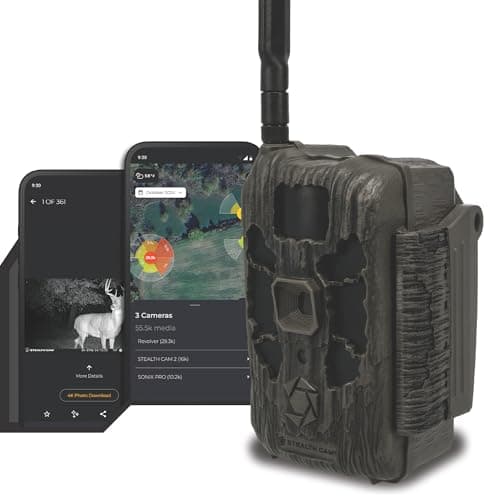
Buy this one
Stealth Cam Deceptor Max 3.0
Stealth Cam Command7.6 /10A 36-LED 940nm no-glow array, sub-0.3 s trigger, 1440p video and onboard AI that filters false triggers before they cost you plan photos, for $119.99.
$99.99Amazon#ad · Price as of October 17, 2026 · Disclosure for the link to Stealth Cam Deceptor Max 3.0
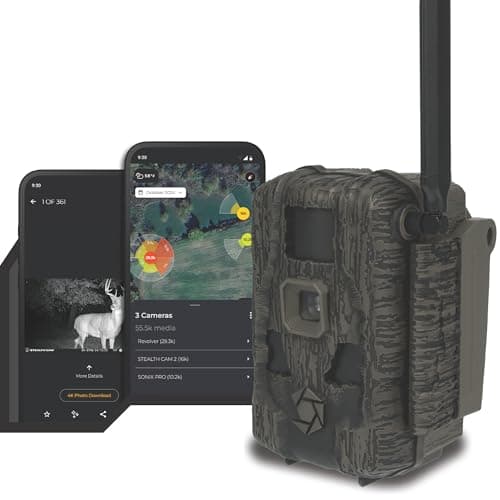
Buy this if $20 is $20
Stealth Cam Fusion Max 3.0
Stealth Cam Command6.8 /10Stealth Cam's volume cellular camera: sub-0.4 s trigger, 42MP stills, 1080p video, 16GB onboard and on-demand requests from $99.99 at the maker.
$69.99Amazon#ad · Price as of October 17, 2026 · Disclosure for the link to Stealth Cam Fusion Max 3.0
The short version
That makes this an unusually clean decision. You are not weighing trade-offs; the Deceptor is better at everything the two differ on. The only question is whether the things it is better at matter where you are hanging the camera.
Published figures, side by side
Note the blank row that is not in the table: recovery time. Stealth Cam does not publish one for either camera, and nobody has measured them. That is a real gap, because recovery is the spec that decides whether you get one photo of a group or six — and on cellular cameras generally the measured figures are brutal. Trailcampro measured 11.0 seconds on the Tactacam Reveal Pro 4.0 and 40.3 seconds on the Bushnell CelluCORE 20. Assume nothing flattering about either of these, and read trigger speed explained for why.
The flash: the only real difference
The Deceptor Max 3.0 carries a 36-piece 940nm LED array rated to 100 ft. The number 940 is the point: it is the invisible band, so the array produces no visible red shine when it fires. The Fusion Max 3.0 is described simply as “Infrared,” with no wavelength and no published flash range at all.
In practice that difference shows up in three places. On a pressured public-land trail, a visible flash tells every other hunter exactly where your camera is. At a gate or a shared access road, it tells anyone with bad intentions the same thing. And with animals, a bright IR bloom at eight feet is the one thing most likely to produce the behaviour people argue about — the doe that stares into the lens and then routes around the spot. We take a sceptical line on that last point, and the evidence either way is in do deer avoid trail cameras.
What no-glow costs is reach. A 940nm emitter is dimmer to the sensor than a 850nm one at the same power, which is why low-glow cameras routinely publish 120 to 130 ft of illumination against 80 to 100 ft for no-glow. The 36 LEDs on the Deceptor are Stealth Cam's answer to that — brute-force the array to get 100 ft invisibly. The whole trade is argued in no-glow vs low-glow, and the no-glow cellular field is ranked in best no-glow cellular trail cameras.
Sub-0.3 s against sub-0.4 s
Stealth Cam publishes “< 0.3 s” for the Deceptor and “< 0.4 s” for the Fusion Max. Both are ceilings rather than measurements, so the honest reading is that the Deceptor is in the faster class and the Fusion Max is in the middle of the cellular field. A tenth of a second is about fourteen inches of walking deer — real, but not decisive on its own.
Detection range is 100 ft on both, and both fire 1 to 6 or up to 9 images per activation respectively, which matters more than the trigger gap: a burst gets you the animal twice even if the first frame is early. Stealth Cam also gives both cameras PIR zone selection, so you can mask the half of the frame where the grass moves. Combined with the AI false-image filter, that is the best defence against the thing that actually ruins cellular sets — wasted uploads. See trail camera false triggers.
1440p against 1080p
The Deceptor records 1440p at 30 fps; the Fusion Max records 1080p at 30 fps. Unlike photo resolution, video resolution on a trail camera is hard to fake — it is a genuine readout requirement, not an upscale. Both cameras claim big still figures (50MP on the Deceptor, 42MP on the Fusion Max) and both are the kind of number Trailcampro and even Moultrie describe as interpolated across this category; see trail camera megapixels explained.
So if you want to see the animal move, the 1440p step is real. If you want Stealth Cam's best video, neither of these is it — the Spectre 4K Pro records 4K at 30 fps from separate day and night sensors and scored 88/100 at Trailcampro, the highest of any Stealth Cam. That camera and the rest of the range are in best Stealth Cam trail cameras.
Everything that is identical
- 16GB of internal memory. Both cameras work with no SD card at all. For cellular that is the right design: the card is only a buffer anyway.
- Command AI. False image detection, PIR zone selection, Rack Alert and camera sharing on both.
- The plan. Identical tiers, identical descending multi-camera schedule.
- Network behaviour. Both are described as automatic nationwide coverage rather than a carrier you choose, which is the right answer for most buyers — see trail camera carriers explained.
- Recharge compatibility. Both accept rechargeable cells, and the Fusion Max takes 12 AA against the Deceptor's 16.
That last line is the Fusion Max's one genuine advantage: four fewer AA batteries to buy every time, which at lithium prices is not nothing. See best batteries for trail cameras.
The plan both of them run on
Stealth Cam Command is $5 a month for 600 photos, $8 a month for 1,200, and $20 a month unlimited, per camera — with a descending schedule on unlimited that drops to $15 for the second camera and $11 each for the third through seventh. That makes Stealth Cam the cheapest entry in cellular and one of the most expensive unlimited first cameras we verified. HD video downloads are $0.25 each on Standard and Live View is a $5/mo add-on for 60 minutes.
The practical consequence: Stealth Cam is a good brand to buy several of and a mediocre brand to buy one of, if you want unlimited. Four cameras on unlimited totals $57 a month. The full comparison against every other ecosystem is in Stealth Cam plans explained and plans for multiple cameras.
Who should buy which
- Buy the Deceptor Max 3.0 for any set where being seen is a cost: public land, a shared lease, a gate, a driveway, a property line. Also buy it if you want video worth watching.
- Buy the Fusion Max 3.0 if the camera is going on private ground nobody else walks, over a feeder or a mineral site, and the $20 is better spent on lithium AAs or a security box.
- Buy neither if your set is a travel corridor where groups move through. Neither maker publishes a recovery time, and cellular cameras generally measure badly on it. A fast card camera is the better tool: see fastest trigger speed trail cameras.
In detail
The contenders, in full
Buy this one
Stealth Cam Deceptor Max 3.0
A 36-LED 940nm no-glow array, sub-0.3 s trigger, 1440p video and onboard AI that filters false triggers before they cost you plan photos, for $119.99.
Spec sheetSpec-checked · sources linked
| Plan ecosystem | Stealth Cam Command. The plan decides the running cost; see the plan explainer linked on this page. |
|---|---|
| Network | Automatic network coverage |
| Plan | Standard $5/mo (600 photos); Plus $8/mo; Unlimited $20/mo with descending multi-camera pricing ($15 second, $11 third to seventh); per camera |
| Trigger speed | < 0.3 s |
| Detection range | 100 ft |
| Flash | No-Glo, 36-piece 940nm LED array |
| Flash range | Out to 100 ft |
| Photo resolution | Up to 50MP, up to nine photos per burst |
| Video | 1440p at 30 fps |
| Batteries | 16 AA; recharge compatible |
| App features | Command AI: false image detection, PIR zone selection, Rack Alert; live view ready; camera sharing; dual-core processor |
| Storage | 16GB internal memory |
How the 7.6 score breaks down
- Trigger speed & recovery (20%)
- 8
- Night image quality (20%)
- 9
- Battery & solar life (20%)
- 7
- Real monthly plan cost (20%)
- 6
- Detection range & field of view (10%)
- 8
- App, setup & reliability (10%)
- 8
What the spec sheet supports
- 36 LEDs at 940nm: the largest no-glow array in this group
- PIR zone selection and false-image filtering cut wasted uploads on windy sets
- 16 AA bay for long runs; 16GB internal memory
- Stealth Cam's Standard plan is $5/mo per camera
Where it falls short
- Unlimited plan is $20/mo for the first camera, the priciest unlimited tier we verified
- 16 AA batteries is a lot of batteries to buy
- Stealth Cam does not publish a recovery time
Skip this if…
…you want unlimited photos on several cameras; the descending schedule still totals $57/mo for four.
#ad · Price as of October 17, 2026 · Disclosure for the link to Stealth Cam Deceptor Max 3.0
Buy this if $20 is $20
Stealth Cam Fusion Max 3.0
Stealth Cam's volume cellular camera: sub-0.4 s trigger, 42MP stills, 1080p video, 16GB onboard and on-demand requests from $99.99 at the maker.
Spec sheetSpec-checked · sources linked
| Plan ecosystem | Stealth Cam Command. The plan decides the running cost; see the plan explainer linked on this page. |
|---|---|
| Network | Nationwide coverage; a separate Command data plan is required |
| Plan | Command: $5/mo (600 photos), $8/mo (1,200), $20/mo unlimited, per camera |
| Trigger speed | < 0.4 s; 1 to 6 images per activation |
| Detection range | 100 ft, advanced PIR |
| Flash | Infrared |
| Photo resolution | Up to 42MP |
| Video | 1080p at 30 fps |
| App features | On Demand requests, camera sharing, recharge compatible |
| Storage | 16GB internal memory |
| Fits | In stock at Trailcampro at $119.95 with an 84/100 score; $99.99 and out of stock at Stealth Cam's own store when we checked |
How the 6.8 score breaks down
- Trigger speed & recovery (20%)
- 7
- Night image quality (20%)
- 6
- Battery & solar life (20%)
- 7
- Real monthly plan cost (20%)
- 6
- Detection range & field of view (10%)
- 8
- App, setup & reliability (10%)
- 8
What the spec sheet supports
- The cheapest way onto Stealth Cam's Command app and its $5 base plan
- 100 ft detection and a sub-0.4 s trigger at a budget price
- 16GB internal memory, so a forgotten card doesn't cost you a season
Where it falls short
- Plain IR, no no-glow option and no published flash range
- 1080p video where the Spectre records 4K
- No published recovery time
Skip this if…
…night detail at distance matters; the Spectre 4K Pro's night sensor is worth the extra $30.
#ad · Price as of October 17, 2026 · Disclosure for the link to Stealth Cam Fusion Max 3.0
How we scored this
The research behind these picks
Every pick here is built from documented evidence: the maker's published trigger speed, flash type, battery configuration and detection range; each brand's plan tiers verified on its own plan page and turned into the real monthly cost at one and four cameras; the independent shootouts (Trailcampro, Outdoor Life, Field & Stream, TechGearLab) cited by name for the measurements they published; and a public rubric applied the same way to every model. Every figure links to where it came from, so you can check our work in one click.
Scores are editorial judgments from that documented research. Commissions never set a score or decide a pick. The rubric and its weights are published.
Corrections & updates
- Published. Every figure read on Stealth Cam's own product and plan pages; stock and the 84/100 score are Trailcampro's.
Questions
Frequently asked
What is the difference between the Stealth Cam Fusion Max and the Deceptor Max?
The flash, mainly. The Deceptor Max 3.0 has a 36-LED 940nm no-glow array rated to 100 ft; the Fusion Max 3.0 has plain infrared with no published wavelength or range. The Deceptor is also published at sub-0.3 s rather than sub-0.4 s and records 1440p rather than 1080p. The app, plan, 16GB memory and AI filtering are identical.
Is the Stealth Cam Deceptor Max 3.0 worth the extra money?
For about $20 you get an invisible flash, a faster published trigger and a video resolution step, with nothing given up. On any set where somebody might see the camera, yes. Over a feeder on private ground, the Fusion Max does the same job.
Is the Stealth Cam Fusion Max 3.0 no glow?
No. Stealth Cam describes its flash only as “Infrared,” with no wavelength and no range figure. The Deceptor Max 3.0 is the no-glow camera in this pair, with a 940nm array.
Do the Fusion Max and Deceptor Max use the same plan?
Yes. Both run on Stealth Cam Command: $5/mo for 600 photos, $8/mo for 1,200 and $20/mo unlimited per camera, with the unlimited tier dropping to $15 for a second camera and $11 each for the third through seventh.
How many batteries do these cameras take?
The Deceptor Max 3.0 takes 16 AA and the Fusion Max 3.0 takes 12 AA, and both are recharge compatible. On lithium AAs that is a real running-cost difference in the Fusion Max's favour.
Keep reading
Related on Cam & Canopy
- Best Stealth Cam trail camerasThe whole range, ranked, including the 4K Spectre.
- Stealth Cam Deceptor Max 3.0 reviewThe winner here, in full.
- Stealth Cam plans explainedThe tiers both of these run on.
- Best no-glow cellular camerasWhere the Deceptor's array ranks against the field.
- No-glow vs low-glowWhat an invisible flash costs in reach.
Receipts
Sources
- Stealth Cam — Deceptor Max 3.0 product page (checked 2026-09-21)
- Stealth Cam — Fusion Max 3.0 product page (checked 2026-09-26)
- Stealth Cam — Command data plans page (checked 2026-10-01)
- Trailcampro — cellular trail camera collection, prices, scores and stock (checked 2026-09-26)
- Stealth Cam — Spectre 4K Pro product page (checked 2026-09-26)
- Trailcampro — Tactacam Reveal Pro 4.0 review, measured figures (checked 2026-09-24)
- Trailcampro — Bushnell CelluCORE 20 review, measured trigger, recovery and detection figures (checked 2026-10-09)
Every number above is traceable: specs come from the maker's own product pages (linked on every product), plan prices from the maker's plan page with an “as of” date, and independent measurements are attributed to whoever made them. Amazon prices change often, so every buy button takes you to Amazon's current price for that listing. Read the full method.