Trail Cameras · The rankings
Best no-glow trail cameras under $100: invisible flash stopped being a premium feature
A 940nm array used to mean spending real money. Seven cameras under a hundred dollars now ship one, including the cheapest camera on this site. Ranked on what the flash is actually attached to.
By Mike M.Updated Spec-checked · every figure sourced
#adReader-supported: we may earn a commission if you buy through our links, at no extra cost to you. It never decides a ranking. How we rank · Disclosure
Our top pick
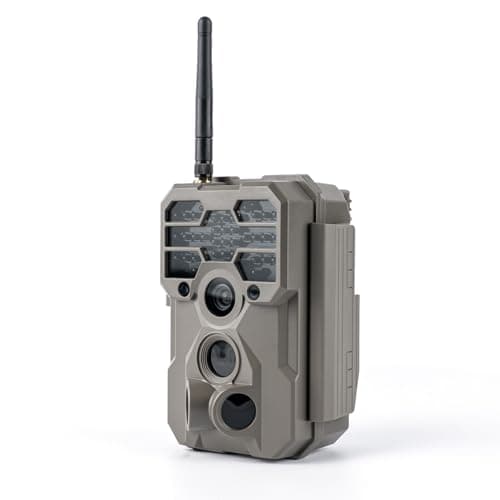
Best overall under $100
GardePro A80 (Wi-Fi)
SD / Wi-Fi940nm no-glow rated to 100 ft on a Sony Starvis sensor behind an f/1.6 lens, with three PIR sensors covering 120 degrees, 4K with audio, Wi-Fi to your phone and a screen on the camera. Nothing else at this price attaches an invisible flash to this much hardware.
#ad · Price as of November 18, 2026 · Disclosure for the link to GardePro A80 (Wi-Fi)
Read the full write-up or compare it with the rest below.
Quick picks
The rankings at a glance
| # | Product | Best for | Score | Price |
|---|---|---|---|---|
| 1 | GardePro A80 (Wi-Fi) 940nm no-glow rated to 100 ft on a Sony Starvis sensor behind an f/1.6 lens, with three PIR sensors covering 120 degrees, 4K with audio, Wi-Fi to your phone and a screen on the camera. Nothing else at this price attaches an invisible flash to this much hardware. | Best overall under $100SD / Wi-Fi | 9.6 /10 | $99.99Amazon |
| 2 | 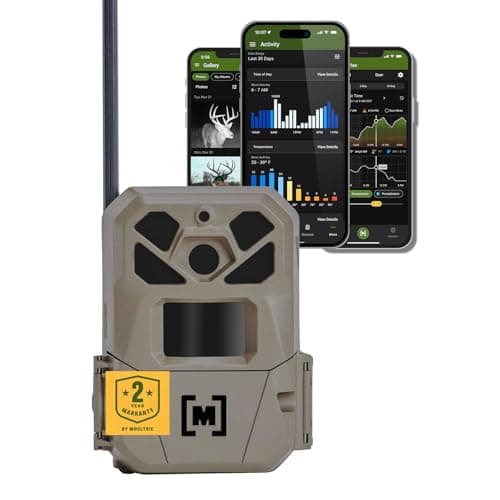 Moultrie Edge 3 Pro If the camera has to send photos rather than store them, this is the single invisible-flash option at this price. A 0.30 s trigger, 100 ft of no-glow and the winner of Trailcampro's 2026 cellular detection shootout. The plan is the cost, and it is mandatory. | The only cellular no-glow under $100Moultrie Mobile | 9.3 /10 | $107.98Amazon |
| 3 | 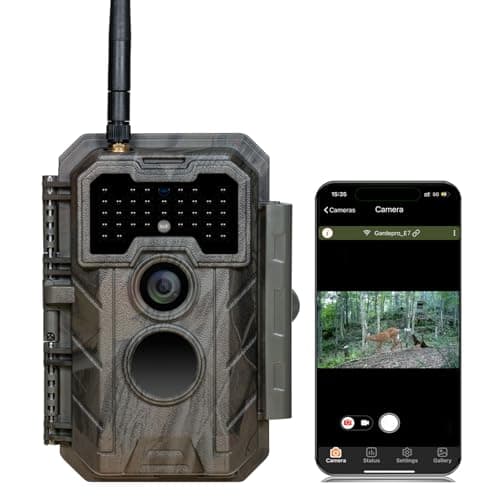 GardePro E7 (Wi-Fi) The only camera near $60 on this site that publishes a trigger AND a recovery figure - 0.2 s and 0.5 s - with 940nm rated to 100 ft, further than the camera detects. A 2.4-inch screen and phone Wi-Fi, no subscription. | Best published numbers under $60SD / Wi-Fi | 9.3 /10 | $59.99Amazon |
| 4 | 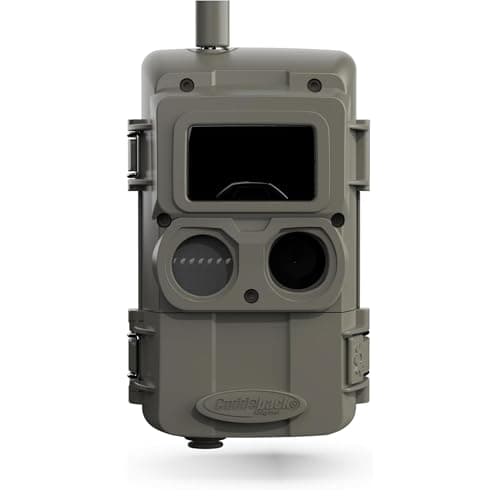 Cuddeback CuddeLink Black Flash LL-3A Cuddeback's Black Flash 940nm body with a 0.25 s trigger, built to relay images camera-to-camera back to one hub rather than carry its own radio. It only makes sense if you intend to run a CuddeLink network; on its own it is a card camera. | Best no-glow for a camera networkSD / Wi-Fi | 9.2 /10 | $95.99Amazon |
| 5 | 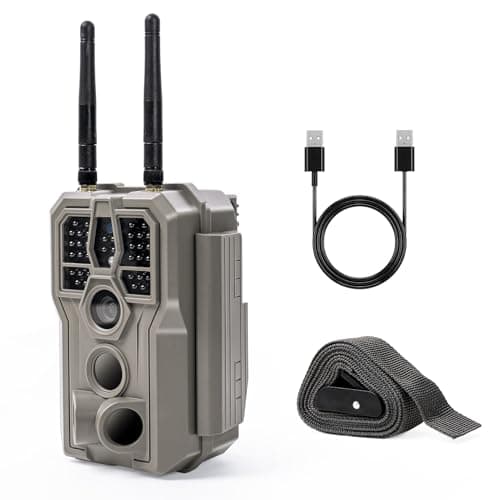 GardePro E8 2.0 (Wi-Fi) A sealed 7,800 mAh lithium pack instead of AAs, 4K with audio, and 165 ft of dual-antenna Wi-Fi to your phone at the tree. No AA bill and no monthly fee, with a stated 0.1 s trigger that no third party has checked. | Best no-glow with a built-in batterySD / Wi-Fi | 9.2 /10 | $89.99Amazon |
| 6 | 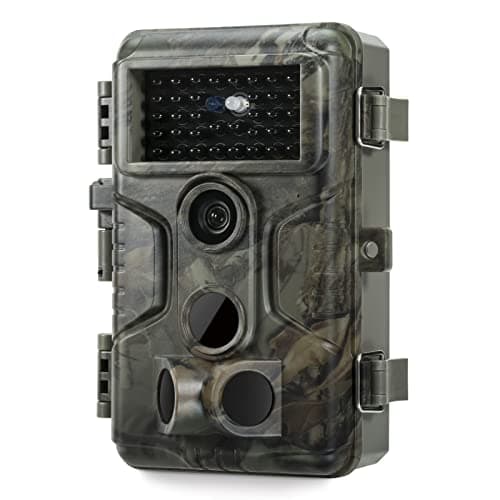 GardePro A3S Three PIR sensors covering 120 degrees out to 85 ft, a Sony Starvis sensor and 940nm no-glow, with a 2.4-inch screen for setup. No Wi-Fi at all, which is why it sits here rather than higher. | Widest detection cone at this priceSD / Wi-Fi | 9.2 /10 | $71.99Amazon |
| 7 | 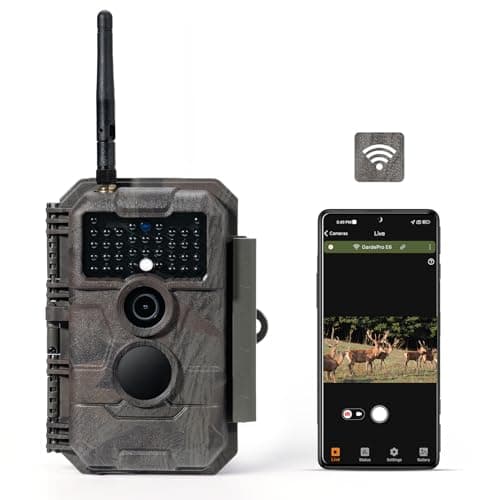 GardePro E6 (Wi-Fi) 940nm no-glow, a 110-degree wide lens, a 2.4-inch screen and phone transfer at the bottom of this page's price range. The 0.5 s trigger and 75 ft night range are the honest reasons it ranks last rather than first. | Budget pick: cheapest invisible flash with a real spec sheetSD / Wi-Fi | 8.9 /10 | $61.99Amazon |
#ad · Prices come live from Amazon, last checked November 18, 2026. Scores are ours, built from published specs, verified plan prices and cited independent tests, not our own field measurements. Row photos are Amazon's own product images for the listing each row links. Tap a row for the full write-up.
What changed: 940nm got cheap
Not long ago, “no glow” was the word that moved a trail camera from the $90 shelf to the $160 shelf. The emitters cost more, the brands charged for it, and the budget end of the market was 850nm low-glow without exception.
That is no longer true, and it is the reason this page exists separately from the no-glow roundup with no price cap. Seven cameras under a hundred dollars now ship a genuine 940nm array, including the cheapest camera on this site. Invisible flash has become a commodity feature at the bottom of the market.
Which immediately changes what you should be shopping on. When every camera in the bracket has the flash, the flash stops being the differentiator. What separates these seven is what the 940nm emitters are bolted to: the sensor behind the lens, how wide and how far the PIR array reaches, how fast the shutter fires, and whether the photographs can leave the woods without you walking in. So that is what this page ranks on, and the flash is treated as the entry requirement it has become.
One honesty note that applies to the whole bracket: with one exception, no camera here has had its trigger speed independently measured. GardePro publishes 0.1 s on several bodies, and the two GardePro cameras a third-party lab has actually put a clock on came back around half a second. We print the maker's figure and that context together rather than resolving it, and we do not estimate a number no one has published.
How we ranked them
The site's standard rubric, with no thumb on the scale for price and none for flash type — every camera here clears the flash bar by definition, so it cannot be a tiebreaker. Full weights on how we rank.
- Trigger speed and recovery. A published trigger with a published recovery beats a published trigger alone, and both beat an unsourced “as fast as 0.1 s”. Only one camera on this page publishes both.
- Night image quality. With wavelength held constant, this becomes a question of stated night range, sensor and aperture. A Sony Starvis sensor behind f/1.6 gathers more light than a generic sensor behind f/2.0, and that shows at the edge of the flash.
- Battery and solar life. AA count, a sealed lithium pack, a 12V jack, and whether a panel fits. One camera here replaces the AA bay entirely.
- Detection range and field of view. Published distance AND published angle together. A 120-degree cone covers a field edge that a 70-degree cone misses, at the same stated distance.
- Real monthly plan cost. Six of these seven have none, which is most of why the one that does sits second rather than first despite the best trigger on the page.
Prices and stock were read live from Amazon through the site's price pipeline on the day of publication; no number is typed into this page's prose.
What no-glow actually buys you
Worth being precise, because the feature is widely oversold. A 940nm array emits infrared above the range most eyes register, so it produces no visible glow when it fires. An 850nm array emits a dull red flash that is clearly visible at night.
The usual pitch is that deer spook at low-glow. The honest answer is that deer notice it less than hunters believe. The animal that reliably notices a red flash in the dark is a person, which makes the real argument for 940nm a security argument rather than a hunting one: a camera that announces itself on public land, a lease boundary or a gate near a road is a camera somebody finds.
There is a trade, and it is physics rather than marketing. 940nm emitters put out less usable light than 850nm emitters of the same power, so for a given flash budget an invisible array generally reaches less far than a visible one. That is why the stated night ranges here top out at 100 ft while low-glow bodies at the same price claim more. The full argument is in no-glow vs low-glow.
The flash-range trap
A specification worth reading carefully on every camera here: night range and detection range are two different numbers, and makers quote whichever is larger.
The GardePro E7 is the clean example. It publishes a 100 ft night-vision distance and a 75 ft detection range at a 70-degree angle. The flash reaches further than the sensor does, which means the extra 25 ft of illumination is wasted — the camera cannot be triggered by anything out there in the first place. The A80 is the better-balanced body on this page precisely because both of its figures land at 100 ft.
So when two cameras here quote the same night range, check what the PIR array reaches and how wide it sweeps before you treat them as equivalent. More detail on how those figures are measured and why angle matters as much as distance is in trail camera detection range.
If it has to be cellular
Six of these seven store photographs on a card or in onboard memory and you walk in to collect them. Exactly one sends them.
The Moultrie Edge 3 Pro is the only 940nm no-glow cellular camera under $100, which makes it the default rather than a recommendation for anyone who needs both at once. It is a genuinely strong body — fastest trigger on this page, and the winner of an independent 2026 cellular detection shootout — but its plan starts at $8.99 a month per camera with no free tier, and that repeats for as long as you own it.
Price it over the years you intend to run it before deciding, because the plan will exceed the camera. The full cellular field at this price, with each plan costed, is in best cellular trail cameras under $100; every brand's tiers at one and four cameras are in plans compared.
The cameras, side by side
The row that separates these most is Detection range, not Flash — which is the point of ranking a bracket where every camera already has the flash.
Which one is for you
- Best photographs, no monthly bill. GardePro A80. The Starvis sensor and the balanced 100 ft / 100 ft pair of figures are what you are paying for.
- It has to send photos. Moultrie Edge 3 Pro, and budget for the plan.
- Tightest budget, still invisible. GardePro E6. A genuine 940nm array at the bottom of the bracket; accept the 0.5 s trigger and the shorter range.
- You are tired of buying AAs. GardePro E8 2.0, with its sealed 7,800 mAh pack.
- You are building a mesh across a property. Cuddeback LL-3A, but only alongside a CuddeLink Home — on its own it is just a card camera.
If the price cap is softer than it looks, the invisible-flash field opens up considerably above it: best no-glow trail cameras ranks the category with no cap, and best trail cameras under $200 is where independently measured cameras begin.
In detail
The picks, in full
Rank 1
Best overall under $100
GardePro A80 (Wi-Fi)
940nm no-glow rated to 100 ft on a Sony Starvis sensor behind an f/1.6 lens, with three PIR sensors covering 120 degrees, 4K with audio, Wi-Fi to your phone and a screen on the camera. Nothing else at this price attaches an invisible flash to this much hardware.
Spec sheetSpec-checked · sources linked
The rubric behind the 9.6
- Trigger speed & recovery (25%)
- 8
- Night image quality (25%)
- 9
- Battery life (20%)
- 8
- Detection range & field of view (15%)
- 9
- Ease of use & value (15%)
- 10
Criterion scores are on the rubric's own 0–10 scale and weight to 8.7. The published 9.6 places that total on our 8.4-9.8 recommendation scale. How the scale works.
What the spec sheet supports
- A named Sony Starvis sensor and an f/1.6 lens at $99.99, which is unusual under $100
- Wi-Fi 6 rather than the 2.4GHz radios the cheaper GardePros use
- 940nm no-glow with a stated 100 ft night range
- A 2.4-inch screen AND phone preview, so you can aim it either way
Where it falls short
- '0.1 s' is GardePro's claim with no independent measurement behind it
- No published recovery time
- 45 ft of Wi-Fi means you still walk to the set; nothing reaches the house
- Multi-camera and bundle variants read sold out even where the single camera is listed
Skip this if…
…you want photos at home without walking in; only the T6LRW (hub) and E9 3.0 Pro (router mode) do that.
#ad · Price as of November 18, 2026 · Disclosure for the link to GardePro A80 (Wi-Fi)
Rank 2
The only cellular no-glow under $100
Moultrie Edge 3 Pro
If the camera has to send photos rather than store them, this is the single invisible-flash option at this price. A 0.30 s trigger, 100 ft of no-glow and the winner of Trailcampro's 2026 cellular detection shootout. The plan is the cost, and it is mandatory.
Spec sheetSpec-checked · sources linked
| Plan ecosystem | Moultrie Mobile. The plan decides the running cost; see the plan explainer linked on this page. |
|---|---|
| Network | All 4 major networks, Auto Connect |
| Plan | Standard $8.99/mo per camera; Unlimited $12.99/mo per camera; Pro Series $22.99/mo per camera |
| Trigger speed | 0.30 s |
| Detection range | 100 ft; winner of Trailcampro's 2026 cellular detection shootout |
| Flash | No-glow |
| Flash range | 100 ft |
| Photo resolution | 50MP |
| Video | 1440p QHD |
| External power | USB-C input; POWER MAG packs and 3.4W Solar Power Pack II |
| App features | GPS, Moultrie AI (switches to HD video on a buck), on-demand, Live Aim; 50° field of view; includes Easy Aim Mount |
| Storage | Built-in memory, no SD card required |
The rubric behind the 9.3
- Trigger speed & recovery (20%)
- 9
- Night image quality (20%)
- 9
- Battery & solar life (20%)
- 7
- Real monthly plan cost (20%)
- 6
- Detection range & field of view (10%)
- 9
- App, setup & reliability (10%)
- 9
Criterion scores are on the rubric's own 0–10 scale and weight to 8.0. The published 9.3 places that total on our 8.4-9.8 recommendation scale. How the scale works.
What the spec sheet supports
- First in Trailcampro's 2026 cellular detection shootout, an independent result
- No-glow with 0.30 s trigger and 100 ft on both detection and flash
- 1440p video and 50MP stills, the highest published numbers in this group
- Built-in memory and an Easy Aim Mount in the box
Where it falls short
- Per-camera plans with no free tier; four cameras on Unlimited is $51.96/mo
- USB-C power only; no AA tray means a POWER MAG or panel is the whole power plan
- 50MP is interpolated
Skip this if…
…you run four or more cameras on a budget; the plan cost outruns the camera price within a season.
#ad · Price as of November 18, 2026 · Disclosure for the link to Moultrie Edge 3 Pro
Rank 3
Best published numbers under $60
GardePro E7 (Wi-Fi)
The only camera near $60 on this site that publishes a trigger AND a recovery figure - 0.2 s and 0.5 s - with 940nm rated to 100 ft, further than the camera detects. A 2.4-inch screen and phone Wi-Fi, no subscription.
Spec sheetSpec-checked · sources linked
| Category | SD / Wi-Fi |
|---|---|
| Trigger speed | 0.2 s (maker spec) |
| Recovery time | 0.5 s (maker spec) |
| Detection range | 75 ft (23 m) at a 70° detection angle |
| Flash | 940nm no-glow IR LEDs |
| Flash range | 100 ft (30 m) night-vision distance |
| Photo resolution | 64MP; 6.0 mm focal length, f/1.6 aperture, 70° field of view |
| Video | 1296p HD with sound |
| Batteries | 8 AA (1.5V each); AC adapter and SP350 solar panel compatible |
| App features | 2.4GHz Wi-Fi to a phone at 45 ft+ (13 m), Bluetooth pairing at 33 ft (10 m), 54 Mbps maximum transfer; 2.4-inch color screen |
| Storage | SD card (64GB included in some bundles) |
| Fits | $59.99 (regular $99.99) and listed in stock on GardePro's Wi-Fi collection; bundle variants read sold out |
| Dimensions | IP66 waterproof |
The rubric behind the 9.3
- Trigger speed & recovery (25%)
- 8
- Night image quality (25%)
- 8
- Battery life (20%)
- 8
- Detection range & field of view (15%)
- 6
- Ease of use & value (15%)
- 10
Criterion scores are on the rubric's own 0–10 scale and weight to 8.0. The published 9.3 places that total on our 8.4-9.8 recommendation scale. How the scale works.
What the spec sheet supports
- 0.2 s trigger AND a published 0.5 s recovery at $59.99: most cameras at twice the price publish neither
- 940nm no-glow rated to 100 ft, further than the camera detects
- A 2.4-inch screen plus phone Wi-Fi, so setup needs nothing else
- Runs on AAs and takes a panel
Where it falls short
- 75 ft detection at 70° is a short, wide cone: good for a feeder, weak for a field edge
- 1296p, not 4K
- Both figures are GardePro's own; nobody independent has measured this camera
- Good to know: GardePro's product page says 64MP and a 70-degree field of view, while the Amazon listing for the same model says 48MP and 110 degrees. We print the maker page's figures
- The 100 ft night claim exceeds the 75 ft detection figure, so the flash outruns the sensor
Skip this if…
…you want measured numbers rather than claimed ones; the T5NG Pro has Trailcampro's data for $40 more.
#ad · Price as of November 18, 2026 · Disclosure for the link to GardePro E7 (Wi-Fi)
Rank 4
Best no-glow for a camera network
Cuddeback CuddeLink Black Flash LL-3A
Cuddeback's Black Flash 940nm body with a 0.25 s trigger, built to relay images camera-to-camera back to one hub rather than carry its own radio. It only makes sense if you intend to run a CuddeLink network; on its own it is a card camera.
Spec sheetSpec-checked · sources linked
The rubric behind the 9.2
- Trigger speed & recovery (25%)
- 9
- Night image quality (25%)
- 7
- Battery life (20%)
- 8
- Detection range & field of view (15%)
- 7
- Ease of use & value (15%)
- 8
Criterion scores are on the rubric's own 0–10 scale and weight to 7.9. The published 9.2 places that total on our 8.4-9.8 recommendation scale. How the scale works.
What the spec sheet supports
- Adds a camera to a live network for under $100 with no extra monthly cost at all
- 940nm no-glow flash, the invisible class, on a camera this cheap
- 0.25 s trigger: quicker than anything Covert, Spypoint or Moultrie publishes
- Dealer list price is $149.99, so the Amazon price is a real discount rather than a marked-up listing
Where it falls short
- Useless on its own: without a CuddeLink Home or Cell Home it is just an SD camera with a short flash
- Black Flash reach is quoted at roughly 50 ft, half the IR version's 100 ft
- Amazon printed no stock line on the day we checked, only a live price
- D cells, and Cuddeback publishes no battery count on any readable page
Skip this if…
…you do not already own a CuddeLink Home; buy the 2+1 cellular kit instead and start the network properly.
#ad · Price as of November 18, 2026 · Disclosure for the link to Cuddeback CuddeLink Black Flash LL-3A
Rank 5
Best no-glow with a built-in battery
GardePro E8 2.0 (Wi-Fi)
A sealed 7,800 mAh lithium pack instead of AAs, 4K with audio, and 165 ft of dual-antenna Wi-Fi to your phone at the tree. No AA bill and no monthly fee, with a stated 0.1 s trigger that no third party has checked.
Spec sheetSpec-checked · sources linked
The rubric behind the 9.2
- Trigger speed & recovery (25%)
- 8
- Night image quality (25%)
- 8
- Battery life (20%)
- 8
- Detection range & field of view (15%)
- 6
- Ease of use & value (15%)
- 9
Criterion scores are on the rubric's own 0–10 scale and weight to 7.9. The published 9.2 places that total on our 8.4-9.8 recommendation scale. How the scale works.
What the spec sheet supports
- 165 ft of dual-antenna Wi-Fi: you can pull files from outside the set's scent cone
- 4K with audio at $89.99
- 8 AAs, so a dead camera is a five-minute fix in the field
- GardePro states it plainly: no data plan, no subscription
Where it falls short
- No screen on the camera at all, so aiming means bringing your phone
- GardePro publishes no detection range, no night range and no recovery time
- The 0.1 s figure is a maker claim with no independent measurement
- Wi-Fi is camera-to-phone only; it cannot reach a home router
Skip this if…
…you want to set the camera up without a phone in your hand; the A80 and E7 both have a 2.4-inch screen.
#ad · Price as of November 18, 2026 · Disclosure for the link to GardePro E8 2.0 (Wi-Fi)
Rank 6
Widest detection cone at this price
GardePro A3S
Three PIR sensors covering 120 degrees out to 85 ft, a Sony Starvis sensor and 940nm no-glow, with a 2.4-inch screen for setup. No Wi-Fi at all, which is why it sits here rather than higher.
Spec sheetSpec-checked · sources linked
| Category | SD / Wi-Fi |
|---|---|
| Trigger speed | 0.1 s 'ultra-fast' (maker claim), from three PIR sensors |
| Detection range | 85 ft (27 m) across a 120° angle (60° center plus 30° each side) |
| Flash | 940nm no-glow IR LEDs |
| Flash range | 100 ft (30 m) night-vision distance |
| Photo resolution | 64MP; Sony Starvis sensor |
| Video | 1296p or 1080p |
| Batteries | 8 AA, or 8 in parallel for 12V |
| External power | DC 12V input (5.5 x 2.1 mm) for an AC adapter or a solar panel |
| App features | 2.4-inch color screen for setup and review; no Wi-Fi |
| Storage | Memory cards up to 512GB |
| Fits | $71.99 (regular $94.99) on GardePro's listing, but the single-camera variant read 'Variant sold out or unavailable' on the product page when we checked |
| Dimensions | IP66 waterproof |
The rubric behind the 9.2
- Trigger speed & recovery (25%)
- 7
- Night image quality (25%)
- 8
- Battery life (20%)
- 8
- Detection range & field of view (15%)
- 8
- Ease of use & value (15%)
- 8
Criterion scores are on the rubric's own 0–10 scale and weight to 7.8. The published 9.2 places that total on our 8.4-9.8 recommendation scale. How the scale works.
What the spec sheet supports
- A named Sony Starvis sensor at GardePro's lowest price
- 940nm no-glow rated to 100 ft, which the $50 tier does not offer
- Three PIR sensors covering 120°
- 2.4-inch screen and 512GB card support
Where it falls short
- The single-camera variant read sold out on GardePro's own product page when we checked
- '0.1 s' is a claim; nobody independent has measured the A3S
- No published recovery time
- No Wi-Fi, so files come off the card
Skip this if…
…you can stretch to $99.95; the T5NG Pro has measured figures, a 91/100 score and 120 ft of detection.
#ad · Price as of November 18, 2026 · Disclosure for the link to GardePro A3S
Rank 7
Budget pick: cheapest invisible flash with a real spec sheet
GardePro E6 (Wi-Fi)
940nm no-glow, a 110-degree wide lens, a 2.4-inch screen and phone transfer at the bottom of this page's price range. The 0.5 s trigger and 75 ft night range are the honest reasons it ranks last rather than first.
Spec sheetSpec-checked · sources linked
The rubric behind the 8.9
- Trigger speed & recovery (25%)
- 5
- Night image quality (25%)
- 8
- Battery life (20%)
- 8
- Detection range & field of view (15%)
- 7
- Ease of use & value (15%)
- 9
Criterion scores are on the rubric's own 0–10 scale and weight to 7.3. The published 8.9 places that total on our 8.4-9.8 recommendation scale. How the scale works.
What the spec sheet supports
- A 110° lens: the widest field of view on the Wi-Fi cameras here, which suits a yard or a food plot
- 940nm no-glow, not the 850nm low-glow the cheapest cameras usually use
- 2.4-inch screen and phone transfer at $59.99
- A plain 12V jack, so any panel with the right plug works
Where it falls short
- 0.5 s trigger and one PIR sensor: the E7 is 0.2 s with three for the same money
- 20 fps video, which looks stuttery next to 30 fps
- No published recovery time
- 75 ft of night range is the shortest here
Skip this if…
…anything crosses your set at a walk; spend the same $59.99 on the E7 and get 0.2 s and 100 ft of flash.
#ad · Price as of November 18, 2026 · Disclosure for the link to GardePro E6 (Wi-Fi)
Buyer's guide: getting the most from an invisible flash
Lithium cells, or the flash underperforms
An infrared array is the most current-hungry thing a trail camera does, and a 940nm array needs more of it than an 850nm one to light the same distance. On tired alkalines the first thing to degrade is night exposure, and the symptom looks like a bad camera rather than a bad battery: best batteries for trail cameras.
Hang it closer than you think
Because invisible emitters reach less far, a no-glow camera rewards a tighter set. Thirty to forty feet off a trail with the camera angled down the path produces better night frames than sixty feet square-on, whatever the stated range says: trail camera placement.
Do not tape or paint over the array
It is a recurring idea and it does not work. Covering the emitters absorbs the infrared the camera needs, and the result is black night photographs that look like a hardware fault. If a camera glows and you need it not to, the fix is a 940nm body — which is what this page is for.
Match the card to the camera
Six of these seven take an SD card, and two of them record 4K, which wants a V30 card rather than whatever was in the drawer. Capacity, format and speed class are covered in best SD cards for trail cameras.
An invisible camera is still a findable camera
No-glow removes the night-time giveaway; it does not remove the camera-shaped object strapped to a tree at eye level. If theft is the reason you want invisible flash, finish the job: how to hide a trail camera and best security boxes.
Treat a 0.1 s claim as marketing
Five of the seven cameras here are GardePro bodies and several publish 0.1 s. The two GardePro cameras an independent lab has measured came back around half a second. Assume the latter and be pleasantly surprised.
The short version
Our recommendation
Top pick
GardePro A80 (Wi-Fi)
Best overall under $100. 940nm no-glow rated to 100 ft on a Sony Starvis sensor behind an f/1.6 lens, with three PIR sensors covering 120 degrees, 4K with audio, Wi-Fi to your phone and a screen on the camera. Nothing else at this price attaches an invisible flash to this much hardware.
#ad · Price as of November 18, 2026 · Disclosure for the link to GardePro A80 (Wi-Fi)
Runner-up
Moultrie Edge 3 Pro
The only cellular no-glow under $100. If the camera has to send photos rather than store them, this is the single invisible-flash option at this price. A 0.30 s trigger, 100 ft of no-glow and the winner of Trailcampro's 2026 cellular detection shootout. The plan is the cost, and it is mandatory.
#ad · Price as of November 18, 2026 · Disclosure for the link to Moultrie Edge 3 Pro
Brands: want your product tested? For Brands.
How we scored this
The research behind these picks
Every pick here is built from documented evidence: the maker's published trigger speed, flash type, battery configuration and detection range; each brand's plan tiers verified on its own plan page and turned into the real monthly cost at one and four cameras; the independent shootouts (Trailcampro, Outdoor Life, Field & Stream, TechGearLab) cited by name for the measurements they published; and a public rubric applied the same way to every model. Every figure links to where it came from, so you can check our work in one click.
Scores are editorial judgments from that documented research. Commissions never set a score or decide a pick. The rubric and its weights are published.
Corrections & updates
- Published. Price and stock for all seven cameras read live from Amazon the same day; every flash, detection and trigger figure quoted from the maker page already cited for that camera in the registry.
Questions
Frequently asked
What is the best no-glow trail camera under $100?
The GardePro A80: 940nm no-glow rated to 100 ft, a Sony Starvis sensor behind an f/1.6 lens, three PIR sensors covering 120 degrees out to 100 ft, 4K with audio, Wi-Fi to your phone and a 2.4-inch screen, with no monthly fee of any kind.
Is there a no-glow cellular trail camera under $100?
One: the Moultrie Edge 3 Pro. It is the only 940nm cellular body at this price, it has the fastest published trigger on this page at 0.30 s, and it won Trailcampro's 2026 cellular detection shootout. Its plan starts at $8.99 a month per camera with no free tier.
Do deer see no-glow trail cameras?
A 940nm array produces no visible glow, so there is nothing for a deer to see when it fires. The more useful point is that deer notice an 850nm low-glow flash less than most hunters assume — the animal that reliably notices a red flash at night is a person, which makes no-glow mainly a theft-prevention feature.
Is no-glow worth it on a cheap trail camera?
At this price you barely pay for it any more, which is the finding of this page: seven cameras under $100 ship a genuine 940nm array, including the cheapest camera on this site. The trade is range — invisible emitters reach less far for the same power, so stated night ranges here top out at 100 ft.
What is the cheapest no-glow trail camera with a real spec sheet?
The GardePro E6, which sits at the bottom of this page's range with a 940nm array, a 110-degree wide lens, a 2.4-inch screen and phone transfer. Its 0.5 s trigger and 75 ft night range are why it ranks last here rather than first.
Does no-glow mean the camera takes worse night pictures?
Not worse, but generally shorter-reaching. A 940nm emitter puts out less usable light than an 850nm emitter of the same power, so the lit zone is smaller. What recovers that is the sensor and the lens behind it, which is why the A80's Sony Starvis sensor at f/1.6 ranks above cameras with the same flash wavelength.
Keep reading
Related on Cam & Canopy
- Best no-glow trail camerasThe same category with no price cap.
- Best trail cameras under $100The bracket without the flash filter.
- Best cellular trail cameras under $100If the photos have to leave the woods.
- No-glow vs low-glowWhat 940nm costs you in reach, and what it buys.
- Trail camera detection rangeWhy angle matters as much as distance.
- Best trail camera for night picturesRanked on night image quality alone.
Receipts
Sources
- GardePro — A80 Wi-Fi Trail Camera product page (checked 2026-09-28)
- GardePro — E7 Wi-Fi Trail Camera product page (checked 2026-09-28)
- GardePro — E6 Wi-Fi Trail Camera product page (checked 2026-09-28)
- GardePro — E8 2.0 Wi-Fi Trail Camera product page (checked 2026-09-26)
- GardePro — A3S non-cellular trail camera product page (checked 2026-09-28)
- Moultrie — EDGE 3 PRO product page (checked 2026-09-21)
- Cuddeback - brand's own Amazon listing for the CuddeLink Black Flash LL-3A (1 pack): 940nm invisible flash, live price (checked 2026-10-23)
- Farmstead Outdoors - Cuddeback CuddeLink LL-3A dealer page reproducing Cuddeback's spec copy: D-cell power, any full-size SD card, 23-camera network, 5 s to 1 hour delays, $149.99 list (checked 2026-10-23)
- Moultrie Mobile — plans page (checked 2026-09-21)
Every number above is traceable: specs come from the maker's own product pages (linked on every product), plan prices from the maker's plan page with an “as of” date, and independent measurements are attributed to whoever made them. Amazon prices change often, so every buy button takes you to Amazon's current price for that listing. Read the full method.