Cellular Trail Cameras · The rankings
Best Cuddeback trail cameras: the only system where camera number six costs nothing a month
Every other cellular brand on this site charges you per camera. Cuddeback links its cameras to each other and puts one data plan on one hub, which changes the arithmetic completely once you pass two cameras. The catch is that Cuddeback publishes almost nothing you can read.
By Mike M.Updated Spec-checked · every figure sourced
#adReader-supported: we may earn a commission if you buy through our links, at no extra cost to you. It never decides a ranking. How we rank · Disclosure
Quick picks
The rankings at a glance
| # | Product | Best for | Score | Price |
|---|---|---|---|---|
| 1 | 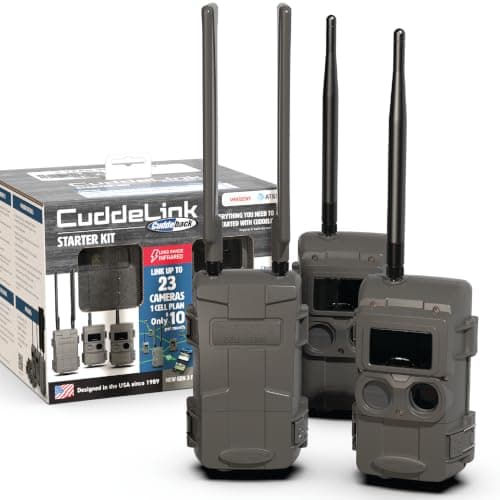 Cuddeback CuddeLink 2+1 Cellular Starter Kit (Black Flash) Two 940nm no-glow cameras and a Cell Home in one box, at about $300 and in stock. One data plan carries the network, so every camera you add later is free to run. | Best Cuddeback overallCuddeback CuddeLink | 7.5 /10 | $299.99Amazon |
| 2 | 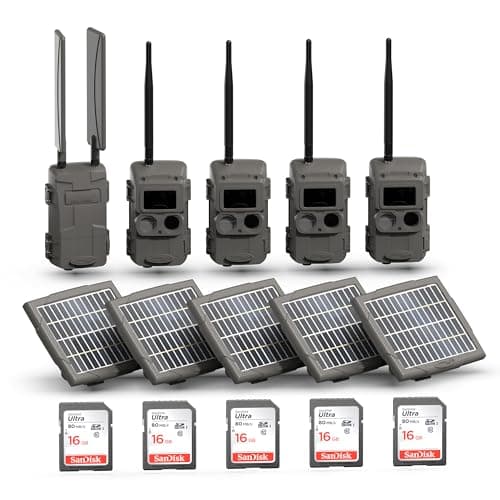 Cuddeback CuddeLink IR 4-Camera Bundle with Cell Home Four IR cameras, a Cell Home, five solar power banks and five SD cards. Expensive up front, and the cheapest four-camera running cost on this site. | Best for a whole propertyCuddeback CuddeLink | 8.3 /10 | $828.90Amazon |
| 3 | 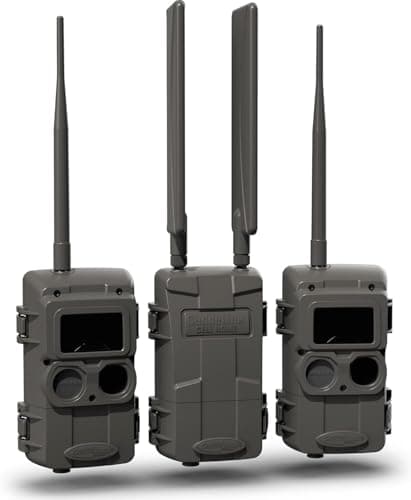 Cuddeback CuddeLink 2+1 Cellular Starter Kit (IR) The same two-plus-hub kit with 850nm IR instead of Black Flash: 100 ft of published night range rather than roughly 50, at the cost of a faint red glow. | Best kit for night reachCuddeback CuddeLink | 7.7 /10 | $296.90Amazon |
| 4 | 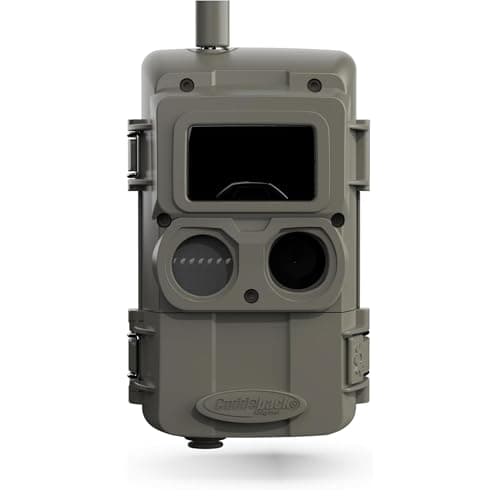 Cuddeback CuddeLink Black Flash LL-3A Under $100, 940nm invisible flash, 0.25 s trigger, and no plan of its own. The camera to buy once the hub is already in the woods. | Best camera to addSD / Wi-Fi | 7.9 /10 | $98.95Amazon |
| 5 | 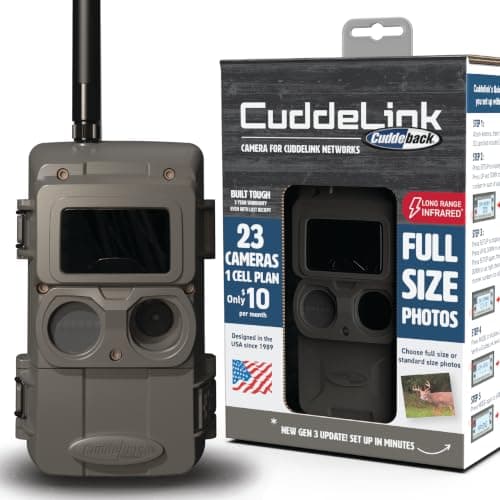 Cuddeback CuddeLink IR LL-2A 100 ft of published IR range for roughly the same price as the no-glow body. The right choice for a food plot, the wrong one for a shared trail. | Best add-on for distanceSD / Wi-Fi | 8.1 /10 | $97.82Amazon |
#ad · Prices come live from Amazon, last checked October 23, 2026. Scores are ours, built from published specs, verified plan prices and cited independent tests, not our own field measurements. Row photos are Amazon's own product images for the listing each row links. Tap a row for the full write-up.
What CuddeLink actually is
Cuddeback does not really sell cellular cameras. It sells a radio mesh with one cellular door in it, and that is a genuinely different product from everything else on this site.
Each CuddeLink camera talks to the camera next to it over a short-range radio link. Images hop from camera to camera until they reach a “Home” device. If that Home is a plain Home, every photo on the network lands on one SD card you collect in one walk. If it is a Cell Home, the Home has the SIM and the data plan, and it pushes the whole network's images to your phone.
Two numbers describe the mesh, and the sources we can read disagree on the first one. A Cuddeback dealer's spec copy says you can deploy up to 23 cameras on one system; a dealer buying guide says up to 15 cameras per hub. Both are dealers reproducing Cuddeback's own material, and Cuddeback's site publishes neither figure in readable form. The honest answer is “between fifteen and twenty-three, and plan for fifteen.”
The second number is range. The dealer guide puts camera-to-camera reach at a quarter to half a mile in dense timber and just over a mile in open country, with daisy-chained networks spanning four miles or more end to end. That is the number that decides whether CuddeLink works on your ground: the mesh does not need every camera to have signal, only a path back to the Home.
The arithmetic that makes it worth it
Start from how this site normally talks about running cost: a cellular camera costs you its plan every month, forever, and the plan outspends the camera inside a season or two. Spypoint, Tactacam, Moultrie, Stealth Cam and Bushnell all charge per camera, with discounts for volume - the full picture is in cellular trail camera plans compared and trail camera plans for multiple cameras.
CuddeLink charges per hub. One plan on the Cell Home carries every linked camera. The marginal monthly cost of your fourth, eighth or fifteenth camera is zero.
That inverts the usual buying order. On a per-camera brand, you minimize the number of cameras because each one has a bill attached. On CuddeLink, the hub is the expensive decision and cameras are nearly disposable - under $100 each at current Amazon prices for the L-series bodies. A six-camera CuddeLink network runs one subscription. Six Moultrie Edge bodies run six.
Two honest caveats. First, Cuddeback does not publish what the Cell Home plan costs, so we cannot print the number you would be comparing against - see the documentation section below. Second, the entry cost is high: a 2+1 kit is around $300 against about $100 for a single budget cell cam. Below three cameras, a per-camera brand almost certainly wins; at four and up, CuddeLink is very hard to beat. How many cameras a property actually needs is worked through in how many trail cameras do I need.
How we ranked them
Cellular kits are scored on the site's published cellular rubric - trigger and recovery, night image quality, battery and solar life, real monthly plan cost, detection and field of view, app and setup. The link-only cameras are scored on the no-plan rubric, because they carry no subscription of their own. Both are at how we rank. Three things decided the order:
- Does it start a network or extend one? A kit with a Cell Home is a complete system; an LL-2A or LL-3A on its own is an SD camera with a radio and nothing to talk to. Kits rank above cameras because buying the camera first is the common, expensive mistake.
- Flash class. 940nm Black Flash is invisible and reaches roughly 50 ft. 850nm IR glows faintly red and reaches 100 ft. Neither is better in the abstract, so each class is ranked within its own job rather than against the other.
- What the brand actually publishes. Every Cuddeback score on this page is capped by the fact that we could not read a single spec on Cuddeback's own website. A brand that will not publish a detection range does not get credit for one.
The range, side by side
The documentation problem
This needs saying before anyone spends $300. Cuddeback's website, cuddeback.com, is a client-rendered application that serves no readable specification, model or plan content. We checked it on 9 October 2026 and again on 23 October 2026 and got the same result both times: a page title and nothing else. There is no spec sheet to read, no plan price list, no model matrix.
That is why this page exists in the shape it does. Every figure above is traceable to one of two places: Cuddeback's own Amazon listings, where the brand publishes its flash wavelength and range, or dealer pages reproducing Cuddeback's spec copy, where the D-cell power, SD-card compatibility, delay ranges, sensor generation and network size come from. We use the same approach on best trail camera straps, where no maker publishes a spec page either, and we label it the same way: the source is named on every row.
What is genuinely missing, and what you should not let any page tell you: Cuddeback publishes no detection range, no detection angle, no recovery time, no battery count, and no Cell Home plan price. Anyone quoting those numbers for a CuddeLink camera is quoting something they cannot source. We would rather print “not published” and lose the comparison than invent the row.
Black Flash or IR: pick before you buy
Cuddeback sells both flash classes in the same bodies at the same price, which makes this the cleanest version of a decision every reader on this site eventually faces.
- Black Flash (LL-3A, Black Flash kit). 940nm emitters. Invisible to deer and to people. Roughly 50 ft of night reach per the dealer guide. The right choice on a pressured trail, a shared access road or public ground - anywhere a red glow invites someone to investigate.
- IR (LL-2A, IR kit, four-camera bundle). 850nm emitters, 100 ft of published range per Cuddeback's own listing. A faint red glow at the lens when it fires. The right choice on a food plot, a field edge or a feeder where the extra 50 ft is the whole picture and nobody else walks past.
Doubling the night reach for a visible glow is a bigger trade than most spec sheets make it look, and it is the same trade across every brand. The full version, with what the wavelengths actually do, is in no-glow vs low-glow. If theft is the worry rather than spooked deer, start at how to keep your trail camera from being stolen.
Siting a mesh is real work
A per-camera cell cam is a ten-minute job: strap it, aim it, check the bars, walk away. A CuddeLink network is a planning exercise, and pretending otherwise is how people end up disappointed.
Each camera must reach a neighbor, and each chain must reach the Home. In timber that means thinking in quarter-mile hops; in open country you get a mile and more. The Home wants the best cell signal on the property, which is usually not where you want a camera - so the Home goes on the high ground or by the road, and the cameras chain in to it. Expect to move at least one camera after the first week.
The payoff is that the walk-in disappears afterwards. No SD swaps, no scent in the core of the property, no batteries in November. The general discipline is the same one in trail camera placement and how often to check trail cameras; the mesh just raises the stakes on getting it right the first time. On public ground, where you cannot leave a hub sitting out, this system is usually the wrong tool - see public land trail camera strategy.
One more practical point: the L-series cameras run on D cells, not AA. If you already stock lithium AAs for a Browning or a GardePro, none of that inventory carries over. Budget the batteries separately and read best batteries for trail cameras before you buy a case of the wrong ones.
Which Cuddeback for which property
- Starting from nothing, pressured ground. The 2+1 Black Flash kit. Two invisible-flash cameras and the hub, then add LL-3A bodies as you learn the property.
- Starting from nothing, open ground and feeders. The 2+1 IR kit. You give up the invisible flash and double the night reach.
- A whole farm, all at once. The four-camera bundle with the Cell Home, five solar power banks and the cards. It is the most expensive line item on this site and the cheapest four-camera running cost on it.
- You already own a Home. Buy cameras, not kits. LL-3A for cover, LL-2A for distance, under $100 each and nothing per month.
- One camera on one property. Not Cuddeback. Buy a published, plan-priced single camera instead - start at best cellular trail cameras.
What we did not rank
The J-series and G-series cameras. Both families still appear at dealers, and the dealer guide credits them with the same 0.25 s trigger and 20MP sensor as the L-series. We did not rank them because we could not confirm current stock on a listing whose title matched a specific model, and we do not rank a camera we cannot point a buy link at.
The plain (non-cellular) CuddeLink Home. It is the cheaper way into the mesh if you are happy collecting one SD card instead of getting photos on your phone. It belongs on a page about SD workflows rather than here; the card discipline is in trail camera SD card guide.
Multi-camera bundle listings beyond the four-camera kit. Larger bundles exist, including an eight-camera configuration. They are the same hardware in bigger boxes, and a reader buying at that scale is better served pricing the four-camera bundle plus individual cameras.
A CuddeLink plan cost comparison. We cannot build one. Until Cuddeback publishes Cell Home plan prices somewhere readable, the only honest statement is the architectural one: one plan, not one per camera.
In detail
The picks, in full
Rank 1
Best Cuddeback overall
Cuddeback CuddeLink 2+1 Cellular Starter Kit (Black Flash)
Two 940nm no-glow cameras and a Cell Home in one box, at about $300 and in stock. One data plan carries the network, so every camera you add later is free to run.
Spec sheetSpec-checked · sources linked
How the 7.5 score breaks down
- Trigger speed & recovery (20%)
- 9
- Night image quality (20%)
- 7
- Battery & solar life (20%)
- 7
- Real monthly plan cost (20%)
- 8
- Detection range & field of view (10%)
- 7
- App, setup & reliability (10%)
- 6
What the spec sheet supports
- One subscription for the whole network instead of one per camera: the only mainstream system on this site built that way
- No-glow 940nm flash on both cameras in the kit, so a pressured trail never sees a red glow
- 0.25 s is the quickest trigger figure any source publishes for Cuddeback, and it beats every Covert, Spypoint and Moultrie body on this site
- In stock on Amazon at about $300 when we checked, and the kit undercuts buying a Home plus two cameras separately
- Expands by adding cameras, not plans: the marginal monthly cost of camera four is nothing
Where it falls short
- Cuddeback's own website serves no readable spec, model or plan content, so you cannot look up a single number on it
- Nobody publishes a Black Flash range: the roughly 50 ft figure is a dealer's, and it is half what Cuddeback's IR bodies are quoted at
- Sources disagree on how many cameras one Home carries: 15 in one dealer guide, 23 in another dealer's spec copy
- D cells, not AA, so the batteries you already own for other cameras do not fit
- No plan prices anywhere public: you find out the running cost after you buy
Skip this if…
…you want one camera on one property; a single-camera plan from Moultrie or Tactacam is far cheaper than a hub you do not need.
#ad · Price as of October 23, 2026 · Disclosure for the link to Cuddeback CuddeLink 2+1 Cellular Starter Kit (Black Flash)
Rank 2
Best for a whole property
Cuddeback CuddeLink IR 4-Camera Bundle with Cell Home
Four IR cameras, a Cell Home, five solar power banks and five SD cards. Expensive up front, and the cheapest four-camera running cost on this site.
Spec sheetSpec-checked · sources linked
| Plan ecosystem | Cuddeback CuddeLink. The plan decides the running cost; see the plan explainer linked on this page. |
|---|---|
| Network | Cellular through the included Cell Home; the four cameras link to it rather than to a carrier |
| Plan | One plan on the Cell Home for all four cameras. Cuddeback publishes no tier prices on a readable page |
| Trigger speed | 0.25 s across the linked camera families, per the dealer guide |
| Flash | Low-glow 850nm IR on the L-series IR bodies, per Cuddeback's own LL-2A listing |
| Flash range | 100 ft on Cuddeback's IR bodies, per the brand's own LL-2A listing |
| Photo resolution | 20MP across the linked camera families, per the dealer guide |
| External power | Five solar power banks included in the bundle |
| App features | Images daisy-chain camera to camera and out through the Cell Home; the dealer guide puts camera-to-camera range at a quarter to half a mile in timber and just over a mile in open country |
| Storage | Five 16GB SD cards included; the cameras take any full-size card |
How the 8.3 score breaks down
- Trigger speed & recovery (20%)
- 9
- Night image quality (20%)
- 8
- Battery & solar life (20%)
- 9
- Real monthly plan cost (20%)
- 9
- Detection range & field of view (10%)
- 7
- App, setup & reliability (10%)
- 6
What the spec sheet supports
- Four cameras on one subscription: at four cameras this is the cheapest running cost of any cellular system on this site
- Solar power banks for every camera plus a spare, which is the difference between a system and a chore
- Cameras relay through each other, so a camera with no signal of its own still reports as long as it can reach a neighbor
- 100 ft of published IR reach and a 0.25 s trigger on every body in the bundle
Where it falls short
- Comfortably the most expensive single line item on this site: a serious outlay before you have paid for a photo
- Low-glow IR only in this bundle; the no-glow cameras have to be bought separately
- Siting a mesh is work: each camera has to reach a neighbor, which takes a walk and some trial and error
- Cuddeback's own site publishes nothing readable, and the plan price is not public
Skip this if…
…you run one or two cameras; the hub and the bundle are both wasted and a per-camera plan is cheaper.
#ad · Price as of October 23, 2026 · Disclosure for the link to Cuddeback CuddeLink IR 4-Camera Bundle with Cell Home
Rank 3
Best kit for night reach
Cuddeback CuddeLink 2+1 Cellular Starter Kit (IR)
The same two-plus-hub kit with 850nm IR instead of Black Flash: 100 ft of published night range rather than roughly 50, at the cost of a faint red glow.
Spec sheetSpec-checked · sources linked
| Plan ecosystem | Cuddeback CuddeLink. The plan decides the running cost; see the plan explainer linked on this page. |
|---|---|
| Network | Dual carrier: sold as AT&T and Verizon, per Cuddeback's own listing title |
| Plan | One plan on the Cell Home covers every linked camera; Cuddeback publishes no tier prices on a readable page |
| Trigger speed | 0.25 s across the linked camera families, per the dealer guide |
| Flash | Low-glow 850nm IR, per Cuddeback's own listing for the matching LL-2A camera |
| Flash range | 100 ft on Cuddeback's IR bodies, per the brand's own LL-2A listing |
| Photo resolution | 20MP across the linked camera families, per the dealer guide |
| Batteries | D cells, per the dealer spec copy for the matching LL-2A |
| App features | The Cell Home relays the network to the phone on one subscription |
| Storage | Any full-size SD card in each camera, per the dealer spec copy |
How the 7.7 score breaks down
- Trigger speed & recovery (20%)
- 9
- Night image quality (20%)
- 8
- Battery & solar life (20%)
- 7
- Real monthly plan cost (20%)
- 8
- Detection range & field of view (10%)
- 7
- App, setup & reliability (10%)
- 6
What the spec sheet supports
- 100 ft of published night reach against roughly 50 ft for the Black Flash kit: the right pick on a food plot or a field edge
- Same single-plan architecture: the Home pays for data, the cameras do not
- Around $297 on Amazon when we checked, a few dollars under the Black Flash kit
- 0.25 s trigger, the same quick sensor as the rest of the CuddeLink range
Where it falls short
- 850nm IR glows faintly red at the lens, which is a real problem on shared access and public ground
- Single-digit stock on Amazon at our check, and Cuddeback's own site cannot be used to confirm anything
- Same documentation vacuum as the whole brand: no readable spec page, no published plan prices
- D cells and a hub to site mean this is a weekend install, not a ten-minute one
Skip this if…
…the cameras cover a pressured trail or a shared access road; pay the same money for the Black Flash kit and give up the reach.
#ad · Price as of October 23, 2026 · Disclosure for the link to Cuddeback CuddeLink 2+1 Cellular Starter Kit (IR)
Rank 4
Best camera to add
Cuddeback CuddeLink Black Flash LL-3A
Under $100, 940nm invisible flash, 0.25 s trigger, and no plan of its own. The camera to buy once the hub is already in the woods.
Spec sheetSpec-checked · sources linked
How the 7.9 score breaks down
- Trigger speed & recovery (25%)
- 9
- Night image quality (25%)
- 7
- Battery life (20%)
- 8
- Detection range & field of view (15%)
- 7
- Ease of use & value (15%)
- 8
What the spec sheet supports
- Adds a camera to a live network for under $100 with no extra monthly cost at all
- 940nm no-glow flash, the invisible class, on a camera this cheap
- 0.25 s trigger: quicker than anything Covert, Spypoint or Moultrie publishes
- Dealer list price is $149.99, so the Amazon price is a real discount rather than a marked-up listing
Where it falls short
- Useless on its own: without a CuddeLink Home or Cell Home it is just an SD camera with a short flash
- Black Flash reach is quoted at roughly 50 ft, half the IR version's 100 ft
- Amazon printed no stock line on the day we checked, only a live price
- D cells, and Cuddeback publishes no battery count on any readable page
Skip this if…
…you do not already own a CuddeLink Home; buy the 2+1 cellular kit instead and start the network properly.
#ad · Price as of October 23, 2026 · Disclosure for the link to Cuddeback CuddeLink Black Flash LL-3A
Rank 5
Best add-on for distance
Cuddeback CuddeLink IR LL-2A
100 ft of published IR range for roughly the same price as the no-glow body. The right choice for a food plot, the wrong one for a shared trail.
Spec sheetSpec-checked · sources linked
How the 8.1 score breaks down
- Trigger speed & recovery (25%)
- 9
- Night image quality (25%)
- 8
- Battery life (20%)
- 8
- Detection range & field of view (15%)
- 7
- Ease of use & value (15%)
- 8
What the spec sheet supports
- 100 ft of published night range, double the Black Flash body, for roughly the same price
- No monthly cost: it rides the Home's plan like every other linked camera
- 0.25 s trigger and a 3rd-generation sensor with adjustable sensitivity
- Dealer list is $130.00, so under $100 on Amazon is a genuine saving
Where it falls short
- 850nm IR glows red: wrong camera for a pressured trail or a shared gate
- Needs an existing CuddeLink Home to do anything useful
- Amazon printed no stock line on the day we checked, only a live price
- Cuddeback publishes no trigger, detection or battery figure on any readable page of its own
Skip this if…
…the camera watches a trail other hunters use; take the LL-3A's no-glow flash and the shorter reach.
#ad · Price as of October 23, 2026 · Disclosure for the link to Cuddeback CuddeLink IR LL-2A
Buyer's guide: buying into CuddeLink
Buy the hub first, always
The single most common Cuddeback mistake is buying a cheap L-series camera because it is under $100, then discovering it has nothing to talk to. A linked camera without a Home is an SD camera with a short flash and a radio that does nothing. Buy a kit, then add cameras.
Plan for fifteen cameras, not twenty-three
One dealer source says 23 per system, another says 15 per hub. Neither is Cuddeback publishing it directly. If your plan only works at the upper figure, confirm it with Cuddeback before you spend - and if you are anywhere near that many cameras, the per-hub pricing has already paid for itself several times over.
Site the Home for signal, the cameras for deer
The Home is the only device that needs cell coverage. Put it where the bars are - high ground, a field edge, near the road - and let the cameras chain back to it. This is the opposite of how you site a per-camera cell cam, where every single body needs its own signal.
Match the flash class to the traffic, not the spec sheet
940nm invisible flash with roughly 50 ft of reach, or 850nm with 100 ft and a faint red glow. Decide by who else walks that trail. Mixing both classes on one network is fine and often correct: Black Flash on the access, IR on the plot.
Budget D cells and a panel
The L-series bodies take D cells, and the dealer guide estimates six to twelve months depending on model. The four-camera bundle ships with solar power banks for exactly this reason. If you buy a kit instead, price the power separately - external battery packs and solar panels both apply.
Accept that you cannot pre-read the plan price
You can read Spypoint's, Tactacam's, Moultrie's and Stealth Cam's plan prices before you buy a camera. You cannot read Cuddeback's. If that is a dealbreaker - and for a reader whose whole upgrade is about getting the monthly bill down, it reasonably might be - the published alternatives are ranked in cheapest cellular trail camera plans.
Ask whether you need a mesh at all
If the property has coverage everywhere and you run two cameras, a mesh is engineering you do not need. CuddeLink earns its keep on big ground, broken terrain, dead spots and camera counts above three. The broader question of whether cellular is worth it at all is in are cellular trail cameras worth it.
How we scored this
The research behind these picks
Every pick here is built from documented evidence: the maker's published trigger speed, flash type, battery configuration and detection range; each brand's plan tiers verified on its own plan page and turned into the real monthly cost at one and four cameras; the independent shootouts (Trailcampro, Outdoor Life, Field & Stream, TechGearLab) cited by name for the measurements they published; and a public rubric applied the same way to every model. Every figure links to where it came from, so you can check our work in one click.
Scores are editorial judgments from that documented research. Commissions never set a score or decide a pick. The rubric and its weights are published.
Corrections & updates
- Published, after the 2026-10-09 pass blocked this page on its sourcing. cuddeback.com re-checked 2026-10-23 and still serves no readable spec or plan content, so every figure is sourced to Cuddeback's own Amazon listings or to dealer pages reproducing Cuddeback's spec copy, with the source named per row. Network size is printed as a disagreement (15 per hub in one dealer guide, 23 per system in another dealer's spec copy) rather than resolved. Prices and stock for all five listings read live on 2026-10-23.
Questions
Frequently asked
What is the best Cuddeback trail camera?
The CuddeLink 2+1 Cellular Starter Kit in Black Flash. It is the cheapest complete way into the system - two 940nm no-glow cameras plus the Cell Home that carries the only data plan - and every camera you add after it reports through the same hub at no extra monthly cost.
How does CuddeLink work?
Each camera sends its images by short-range radio to the camera next to it, and the images hop along the chain to a Home device. A plain Home collects everything on one SD card; a Cell Home has the SIM and pushes the whole network to your phone. A dealer guide puts camera-to-camera range at a quarter to half a mile in timber and just over a mile in the open.
How many cameras can one CuddeLink network hold?
Sources disagree, and Cuddeback publishes no readable figure. A dealer reproducing Cuddeback's spec copy says up to 23 cameras on one system; a dealer buying guide says up to 15 per hub. Plan for 15 and confirm with Cuddeback if your setup needs more.
Do Cuddeback cameras need a subscription for every camera?
No, and that is the whole reason to buy the system. Only the Cell Home carries a data plan. The linked cameras have no subscription of their own, so the monthly bill does not grow as the network does. Cuddeback does not publish what the Cell Home plan costs.
What is the difference between the Cuddeback LL-2A and LL-3A?
Flash only. The LL-2A uses 850nm low-glow IR with 100 ft of published range and a faint red glow at the lens. The LL-3A uses 940nm Black Flash, which is invisible, at roughly half the reach. Both are quoted at a 0.25 s trigger and 20MP, both run on D cells, and both need an existing Home.
Why does this page say Cuddeback publishes nothing?
Because cuddeback.com is a client-rendered application that returns no readable specification or plan content - checked twice, on 9 October and 23 October 2026. Every figure on this page is sourced to Cuddeback's own Amazon listings or to dealer pages reproducing Cuddeback's spec copy, and each row names which.
Keep reading
Related on Cam & Canopy
- Trail camera plans for multiple camerasWhat every other brand charges once you pass two cameras.
- Cellular trail camera plans comparedThe published tier prices CuddeLink has no equivalent for.
- Best Covert trail camerasThe other brand on this site that publishes almost nothing you can read.
- No-glow vs low-glowBlack Flash or IR, and what the 50 ft difference really costs.
- Best cellular trail camera for low signalThe per-camera answer to the dead-spot problem CuddeLink solves with a mesh.
- How many trail cameras do I needThe camera count at which per-hub pricing starts to win.
Receipts
Sources
- Cuddeback - cuddeback.com CuddeLink page: client-rendered app, serves no readable spec or plan content (checked 2026-10-23)
- Cuddeback - brand's own Amazon listing for the CuddeLink 2+1 Cellular Starter Kit, Black Flash, AT&T and Verizon: live price and stock (checked 2026-10-23)
- Cuddeback - brand's own Amazon listing for the CuddeLink 2+1 Cellular Starter Kit, IR, AT&T and Verizon: live price and stock (checked 2026-10-23)
- Cuddeback - CuddeLink IR 4-camera bundle with Cell Home, 5 solar power banks and 5 SD cards: live price and stock (checked 2026-10-23)
- Cuddeback - brand's own Amazon listing for the CuddeLink Black Flash LL-3A (1 pack): 940nm invisible flash, live price (checked 2026-10-23)
- Cuddeback - brand's own Amazon listing for the CuddeLink IR LL-2A (L Series, 1 pack): 100 ft range, live price (checked 2026-10-23)
- Farmstead Outdoors - Cuddeback CuddeLink LL-3A dealer page reproducing Cuddeback's spec copy: D-cell power, any full-size SD card, 23-camera network, 5 s to 1 hour delays, $149.99 list (checked 2026-10-23)
- Farmstead Outdoors - Cuddeback CuddeLink LL-2A dealer page reproducing Cuddeback's spec copy: D-cell power, any full-size SD card, 23-camera network, $130.00 list (checked 2026-10-23)
- Hunt 'Em Up Outdoors - CuddeLink buying guide: 0.25 s trigger, 20MP, 15 cameras per hub, quarter to half a mile camera-to-camera in timber, 6-12 month battery (checked 2026-10-23)
Every number above is traceable: specs come from the maker's own product pages (linked on every product), plan prices from the maker's plan page with an “as of” date, and independent measurements are attributed to whoever made them. Amazon prices change often, so every buy button takes you to Amazon's current price for that listing. Read the full method.