Power · Guide
How many batteries does a trail camera take? Six to sixteen AA, and the count is a running cost
Trail cameras on this site take 6, 8, 12 or 16 AA cells, or carry a sealed rechargeable pack instead. The count is not a detail. Sixteen lithium AAs is three times the refill cost of six, and every battery-life claim you have read assumes lithium.
By Mike M.Updated Spec-checked · every figure sourced
#adReader-supported: we may earn a commission if you buy through our links, at no extra cost to you. It never decides a ranking. How we rank · Disclosure
The counts, by camera
| Camera | Cells | External power |
|---|---|---|
| Browning Strike Force Pro X 1080 | 6 AA | 12V jack |
| Bushnell CORE DS-4K / CORE S-4K | 6 AA | 12V jack |
| GardePro T5NG, T5NG Pro, T6LRW, A60, A80, E7, E6 | 8 AA | 12V jack on several |
| Browning Defender Pro Scout Max HD | 8 AA | 12V jack |
| Tactacam Reveal X 4.0 / Pro 4.0 | 12 AA | DC 12V-2A, FlexPack R5 / R10 |
| Bushnell CelluCORE 20 | 12 AA | 12V jack |
| Stealth Cam Fusion Max 3.0 | 12 AA | Recharge compatible |
| Stealth Cam Deceptor Max 3.0 | 16 AA | Recharge compatible |
| GardePro E8 2.0 Pro, E9 3.0 Pro | None — 7,800 mAh sealed pack | Solar panel bundles |
| GardePro A80 Pro | None — 8,000 mAh sealed pack | Solar jack |
| GardePro X66 3.0 Ultra | None — 17,500 mAh pack included | SP300 / SP1000 panels |
Every figure there is the maker's own published specification. Note that nothing on this site takes C or D cells, and nothing takes a 9V — the category standardised on AA years ago, which is the one piece of good news in this article.
Why the count varies so much
Three things drive the number up. The first is the radio: a cellular camera has to push data over LTE, which is by far the biggest draw inside the housing, and that is why every 12-AA and 16-AA camera on that table is a cell cam. The second is the flash array. The Stealth Cam Deceptor Max carries thirty-six 940nm LEDs, and firing thirty-six emitters to 100 ft needs current. The third is live view and video, which keep the camera awake rather than letting it sleep between triggers.
Card cameras get away with 6 or 8 cells because they do almost nothing between triggers: wake, expose, write, sleep. That is also why card cameras post absurd runtime estimates — an independent lab estimated 29.8 months in photo mode for the GardePro T5NG Pro on 8 AA lithiums, against 14.1 months for a Tactacam Reveal X 4.0 on 12. The slower camera with fewer batteries lasts twice as long. The mechanics are in trail camera battery life explained.
What each count costs to fill
Here is the part nobody puts on a spec sheet. Lithium AA cells are the only chemistry that delivers the claimed runtimes, and they are not cheap. Whatever you pay per cell, multiply it by the bay size and then by the number of cameras you run and the number of refills a year. A four-camera set of 16-AA cameras is sixty-four lithium cells per refill. A four-camera set of 8-AA cameras is thirty-two.
That is the single most overlooked running cost in this hobby, and on a card-camera set it is the only running cost. It is also why the 12V jack on the right-hand column of that table matters more than the cell count: it is the exit.
Lithium, alkaline or rechargeable
Lithium primaries. What every battery-life claim assumes. They hold voltage almost flat until they die, they do not leak the way alkalines do, and they work in the cold. Buy these if you buy anything.
Alkaline. Cheap, and a false economy in a trail camera. Their voltage sags as they discharge, and an infrared flash is the most current-hungry thing the camera does — so the first symptom of tired alkalines is black night photos from a camera that still reports battery left. In November the sag is worse. If your night pictures have gone dark, start with trail camera not taking night pictures and batteries in cold weather.
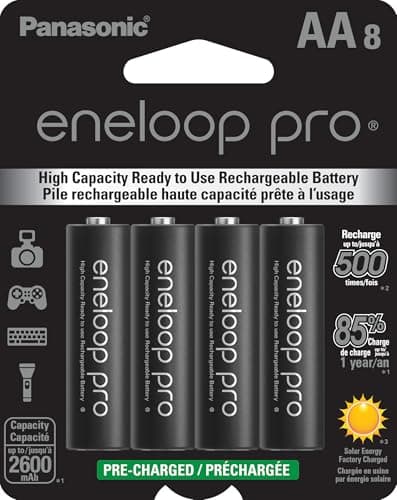
Rechargeable NiMH. A sensible middle route if you are checking cameras often anyway: low-self-discharge cells like the eneloop pro hold charge on the shelf and pay for themselves over a few cycles. The catch is nominal voltage — 1.2V per cell rather than 1.5V — so some cameras report a lower battery level and some shorten their runtime estimates accordingly. Several cameras state recharge compatibility explicitly; check before you commit to a set of twenty.
The cameras with no AA bay at all
A growing number of cameras ship with a sealed rechargeable pack and no AA tray: GardePro's E8 2.0 Pro and E9 3.0 Pro at 7,800 mAh, the A80 Pro at 8,000 mAh with a maker claim of up to a year per charge, and the cellular X66 3.0 Ultra with a 17,500 mAh pack rated for 300 charge cycles.
The trade is real in both directions. You never buy batteries again, and the camera is lighter and better sealed. But you cannot hand it a fresh set in the dark at the tree, and when the pack degrades out of warranty the camera is finished. Three hundred charge cycles is a long time for a trail camera and not forever. If your sets are hard to reach, prefer a pack plus a panel; if you check cameras often and want them to last a decade, prefer an AA bay.
What to put in them, and how to stop
Our picks for this
Two chemistries and two ways out
The first two go in the bay. The second two replace the bay entirely, which is the real answer if you are tired of counting cells.
Best AA batteries for trail cameras
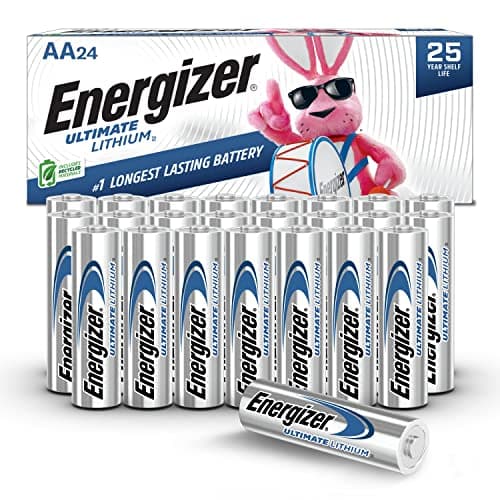
Energizer Ultimate Lithium AA
Batteries8.9/10The cell every runtime estimate on this site assumes, including the 29.8-month and 14.1-month figures measured by Trailcampro. Flat voltage curve, cold tolerant, no leaking.
$41.00Amazon#ad · Price as of October 17, 2026 · Disclosure for the link to Energizer Ultimate Lithium AA
Best rechargeable AA batteries
Panasonic eneloop pro AA
Batteries7.7/10Low-self-discharge NiMH for cameras you check often. 1.2V nominal, so confirm your camera states recharge compatibility before buying a tray's worth.
$37.73Amazon#ad · Price as of October 17, 2026 · Disclosure for the link to Panasonic eneloop pro AA
- MoultrieNo image
Best battery pack for Moultrie Edge
Moultrie POWER MAG III
Battery pack8.3/10A rechargeable pack that drops into the battery compartment, so one object replaces eight or twelve cells.
Check price · Amazon#ad · Price as of October 17, 2026 · Disclosure for the link to Moultrie POWER MAG III
Best 12V battery box
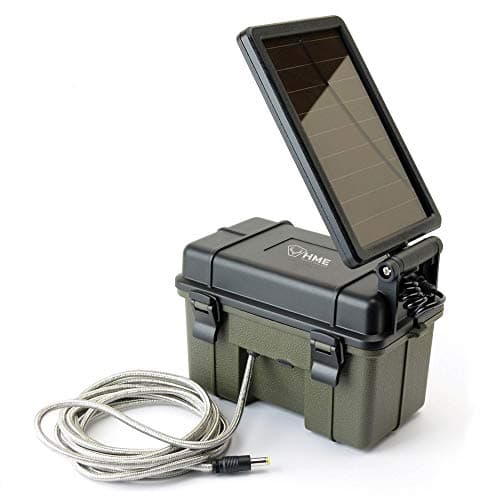
HME Trail Camera 12V/Solar Auxiliary Power Pack
Battery pack7.5/10A 12V pack with a panel that plugs into the external jack. This is the setup that turns a camera you visit monthly into one you visit twice a year.
$61.99Amazon#ad · Price as of October 17, 2026 · Disclosure for the link to HME Trail Camera 12V/Solar Auxiliary Power Pack
Two ways to stop buying batteries
The 12V jack. If your camera has one — and most Browning, Bushnell and GardePro bodies do, along with the Tactacam 4.0 line — it will take a 12V battery box or a panel with no adapter. That is the cheapest permanent fix, because a sealed lead-acid or lithium box holds many multiples of an AA tray's energy. See 12V battery boxes for trail cameras and best external battery packs.
A panel. A solar panel on a set that gets real sun ends the problem entirely, and most brands sell one that matches their own jack. The caveat is sunlight: a panel bolted to a camera pointed at a shaded trail collects very little, which is why an aimable panel on a cable usually beats an integrated one. Start with best trail camera solar panels and the honest case in are solar trail cameras worth it.
One last setting-level tip: the cheapest battery saving is free. Shoot the middle resolution rather than the largest, keep video off unless you want video, and do not run a cellular camera in a mode that uploads full-resolution originals of every frame. Several brands send a reduced-size image by default for exactly this reason. See trail camera settings and megapixels explained.
How we scored this
The research behind these picks
Every pick here is built from documented evidence: the maker's published trigger speed, flash type, battery configuration and detection range; each brand's plan tiers verified on its own plan page and turned into the real monthly cost at one and four cameras; the independent shootouts (Trailcampro, Outdoor Life, Field & Stream, TechGearLab) cited by name for the measurements they published; and a public rubric applied the same way to every model. Every figure links to where it came from, so you can check our work in one click.
Scores are editorial judgments from that documented research. Commissions never set a score or decide a pick. The rubric and its weights are published.
Questions
Frequently asked
How many batteries does a trail camera take?
Most take 8 AA. Across the cameras we rank the range is 6 AA (Browning Strike Force Pro X, Bushnell CORE bodies), 8 AA (most GardePro and the Browning Defender), 12 AA (Tactacam Reveal 4.0, Bushnell CelluCORE 20, Stealth Cam Fusion Max 3.0) and 16 AA (Stealth Cam Deceptor Max 3.0).
How many batteries does a Moultrie trail camera take?
Moultrie's Edge bodies are designed around Moultrie's own rechargeable packs as well as AA cells, and the brand sells the POWER MAG III pack that drops into the compartment in place of loose batteries. Check the specific Edge model's page, and see best Moultrie trail cameras.
How many batteries does a Tactacam Reveal take?
The Reveal X 4.0 and Pro 4.0 both take 12 AA, not included, and both accept a DC 12V-2A input or a FlexPack R5 (5,000 mAh) or R10 (10,000 mAh). Trailcampro measured 14.1 and 12.4 months of photo-mode runtime respectively on lithium AAs.
Can I use rechargeable batteries in a trail camera?
Usually yes, and several cameras state recharge compatibility explicitly. The caveat is that NiMH cells are 1.2V nominal rather than 1.5V, so some cameras report a lower battery level and shorten their runtime. Use low-self-discharge cells, and do not mix them with primaries.
Do more batteries mean longer battery life?
No. A 16-AA bay usually signals a camera that needs more current — a cellular radio, a big flash array, live view. An 8-AA card camera routinely outlasts a 12-AA cell cam by a factor of two. Compare measured runtime, not cell count.
Keep reading
Related on Cam & Canopy
- Best batteries for trail camerasThe cells to put in the bay, ranked.
- Battery life explainedWhy an 8-cell camera can outlast a 16-cell one.
- Batteries in cold weatherWhat happens to the bay in November.
- 12V battery boxesThe cheapest way out of buying AAs.
- Best trail cameras for battery lifeThe cameras that need the fewest refills.
Receipts
Sources
- Energizer — Ultimate Lithium AA product page (checked 2026-09-21)
- MicroBattery — Panasonic eneloop pro AA BK-3HCCA spec listing (checked 2026-09-21)
- Moultrie — POWER MAG III product page (checked 2026-09-21)
- HME Products — Trail Camera 12V/Solar Auxiliary Power Pack product page (checked 2026-09-21)
- Trailcampro — GardePro T5NG Pro review, measured figures, score and stock (checked 2026-09-28)
- Trailcampro — Tactacam Reveal X 4.0 product page, measured figures and stock (checked 2026-09-24)
- Trailcampro — Tactacam Reveal Pro 4.0 review, measured figures (checked 2026-09-24)
- Trailcampro — Bushnell CelluCORE 20 review, measured trigger, recovery and detection figures (checked 2026-10-09)
- Stealth Cam — Deceptor Max 3.0 product page (checked 2026-09-21)
- Stealth Cam — Fusion Max 3.0 product page (checked 2026-09-26)
- Browning Trail Cameras — Strike Force Pro X 1080 product page (checked 2026-09-21)
- Bushnell — CORE DS-4K No Glow product page (checked 2026-09-21)
- GardePro — E8 2.0 Pro Wi-Fi Trail Camera product page (checked 2026-09-26)
- GardePro — A80 Pro Wi-Fi Trail Camera product page (checked 2026-09-28)
- GardePro — X66 3.0 Ultra product page (checked 2026-09-21)
Every number above is traceable: specs come from the maker's own product pages (linked on every product), plan prices from the maker's plan page with an “as of” date, and independent measurements are attributed to whoever made them. Amazon prices change often, so every buy button takes you to Amazon's current price for that listing. Read the full method.