Scouting · Guide
When to put out trail cameras: the honest answer is now, and leave them there
The question usually means 'when should I start scouting for this season', and the answer is earlier than most people do it. A camera that has been hanging since February costs you nothing in disturbance by October. A camera hung in October costs you the ground you walked across to hang it.
By Mike M.Updated Spec-checked · every figure sourced
#adReader-supported: we may earn a commission if you buy through our links, at no extra cost to you. It never decides a ranking. How we rank · Disclosure
The short answer
There is no closed season on a trail camera. The reason to hang it early is not that February deer tell you about November deer — they often do not — but that every camera site needs a visit to establish, and the cheapest visit is the one you make eight months before you care about the spot.
That is also why battery chemistry and power are part of the answer rather than a separate topic. A set you intend to leave for a season needs lithium cells or a 12V source, because a camera that dies in September was not really out all year.
The calendar, month by month
| Period | Where the camera goes | What you are learning | What to set |
|---|---|---|---|
| February to April | Travel corridors, south slopes, shed ground | Who survived, where they winter, how they move | Photo mode, high sensitivity, check freely |
| May to August | Mineral, water, field edges, bachelor-group bedding edges | Inventory: what bucks are on the ground | Photo burst or time lapse, long intervals |
| September to October | Entry trails to food, staging areas, plot corners | Daylight movement and timing | Fast trigger, short delay, minimal visits |
| November | Scrapes, pinch points, doe bedding edges | Who is cruising and when | Fast trigger, video if the set allows |
| December to January | Remaining food: standing crops, plots, feeders where legal | Survivors, and next year's inventory | Photo mode, battery conservation, cold-rated cells |
February to April: sheds and travel
The most underrated window. Deer are concentrated on whatever food is left, they are in their most predictable movement of the year, and nothing you do matters to next autumn's hunting. Hang cameras on the trails between bedding and food and leave them.
Two practical jobs here. The first is finding shed antlers, which tells you which bucks made it through — a camera on a travel corridor in March narrows the search enormously. The second is learning the ground: this is the time to discover that the tree you liked gives you a frame full of brush, or that the trail splits twenty yards further on. Fix the angle and the height now, not in October. See trail camera height and trail camera placement.
May to August: inventory
Bucks are in bachelor groups, they are highly visible, and they hit mineral and water on something close to a schedule. This is the best inventory period of the year, and it rewards leaving cameras alone for long stretches.
Two settings matter. First, a photo burst of three frames captures antler detail from more than one angle, which is how you tell two similar bucks apart. Second, this is the one time of year where time-lapse genuinely earns its place: pointed at a field or a plot it records what is using the area at a fixed interval regardless of whether anything trips the sensor, which is exactly the pattern data you want from an open area. See trail camera time lapse mode.
September and October: pattern work
Velvet comes off, bachelor groups break up and the inventory you built over summer becomes much less reliable — bucks shift ranges. What you are after now is timing: which trail into the food, at what time, on what wind.
This is also the point at which your visits start costing you. If you hung cameras in spring, the sets you care about are already established and you can leave them completely alone, pulling images over the air or waiting until after the season. If you are only starting now, hang on field edges and trails you can reach from a road or a plot edge without walking through the bedding you intend to hunt. Camera count discipline matters here too — see how many trail cameras do I need and how often to check trail cameras.
November: the rut
Movement becomes unpredictable and long-range, which cuts both ways. Your presence matters less, because deer are not holding tight patterns. But the information is less actionable for the same reason: a buck photographed at a scrape at 2 p.m. may be three miles away tomorrow.
Put cameras where cruising bucks have to pass: pinch points, saddles, the downwind edges of doe bedding, active scrapes. This is the one period where trigger and recovery speed genuinely decide what you get, because deer are moving and not stopping. A camera with an eleven-second recovery will photograph one deer out of a chase; a camera with a sub-second recovery will photograph all of them. See trigger speed explained and fastest trigger speed trail cameras.
December to January: food
Everything concentrates on what is left to eat, which makes late season the second-best inventory window of the year — you find out who survived, and you start next year's list.
The constraint is cold. Alkaline cells sag badly in freezing temperatures, and because the infrared flash is the most current-hungry thing the camera does, the first symptom is black night photos from a camera that still reports charge. Lithium primaries hold voltage nearly flat and keep working in the cold, which is why every long-runtime estimate on this site assumes them. If you are leaving cameras through a northern winter, read trail camera batteries in cold weather and best trail cameras for cold weather first.
The gear a year-round set needs
Our picks for this
A card camera for the long soak, two cellular cameras for the sets you cannot disturb, and the cells that make it possible
A camera you intend to leave for a year is a different purchase from one you check monthly. These are chosen for runtime and for not needing you.
- GardeProNo image
Best measured value
GardePro T5NG Pro
SD / Wi-Fi8.8/10The long-soak card camera: an independent lab estimated 29.8 months of photo-mode runtime on 8 AA lithiums, with 0.51 s and 120 ft measured and a screen for setting the angle in spring.
Check price · Amazon#ad · Price as of October 17, 2026 · Disclosure for the link to GardePro T5NG Pro
Best detection cellular camera
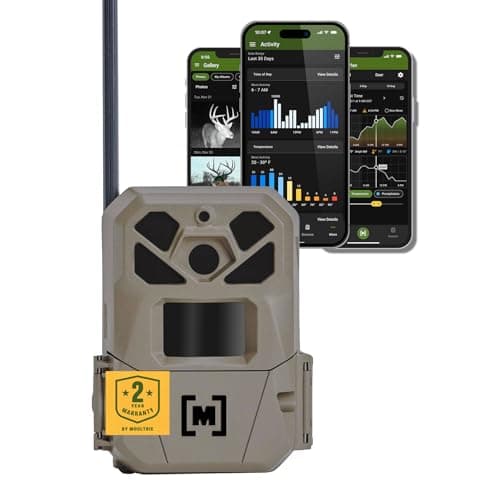
Moultrie Edge 3 Pro
Moultrie Mobile8.0/10For the set you must not walk into during the season: a roaming SIM, 1440p video and published tiers at $8.99 and $12.99 per camera.
$98.99Amazon#ad · Price as of October 17, 2026 · Disclosure for the link to Moultrie Edge 3 Pro
Best no-glow cellular camera
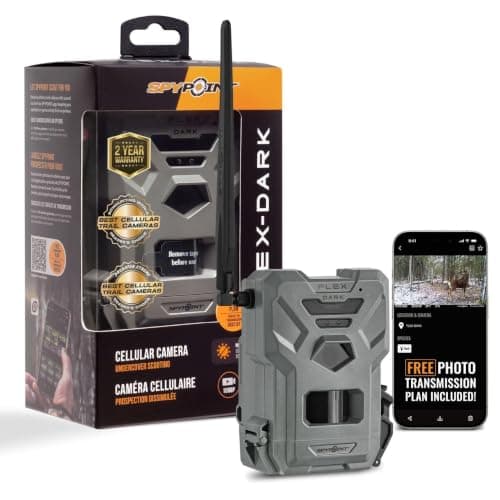
Spypoint Flex-Dark
Spypoint8.4/10The cheapest way to leave several cameras connected all year: 100 photos per camera per month at $0, no-glow, $10/mo unlimited on annual billing.
$97.59Amazon#ad · Price as of October 17, 2026 · Disclosure for the link to Spypoint Flex-Dark

Best AA batteries for trail cameras
Energizer Ultimate Lithium AA
Batteries8.9/10The cell every runtime figure on this site assumes. Flat voltage curve, cold tolerant, no leaking - which is what a camera left out through January needs.
$41.00Amazon#ad · Price as of October 17, 2026 · Disclosure for the link to Energizer Ultimate Lithium AA
One more thing worth doing in the same visit: secure it. A camera you intend to leave for a year is a camera somebody else has a year to find. Steel boxes and cables are in best trail camera security boxes, and the hiding techniques in how to hide a trail camera.
How we scored this
The research behind these picks
Every pick here is built from documented evidence: the maker's published trigger speed, flash type, battery configuration and detection range; each brand's plan tiers verified on its own plan page and turned into the real monthly cost at one and four cameras; the independent shootouts (Trailcampro, Outdoor Life, Field & Stream, TechGearLab) cited by name for the measurements they published; and a public rubric applied the same way to every model. Every figure links to where it came from, so you can check our work in one click.
Scores are editorial judgments from that documented research. Commissions never set a score or decide a pick. The rubric and its weights are published.
Questions
Frequently asked
When should I put out trail cameras for deer?
As early as you can, and ideally in late winter or spring — four to eight months before you intend to hunt the spot. Establishing a camera takes a visit, and a visit in March costs you nothing while a visit in October costs you the ground you walked across.
Is it too late to put out a trail camera in October?
No, but change where you hang it. Use field edges, plot corners and trails you can reach from a road without crossing the bedding you plan to hunt, go in at midday, and leave the camera alone afterwards.
Can you leave trail cameras out all year?
Yes, and it is the better approach. On lithium AAs the measured photo-mode estimates on this site run from 11 months to nearly 30 depending on the camera, and a 12V box or solar panel extends that further. The practical limits are card capacity on an SD camera and plan allowance on a metered cellular tier.
What is the best time of year for trail camera inventory?
Summer, from May to August: bucks are in bachelor groups, highly visible and hitting mineral and water on something close to a schedule. Late season is the second-best window, because everything concentrates on the remaining food.
Should I move my trail cameras during the season?
On sets you intend to hunt, no — every move is a visit at the worst time of year. Move cameras in late winter and spring when it costs nothing, and use the rut as the one in-season window where disturbance matters least.
Keep reading
Related on Cam & Canopy
- Trail camera placementWhere the camera goes once you have decided when.
- Trail camera settingsWhat to change between summer and November.
- How often to check trail camerasThe visit discipline that makes an early hang worth it.
- Batteries in cold weatherWhat a December set needs.
- Trail camera time lapse modeThe summer field-edge setting.
Receipts
Sources
- Trailcampro — GardePro T5NG Pro review, measured figures, score and stock (checked 2026-09-28)
- Moultrie — EDGE 3 PRO product page (checked 2026-09-21)
- Moultrie Mobile — plans page (checked 2026-09-21)
- Spypoint — FLEX-DARK product page (checked 2026-09-21)
- Spypoint — photo transmission plans (checked 2026-09-21)
- Energizer — Ultimate Lithium AA product page (checked 2026-09-21)
- Trailcampro — Tactacam Reveal Pro 4.0 review, measured figures (checked 2026-09-24)
- Tactacam — REVEAL app plans page (checked 2026-09-21)
Every number above is traceable: specs come from the maker's own product pages (linked on every product), plan prices from the maker's plan page with an “as of” date, and independent measurements are attributed to whoever made them. Amazon prices change often, so every buy button takes you to Amazon's current price for that listing. Read the full method.